Polkadot dotUSD Stablecoin Wins 97% Backing: What Just Changed?
The Polkadot dotUSD stablecoin plan has cleared a major governance vote. On 11 November, $DOT holders approved a new strategy from the Polkadot Community Foundation (PCF) with about 97% support.
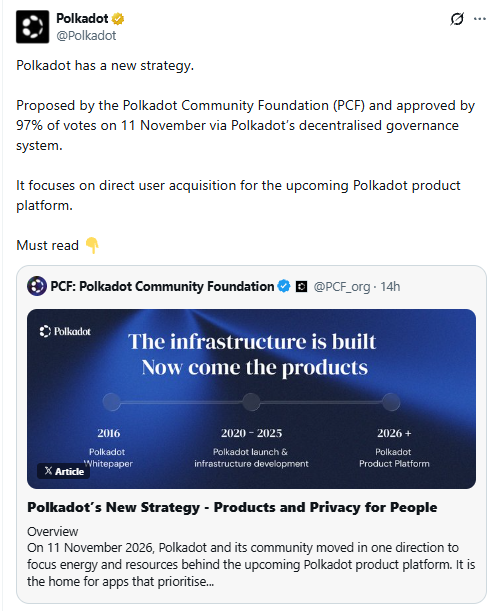
Source: Polkadot Post on X
The strategy shifts Polkadot from building infrastructure to building products for everyday users. Its first financial tool is dotUSD, a dollar-pegged asset meant to be backed by DOT.
The logic is simple. If people use dotUSD inside apps, the system may need more DOT behind it. That is the bet, and delivery is still the open question. For wider market context, see our crypto news today roundup.
What Did the Polkadot Governance Referendum Approve?
The vote was Referendum 1954, titled $DOT DAO Strategy Mandate. It ran on the Wish For Change track and now shows an executed status. The Polkadot governance referendum page lists 97.3% aye, with about 9.65 million $DOT voting yes and about 269,000 DOT voting no.
The mandate ranks user growth above ecosystem size and locked value. In plain terms, Polkadot wants to compete with mobile apps, not only other blockchains. PCF filed the proposal on 12 October.
Marketing money is also changing. Incentives will flow through on-chain rules and reach individual users under per-person limits, instead of going to outside agencies.
How Does the DOT-Backed Stablecoin Work, and Is dotUSD Live?
dotUSD is not brand new. The earlier dotUSD vote, Referendum 1944, passed with about 98.4% support. The token went live on Polkadot mainnet on 8 October.
That first version works through USDT. Users mint and redeem dotUSD against the dollar-pegged token. The DOT-backed design arrives in a two-phase rollout, with $DOT vaults, an oracle, a stability pool and liquidations planned for phase two. The Polkadot dotUSD stablecoin is therefore only partly live.
The mandate points to a Liquity-style model, collateralised by $DOT and professionally audited. The Polkadot Technical Fellowship is set to oversee dotStables. As far as the sources show, the DOT-collateral phase has no confirmed launch date.
The 1944 proposal sought $5 million in seed liquidity, split between USDT and DOT. Some reports mention a trimmed $3 million version, so the final figure needs on-chain checking.
What Will the Polkadot Mobile App Do for dotUSD?
The first consumer product is the Polkadot App. PCF describes it as a mobile app for private messaging and digital cash payments. The mandate asks for free tiers, readable names instead of long addresses, and privacy controls that users set themselves.
dotUSD is meant to be the money inside that app. That makes Polkadot digital payments the real test. A stablecoin only adds DOT adoption if people actually spend it.
Could DOT Token Demand Rise, and What Is the Price Saying?
The link runs through collateral. Once the DOT-backed phase goes live, minting dotUSD would require locking $DOT. More dotUSD use could raise $DOT token demand and reduce circulating supply. That is a design goal, not a result.
DOT traded near $0.80 on 14 November, based on KuCoin market data. During September's dotUSD vote coverage, it traded near $1.13. The two numbers show how little a single governance headline can lock in.
Expert Take: What Should Readers Watch Next?
The data suggests the Polkadot dotUSD stablecoin plan is a mandate, not a finished launch. Four signals matter most:
Launch timing of the DOT-collateral phase
dotUSD supply and pool depth on Asset Hub
A public release date for the Polkadot App
Real usage, such as active users and payment volume
Launch timing of the DOT-collateral phase
dotUSD supply and pool depth on Asset Hub
A public release date for the Polkadot App
Real usage, such as active users and payment volume
The main risk is a peg break. Any asset backed by a volatile token needs strong liquidation rules when prices fall. Execution is a second risk.
Participation is another uncertainty. The referendum page shows support of just 0.13% of DOT issuance. A lopsided vote does not always mean broad turnout.
Conclusion
The Polkadot dotUSD stablecoin plan now has formal backing from $DOT holders. Users come first, dotStables link that usage to DOT, and a mobile app is the front door.
What remains unproven is delivery. The DOT-backed phase, the app launch and real usage will decide whether this Polkadot stablecoin plan matters beyond a headline.
Disclaimer: This article is for information only and is not financial advice. Stablecoins can lose their peg, and DOT prices are volatile. Do your own research before making any decision.
About the Author Madhav Patel
English Blog Writer at coingabbar.com
Madhav is a Crypto and Web3 Content Writer with 6 months of professional experience in creating research-driven content across the blockchain and digital asset industry. He specializes in cryptocurrency, decentralized finance (DeFi), tokenomics, blockchain technology, and emerging Web3 projects.
With a strong focus on in-depth research, SEO content writing, and content optimization, Madhav transforms complex technical and financial concepts into clear, accurate, and engaging articles. His work focuses on simplifying industry developments, explaining project fundamentals, and delivering informative content that helps readers better understand the evolving crypto ecosystem.
Frequently Asked Questions (FAQ)