Executive Summary
Polygon settled $212.2 billion in stablecoin transfers in Q3 2026, about 10% more than a year earlier and level with Q2's $213.6 billion. Native USDC volume rose 25% over the quarter to $71.4 billion, non-USD stablecoin supply grew 60% to $96.4 million (2.3 times its level a year earlier), and onchain FX swaps rose 28% to $102.2 million. Two major issuers also chose the chain for native stablecoins: PayPal USD (PYUSD) began issuing natively on Polygon on July 9, and Revolut launched EURR, its euro stablecoin, on Polygon on August 26. Polygon Labs was also selected for Phase 2 of the Bank of England's Digital Pound Lab and completed a SOC 2 Type I examination of the Open Money Stack. Polygon is built for payments, and the Open Money Stack puts wallets, ramps, compliance, and settlement behind one integration.
Compared with Q3 2025, chain activity and fees grew strongly. Transactions rose 56% to 537.2 million, network fees grew roughly sevenfold to $7.16 million, and tokenholder net income reached $3.72 million, up 6% from Q2 and up from a loss a year earlier. Against Q2, the highest of the last five quarters for transactions, activity eased: transactions declined 28% and network fees 13%, as Polymarket volume cooled after the World Cup and activity across the rest of the chain softened through the quarter. Stablecoin supply on Polygon ended September at $2.98 billion (excluding legacy and looping tokens), about 2% above a year earlier and down 12% over the quarter, with most of the quarterly decline in balances held on centralized exchanges.
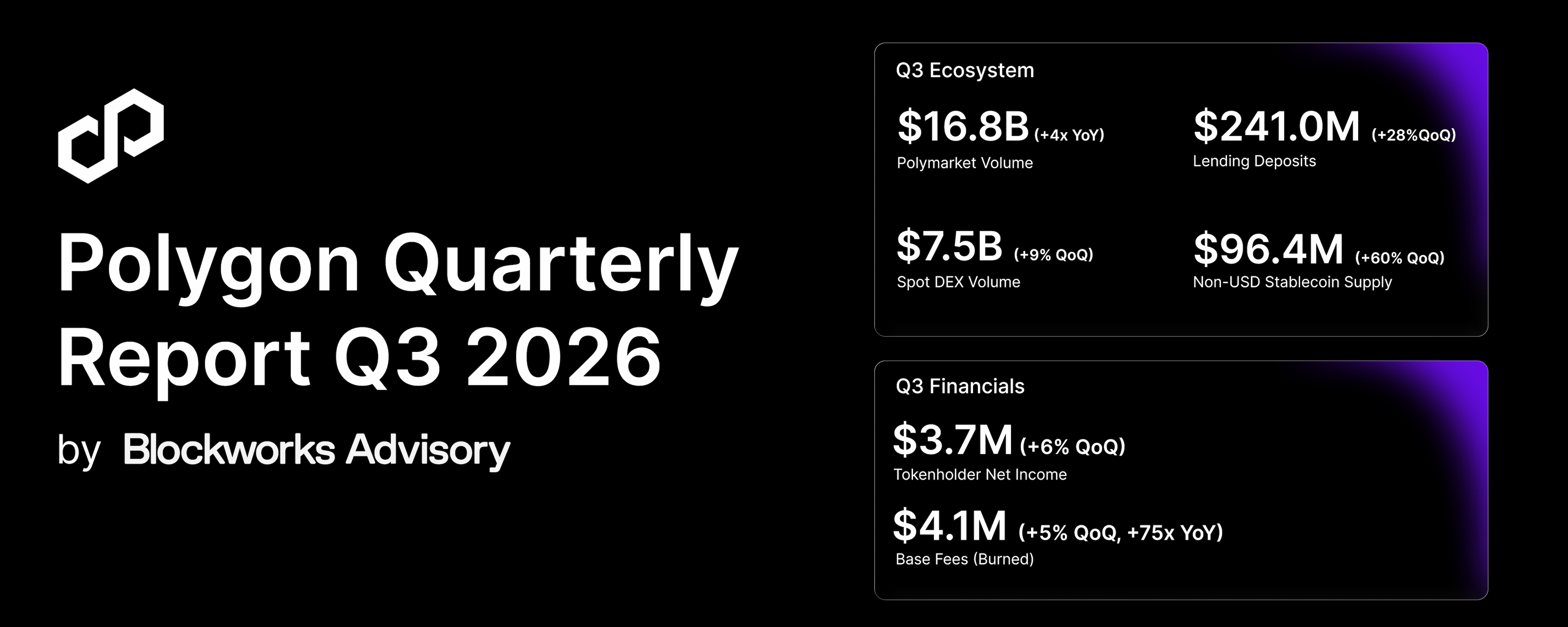
Base fees, which are burned, rose 5% to $4.11 million (46.6 million POL) and made up 57% of fees, up from 47% in Q2. On September 23, the community triggered the first permissionless burn, destroying 100 million POL of previously collected base fees, and further burns can now be triggered each quarter. PIP-92, confirmed on September 28, routes 27.33 million POL of accumulated priority fees to stakers from October 1 to December 1.
Issuance still exceeded the burn in Q3, but the gap has narrowed sharply: 53.4 million POL were issued against 46.6 million POL of base fees, a gap of 6.8 million POL, compared with 53.3 million POL in Q3 2025. Staked POL ended the quarter at 3.44 billion, or 32.1% of total supply, broadly flat from a year earlier.
The Open Money Stack added free embedded wallets, fiat balances, a private mempool, stablecoin subscriptions, and crypto checkout during the quarter, and the Ithaca upgrade went live on mainnet at the end of July to keep payments moving if a block producer stalls. In October, after quarter end, TRON went live on the Open Money Stack and Polygon Labs completed its acquisition of Coinme.
Financials
Network Fees
Polygon generated $7.16 million in network fees in Q3, roughly seven times the $1.07 million of Q3 2025, though down 13% from $8.22 million in Q2 and below the Q1 peak of $11.69 million. Base fees, the portion of each transaction fee that is burned, rose 5% to $4.11 million, while priority fees, the tips paid to validators for inclusion, fell 29% to $3.05 million. Base fees therefore grew from 47% of total fees in Q2 to 57% in Q3. A year earlier, the split was very different: in Q3 2025 base fees were $54,555, and the burn only became material from Q4 2025.
Token holder net income rose 6% to $3.72 million, up from a loss of $0.83 million in Q3 2025, when validator commission on issuance exceeded base fees. Token holder net income is base fees less the commission validators earn on issuance, and it captured 52% of network fees in Q3. Validator payments, which combine priority fees with that commission, fell 27% to $3.44 million. Average fees per transaction stayed in the range of one cent, at $0.0134 on average in Q3 against $0.0114 in Q2 and about $0.003 a year earlier..
POL Supply and Burn
POL issuance runs at roughly 2% a year, split between validator rewards and the community treasury. In Q3, 53.4 million POL were issued and 46.6 million POL of base fees were collected for burning, so issuance exceeded the burn by 6.8 million POL, down from 53.3 million POL in Q3 2025, when only 0.2 million POL of base fees were burned. Q1 was the only quarter in the last five in which the burn outpaced issuance, with 64.0 million POL of base fees against 53.3 million POL issued. The validator share of issuance was 26.2 million POL in Q3, worth $2.34 million at the time it was issued.
Base fees accumulate in a collector contract and are destroyed in periodic burns that anyone can trigger. The quarterly burn figures count base fees as burned when they are paid. The 100 million POL burn on September 23 destroyed fees collected under that accounting, so it is already reflected in the quarterly burn totals and is not added to them a second time.
Staking
Staked POL ended Q3 at 3.44 billion, broadly flat from 3.47 billion a year earlier and down from 3.61 billion at the end of June after net withdrawals of 163 million POL. The stake rate fell from 33.8% to 32.1% of total supply over the quarter. The validator set held at 104 validators run by 99 entities.
Staking yield declined with priority fees. The fee-funded portion of the yield fell from 5.2% at the end of June to 2.7% at the end of September, while the issuance-funded portion held near 3.0%, taking total yield from 8.1% to 5.7%. That remains well above the 3.6% of a year earlier, when fees contributed only 0.5%. Under PIP-85, a share of priority fees accrues to stakers. PIP-92 distributes the first 27.33 million POL of that share by temporarily raising checkpoint rewards, the POL paid to validators and their stakers each time a snapshot of Polygon's state is submitted to Ethereum, from October 1 to December 1, an estimated 7.7% annualized rate on the current stake. PIP-93, a proposal to automate fee distribution to stakers, is in development.
Network Analysis
Network Activity
Polygon processed 537.2 million transactions in Q3, 56% more than the 345.3 million of Q3 2025, though down 28% from 743.5 million in Q2, and daily active addresses averaged 438,000 against 623,000. New addresses fell 37% to 5.8 million for the quarter, while contracts deployed declined 12% to 4.3 million.
Monthly transactions slipped from 197.8 million in July to 163.6 million in September. The chain passed 8 billion cumulative transactions on September 2 and reached 8.16 billion by quarter end.
By transaction count, Polymarket is the largest single source of activity on the chain. Its exchange contract carried 155.3 million transactions, 29% of the quarter's total, and generated $2.96 million in fees, 41% of network fees. Its monthly transactions fell from 62.1 million in July to 41.7 million in September as trading eased after the World Cup. Activity outside prediction markets also slowed, with transactions across the rest of the chain down 10% from July to September.
Stablecoins and Payments
Stablecoin transfer volume reached $212.2 billion in Q3, an average of $2.31 billion a day, about 10% above Q3 2025 and essentially unchanged from Q2. The number of transfers fell 41% to 739 million. The same value moved in fewer, larger payments. USDC.e carried $107.8 billion of the volume, native USDC $71.4 billion (up 25% from $57.3 billion in Q2 and more than double the $33.7 billion of a year earlier) and USDT0 $23.7 billion. Polygon's lifetime USDC and USDT transfer volume reached $2.80 trillion by September 30. Across all stablecoins, Polygon has surpassed $3 trillion in transfer volume, a milestone that was reached in late September.
Stablecoin supply ended Q3 at $2.98 billion, about 2% above a year earlier and down 12% from Q2, excluding legacy tokens and one Australian dollar token whose transfers are dominated by looping. The decline was concentrated in exchange custody: stablecoin balances held on centralized exchanges fell from $565 million to $290 million over the quarter. Each of the four largest tokens shrank: USDC.e ended at $992 million, USDT0 at $792 million, USDC at $617 million, and DAI at $470 million.
Holders rose to 20.8 million from 20.0 million. Polygon has the largest USDT0 holder base of any deployment, with 8.09 million holders (up 24% from 6.51 million a year earlier) against 4.30 million on Arbitrum, and native USDC holders grew from 4.34 million to 4.92 million. PYUSD is issued natively on Polygon and is not yet included in these supply figures.
Local Currencies Onchain
Non-USD stablecoins grew faster than any other part of the stablecoin base. Their supply rose 60% over the quarter to $96.4 million, 2.3 times its level a year earlier, led by the yen, which nearly doubled to $62.1 million, about 3.5 times its Q3 2025 level. JPYC supply on Polygon grew from $18.9 million to $47.8 million, more than its deployments on Avalanche ($20.2 million) and Ethereum ($6.3 million) combined. Non-USD transfer volume rose 46% to $1.22 billion, led by Brazilian real stablecoins, with BRLA, BRL1 and BRZ together moving $832 million in transfers, and JPYC ($246 million).
Onchain FX swaps between stablecoins of different currencies reached $102.2 million in Q3, up 28% from Q2 and 7% from Q3 2025, excluding the looping Australian dollar pair. JPY/USD led at $54.8 million, up from $0.1 million a year earlier, followed by BRL/USD at $24.3 million and SGD/USD at $15.7 million. Mento launched its FX protocol on Polygon on July 27 with a USDm/EURm pool.
Prediction Markets
Polymarket recorded $16.8 billion in notional volume in Q3, more than four times the $4.0 billion of Q3 2025, though down 37% from $26.8 billion in Q2. July accounted for $7.9 billion as the World Cup concluded, and monthly volume settled between $4.3 billion and $4.6 billion in August and September.
Sports remained Polymarket's largest category at $11.6 billion, followed by crypto markets at $2.8 billion. Polymarket's fees rose 48% to $112.0 million.
New wallets halved to 226,000, and stablecoins held in Polymarket on Polygon fell from $958 million to $832 million, still nearly five times the $173 million held a year earlier.
DEX and Lending
DEX volume on Polygon rose 9% to $7.45 billion, 3% above Q3 2025, of which stablecoin swaps accounted for $6.14 billion, up 81% from $3.39 billion a year earlier. Uniswap led with $5.36 billion, and Metric grew from $0.20 billion in Q2 to $1.30 billion.
Lending deposits rose 28% to $241 million and borrows to $64.3 million, with Aave holding $225 million of deposits. Net interest income across lending protocols was $369,000.
Product & Ecosystem Updates
Open Money Stack
Polygon Labs moved to operating as a blockchain-enabled payments company in July and shipped new Open Money Stack capabilities through the quarter. Approved businesses can now create unlimited embedded wallets at no cost, with crosschain routing included (August 11). Fiat balances let businesses hold dollars with licensed banking partners and convert to stablecoins when ready (August 18). Private Mempool sends transactions straight to Polygon's block producers, keeping them out of the public mempool until confirmed (August 24). Stablecoin subscriptions went live on September 23, and crypto checkout followed on September 30, letting merchants add crypto payments to an existing checkout, including Stripe setups, and receive their preferred payout currency. This push culminated on October 14, when Polygon Labs completed its acquisition of Coinme, a licensed and regulated cryptocurrency exchange and off-/onramp network, making the Open Money Stack a U.S.-regulated payments platform. The acquisition of Coinme brings a FinCEN registered Money Services Business with money transmitter licenses in multiple states under Polygon Labs’ umbrella.
The Open Money Stack is multi-chain: wallets and routing run on Polygon and other major chains, so its growth does not map directly onto Polygon Chain activity. In tests published September 24, payment hubs processed 11 million payment updates per second; Polygon Chain itself handles more than 5,000 payments per second after recent upgrades.
Institutional and Enterprise Adoption
PayPal USD began issuing natively on Polygon Chain on July 9 and is available through the Open Money Stack's existing wallets, ramps, and compliance tooling. Ramp opened Stablecoin Accounts on Polygon to more than 70,000 businesses on July 21. On August 12, Polygon Labs joined NOBO and Dun & Bradstreet in Phase 2 of the Bank of England's Digital Pound Lab. Revolut launched EURR on Polygon on August 26, and the Open Money Stack completed a SOC 2 Type I examination on September 2. Stable.com integrated the Open Money Stack for stablecoin bank transfers in more than 180 countries.
Protocol Upgrades and Governance
The Polygon Foundation delivered three hardforks in Q3. Ithaca activated on mainnet at the end of July, adding automatic recovery when a block producer stalls. The Austin and Kyoto hardforks were live by late August, bounding state-sync gas per block and closing seven issues. PIP-91 proposes an optional pass system for admitting new validators. It stays switched off unless governance turns it on, and it needs a security audit before it can be activated.
Subsequent Events
After quarter end, PIP-92's higher staking rewards took effect on October 1, the same day the Lugano hardfork activated on mainnet. TRON went live on the Open Money Stack on October 7, giving businesses access to USDT flows on TRON through the same integration.
Closing Summary
In Q3, PayPal and Revolut issued stablecoins natively on the chain, stablecoin transfer volume reached $212.2 billion (about 10% more than a year earlier), transactions were up 56% and network fees roughly sevenfold from Q3 2025. Non-USD stablecoins grew 60% and the Open Money Stack shipped new capabilities through the quarter. On the fee side, base fees rose to 57% of network fees, the first permissionless burn destroyed 100 million POL, and PIP-92 began routing accumulated priority fees to stakers in October.
Against a strong Q2, transactions fell 28% and network fees 13%, with Polymarket's post-World Cup cooling accounting for part of the drop and activity elsewhere on the chain also easing. Issuance exceeded the base-fee burn by 6.8 million POL, so net supply is still growing on a quarterly basis, though the gap has narrowed from 53.3 million POL a year earlier.
Recurring quarterly burns and PIP-93's automated fee distribution are the next tests of that balance, alongside how the Coinme acquisition and TRON integration translate into payment volume in Polygon Open Money Stack.
This report was commissioned by the Polygon Foundation. By providing this disclosure, we aim to ensure that the research reported in this document is conducted with objectivity and transparency. All content was produced independently by the author(s) and does not necessarily reflect the opinions of Blockworks. or the organization that requested the report. The commissioning organization may have input on the content of the report, but Blockworks maintains editorial control over the final report to retain data accuracy and objectivity. Author(s) submit financial conflict of interest (FCOI) disclosures on a monthly basis that are reviewed by appropriate internal parties and may hold cryptocurrencies named in this report. This report is meant for informational purposes only. It is not meant to serve as investment advice. You should conduct your own research and consult an independent financial, tax, or legal advisor before making any investment decisions. Past performance of any asset is not indicative of future results. Please see our Terms of Service for more information.