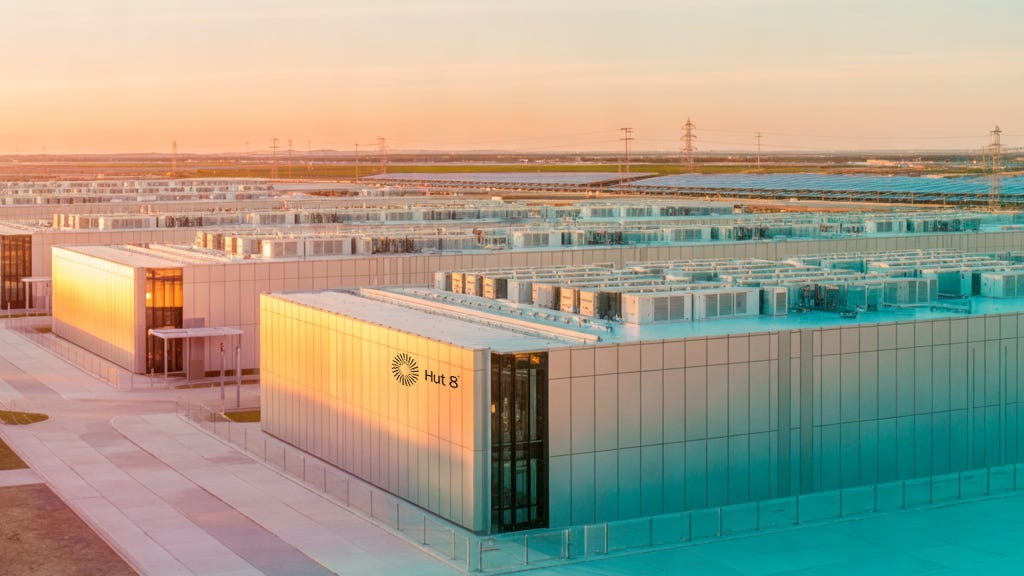
Hut 8's 949 MW of leases rest on Google-backed and investment-grade rent. Core Scientific bills 485 MW for CoreWeave but funds AMD sites at $11M to $12M per MW, with financing not yet secured.
Welcome to Global Data Center Hub. Join investors, operators, and innovators reading to stay ahead of the latest trends in the data center sector in developed and emerging markets globally.
The Converters Agree on Power. They Split on Who Pays to Build.
AI demand has pushed the data center bottleneck past chips. The hard inputs now are sites with energized grid connections and the money to build halls on them before a tenant pays full rent.
That’s why former bitcoin miners became landlords to AI clouds. They already held the power.
Hut 8 and Core Scientific both made that conversion, and both proved the hard part this year. Hut 8 signed 949 MW of IT leases to investment-grade tenants.
Core Scientific now bills 485 MW for CoreWeave. But they answer the next question in opposite ways: who pays to finish the build if it runs over or the money doesn’t close.
Hut 8 pushed that risk out to project lenders and tenant credit. Core Scientific kept it on the parent.
Neither company’s headline profit shows this. Hut 8’s net income of $189.5 million included a $413.8 million Bitcoin gain.
Core Scientific’s $1.18 billion included a $1,034.4 million gain on warrants and contingent value rights.
Both are marks. The structure underneath is what decides the equity.
Hut 8 Moved the Build Risk Onto Lenders and Tenant Credit
Hut 8 holds 949 MW of contracted IT capacity across three projects. River Bend’s 245 MW is leased to Fluidstack for 15 years with a financial backstop from Google.
Beacon Point’s two 352 MW phases go to an unnamed tenant with a high investment-grade rating, and the Phase 2 lease was extended from 15 to 17 years. Hut 8 puts a base-term value of $26.6 billion on the three leases, set before that extension.
Tenants pay for the 949 MW of IT load, not the 1,330 MW of utility power. River Bend’s Q2 2027 target is unchanged. Beacon Point Phase 1 targets Q3 2027 and Phase 2 targets Q2 2028.
The financing sets Hut 8 apart. River Bend and Beacon Point Phase 1 carry $7.5 billion of non-recourse project bonds. Lenders can claim the projects, not the parent.
About $6.4 billion sits restricted for the build, against $156.9 millions of unrestricted cash and an undrawn $1.07 billion revolver. The bonds fully amortize, so rent pays down principal from the start.
Hut 8’s illustrative models, dated and not guidance, show River Bend producing $373 million of net operating income in 2028 and $107 million after debt service.
That is the structure most converters haven’t built: investment-grade leases financed without putting the parent on the hook. What Hut 8 didn’t hand off is delivery.
Google’s backstop covers tenant default, not a late substation, and Phase 2 financing was still open at the print.
Until rent starts, the parent also carries rising overhead, with general and administrative expense excluding stock pay up 78.2% to $34.8 million, and a mining business whose compute margin before depreciation fell from 68.5% to 59.0%.
Free cash flow after property and equipment spending was -$455.7 million.
Read the full Hut 8 analysis: Hut 8 Signed 949 MW. Now It Must Deliver.
Core Scientific Proved Delivery and Kept the Funding Risk
Core Scientific has turned power into billing AI capacity. Billing capacity rose from 120 MW at the end of 2025 to 485 MW, and colocation revenue from $31.3 million to $215.4 million, now 92.5% of total revenue at a 59.6% gross margin.
Operating income swung to $72.4 million and adjusted EBITDA reached $133.6 million. About 82% of CoreWeave’s 590 MW commitment is billing, with Dalton Phase 2 expected by early 2027.
The AMD program adds about 530 MW of signed leases across five sites, delivering from the first half of 2027 through the end of 2028. Beyond that, it has 1,925 MW of non-binding reservations.
Only about 385 MW has secured grid power. Another 600 MW is in utility load studies, and 940 MW depends on on-site generation for which management said it has not filed air permits.
On its CoreWeave sites, the tenant funded up to about $750 million of buildout costs, repaid through rent credits. The AMD sites ask Core Scientific to fund the build itself, at a stated $11 million to $12 million per megawatt.
Third-quarter operating cash flow was $65.3 million against $985.1 millions of capex and land spending. Purchase and construction commitments total about $4.4 billion, mostly due within 24 months.
The $3.3 billion of senior secured notes sit in ring-fenced subsidiaries, but the parent gives an uncapped completion guarantee on specified projects. The 10-Q says additional external financing is required and is not assured.
Core Scientific’s edge is proven delivery: 365 MW of billing capacity added in nine months. Its exposure is that overruns flow back to a parent with a $1,092.1 million stockholders’ deficit, and all reported colocation revenue still came from CoreWeave.
AMD diversifies the contract book. It doesn’t yet diversify the cash.
Read the full Core Scientific analysis: Core Scientific's $1.2B Profit Came With $65M of Operating Cash
Below: where cost overruns land at each company, the three signals that will show which structure holds, and what it means for investors, operators and policymakers.