During the process of institutionalising KRW stablecoins, there were calls for a focus not only on the issuer but also on safe management of reserve assets and the creation of an independent verification system. Some also said that, for use in actual payments and remittances, authorities should also establish a basis for handling by banks, card companies and payment providers, as well as rules for transactions and settlement.
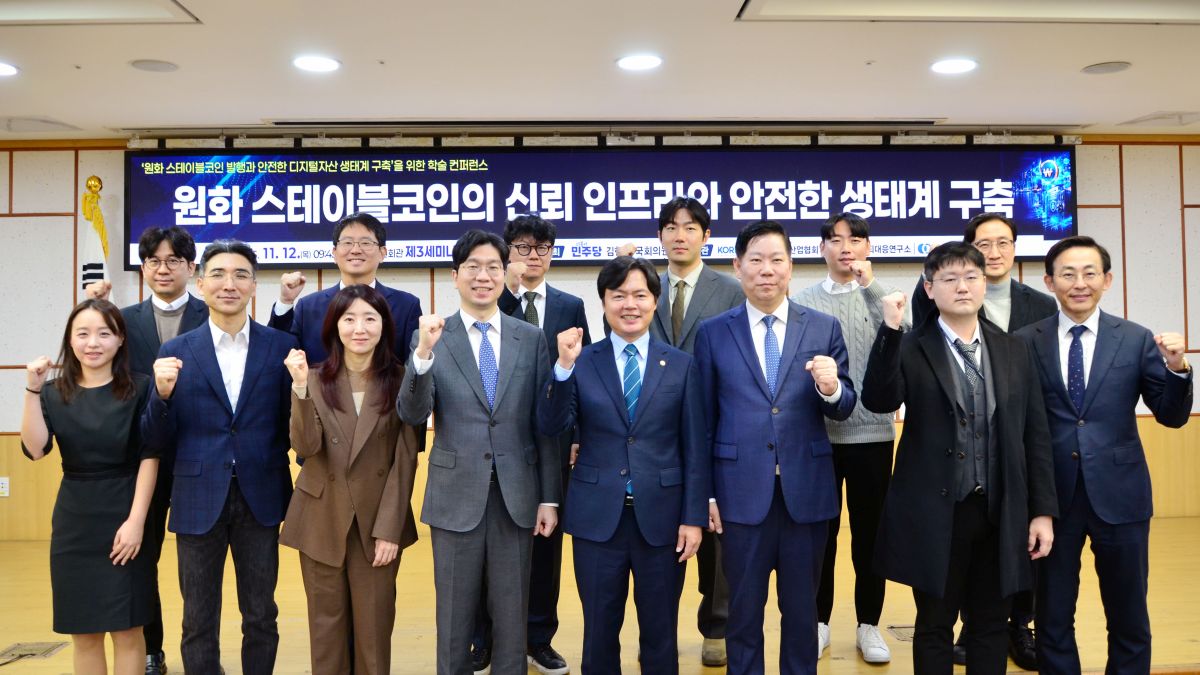
The Korea Fintech Industry Association said it held an academic conference on "KRW stablecoin issuance and building a safe digital asset ecosystem" on Nov. 12 at the National Assembly Members' Office Building, hosted by Democratic Party lawmaker Kim Hyun-jung (김현정). The event was co-organised by the association, the Digital Financial Crime Response Research Institute and BDX.
Ryu Hong-yeol (류홍열), CEO of BDX, introduced overseas regulatory cases such as the U.S. Genius Act and Europe’s MiCA and stressed the importance of managing reserve assets. Ryu said, "The core of institutionalising KRW stablecoins lies not in the issuer but in how safely and transparently reserve assets can be managed and verified." He said this would require segregated custody of reserve assets, use of regulated custodians and establishment of an external verification system.
Han Seo-hee (한서희), a lawyer at law firm Lee & Ko, suggested building a distribution system that enables actual payments and remittances alongside issuance authorisation. Han said, "Legal grounds and transaction and settlement rules should be 마련ed together so that banks, card companies and payment operators can handle stablecoins." Han also cited tasks including wallet and private key management, security standards and improving network separation regulations.
Kim Hyun-jung said, "The core of institutionalising KRW stablecoins is trust, and safe custody of reserve assets and an independent external verification system are needed." She said she would strengthen issuance and distribution requirements and user protection through the second stage of legislation for the Framework Act on Digital Assets.
In the panel discussion, Hwang Seok-jin (황석진), a professor at Dongguk University, and Kang Hyeong-gu (강형구), a professor at Hanyang University, each served as moderators. Panelists included Seo Na-yoon (서나윤), a director at the Financial Services Commission, Ahn Byeong-nam (안병남), a senior specialist (former Financial Supervisory Service team leader), Cho Jae-bin (조재빈), a lawyer at law firm Barun, Ryu Chun (류춘), vice president at Hecto Wallet One, Eom Su-hyeon (엄수현), a director at NHN KCP, Choi Woo-young (최우영), a lawyer at Lee & Ko, Hwang Se-woon (황세운), a researcher at the Korea Capital Market Institute, Kim Dan (김단), a lawyer at law firm Robex, Kim Seong-hyeon (김성현), a team leader at KSNET, and Lee Ji-hoon (이지훈), vice president at WavBridge. They discussed ways to institutionalise KRW stablecoins and build a safe ecosystem.
Participants agreed that, for a stable rollout of KRW stablecoins, practical operating systems should be established together, including reserve asset management, user protection and payments and distribution infrastructure.