RLUSD Overtakes PYUSD: What Ripple’s $37M Lead Means for Stablecoins
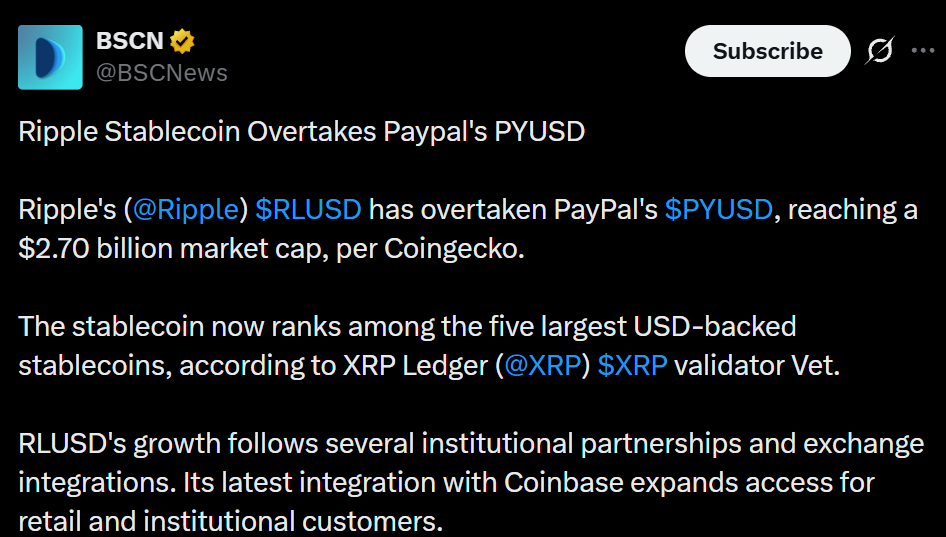
A quiet but notable shift has taken place in the stablecoin market. A dollar-backed token from Ripple has moved ahead of the one from PayPal.
In short, RLUSD overtakes PYUSD by market value, with the first at about $2.71 billion and the second at roughly $2.66 billion, according to live market data.
The Numbers Side by Side
Market cap is the total value of every unit in circulation. A stablecoin aims to stay at $1, so its market cap mostly shows how many units exist.
Here is how the two compare right now:
Detail
RLUSD
PYUSD
Market cap
$2.708 billion
$2.661 billion
24-hour trading volume
$155.06 million
$66.58 million
Circulating supply
2.708 billion
2.661 billion
Price
$1.00
$0.9999
The gap is about $37 million, which is a narrow lead. Both assets trade almost exactly at $1, just as a stablecoin should.
The XRP-linked issuer’s token also saw more trading in the past 24 hours, though daily volume changes constantly.
You can check live figures on the market pages for Ripple USD and PayPal USD.
Why RLUSD Overtakes PYUSD Now: Growth Since Launch
The company launched its stablecoin globally on December 17, 2024. In its latest official announcement, it says the token has passed $2.4 billion in market cap, driven by adoption across exchanges, payments, institutional markets, and on-chain finance.
That means an asset less than two years old now sits above one from a well-known payments business.
The rise in supply is the clearest sign of growing demand, since new units are created only when customers deposit dollars.
Ripple USD also runs natively on the XRP Ledger, which keeps it closely tied to the XRP ecosystem.
The Coinbase Listing Widens Access
On October 28, 2026, Ripple and Coinbase announced a partnership to bring Ripple USD to the exchange.
Starting that day, retail and institutional clients can trade and manage it through Coinbase Prime, Coinbase Exchange, and the Retail app.
Key details from the official press release:
Users get 1:1 conversion from U.S. dollars and other supported USD-denominated stablecoins.
Deposits and withdrawals work across the XRP Ledger, Base and Ethereum.
The issuer will provide liquidity on Base to support growth.
Access for Global Exchange customers, including use as collateral, will follow, though no date was given.
The company says the partnership reaches the largest institutional client base in the U.S. crypto market.
Wider access usually helps a stablecoin grow, because more people can buy, sell and hold it easily.
It also gives businesses a regulated, familiar place to move dollars on-chain without leaving the platforms they already use for trading and custody.
What Backs Each Token
Size is only one part of the story, and it does not tell you how safe a stablecoin is.
Reserves matter just as much, because they are what keeps the near $1 value steady.
The Ripple-issued token: According to the issuer, it is a regulated stablecoin, redeemable for U.S. dollars and backed by reserves that include dollar deposits, short-term U.S. Treasuries and other cash equivalents.
The PayPal-linked token: The PayPal USD page describes it as issued by Paxos Trust Company, redeemable 1:1 for dollars and backed by dollar deposits, short-term Treasuries and similar cash equivalents. It runs on many networks, including Ethereum, Solana and Stellar.
Both follow a similar model. The difference lies in who issues them, where they are used, and how widely they are available.
Ripple USD leans on the XRP Ledger and institutional partners, while PayPal’s version leans on a huge consumer payments network and many blockchains.
What the Lead Means for Users
Even so, the fact that RLUSD overtakes PYUSD is a headline about size, not safety.
The lead is thin and can reverse, because the rival can grow too. For everyday users, the useful takeaway is simple: Ripple’s token is now easier to reach through a major exchange, and it can move across the XRP Ledger, Base, and Ethereum.
Anyone considering either asset should check reserve reports, supported networks and local availability first. This is market information, not financial advice.
Conclusion
To sum up, RLUSD overtakes PYUSD by a narrow margin of roughly $37 million, helped by strong growth since December 2024 and the October 28 exchange launch.
Both stablecoins hold their near $1 value and use similar reserve models. Watch the issuer’s official channels and live market pages for the latest numbers.
Disclaimer
This article is for educational and informational purposes only and is not financial or investment advice. Crypto assets are high risk, their prices can be very volatile, and you can lose some or all of your money. Always do your own research and consider speaking with a licensed financial advisor before making investment decisions.
About the Author Bablu Singh Nirwan
English Blog Writer at coingabbar.com
Bablu Singh Nirwan is a Content Writer with 6 months of experience covering blockchain, cryptocurrency, Web3, and digital finance. He specializes in researching emerging trends, simplifying complex topics, and creating SEO-optimized content. His work focuses on clarity, accuracy, and engaging insights that keep readers informed about the evolving crypto industry.
Frequently Asked Questions (FAQ)