C. Monasterio
TL;DR:
- Material risk: The report by the task force convened by the Royal United Services Institute (RUSI) notes that the use of cryptocurrencies for money laundering represents a material risk for the United Kingdom ahead of its Financial Action Task Force (FATF) mutual evaluation.
- Timing vulnerability: The UK’s mandatory and statutory regulatory regime for cryptoassets will not enter into force until October 25, 2027, which is after the FATF evaluation visit scheduled for June of that same year.
- Impact on fraud: According to data from the City of London Police cited in the document, 66% of investment fraud crimes committed in the country involve cryptocurrencies.
Cryptocurrency money laundering has positioned itself as one of the main institutional challenges for the United Kingdom. According to a report published this Friday by a task force convened by the Royal United Services Institute (RUSI), the country will face international scrutiny at a time of regulatory transition.
The evaluation by the Financial Action Task Force (FATF) —the Paris-based body that sets global standards against money laundering and terrorist financing— will examine whether British regulations work in practice. The task force report, compiled by experts from the private sector, law enforcement agencies, and civil society, warns that British authorities will struggle to demonstrate adequate implementation during the evaluators’ visit scheduled for June. Official approval of the UK report is scheduled for the FATF plenary in February 2028.
Regulatory Challenges and Law Enforcement
According to the RUSI document, the United Kingdom has adopted a more conservative stance compared to jurisdictions such as Hong Kong, the European Union, and Singapore. Although cryptoasset legislation progressed earlier in the year and the Financial Conduct Authority (FCA) finalized its regulations in June, the mandatory compliance regime will remain in a transitional phase during the evaluation.
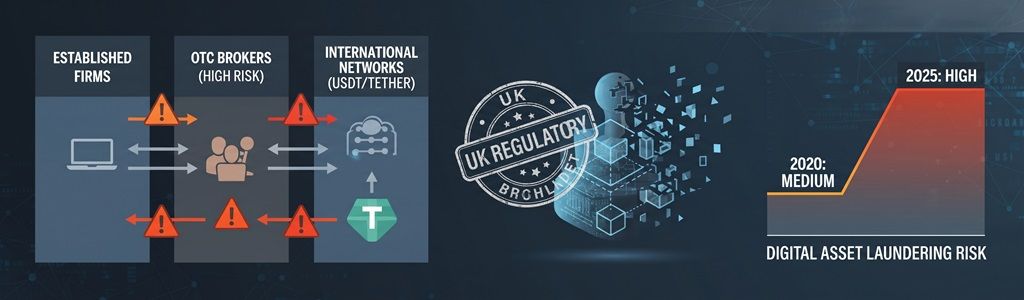
Task force members expressed concern over the supervision of over-the-counter (OTC) brokers, which were identified in the National Crime Agency’s (NCA) 2025 National Risk Assessment as potential laundering channels worth hundreds of millions of dollars annually. Likewise, the 2025 National Risk Assessment elevated the category of digital asset money laundering to a “high” risk level, compared to the “medium” rating recorded in 2020.
The report also highlights the seizure of £5.5 billion (approximately $7.3 billion) executed by the Metropolitan Police in connection with a professional Chinese money launderer convicted in 2025. While the group described the operation as a positive sign of the criminal justice system’s capacity, one member noted that this level of success has not been broadly replicated.
Limitations in the Regulatory Perimeter and Digital Assets
The RUSI analysis warns that the approach of the British regime —aligned with the European Union’s Markets in Crypto-Assets (MiCa) regulation— focuses on identifying formally established cryptocurrency firms. This operational structure could cause higher-risk transactions to move outside the FCA’s perimeter.
Under this scenario, the task of asset tracing will fall on law enforcement agencies, which face operational limitations regarding instruments such as Tether’s USDT stablecoin. A British Treasury report published in July 2025 noted that this cryptocurrency has been extensively used by Russian-speaking money laundering networks. Despite acknowledging the UK’s international cooperation through initiatives such as Operation Destabilise, the task force warned of persistent vulnerabilities associated with resource allocation to the UK Financial Intelligence Unit and the financial capabilities of police forces.
Chainalysis Maps Russian Intermediary Network Facilitating North Korean Crypto Cash Outs
TL;DR Chainalysis identified a network of Russian intermediaries that helped North Korean IT workers convert millions of dollars in cryptocurrency into cash. The United States
Interpol Seizes $105M And Dismantles Illegal Crypto Mines Across Africa
Interpol recovered more than $105 million and dismantled thousands of cybercrime networks across Africa during Operation Serengeti III, which ran from June 29 to August
Colombian Authorities Arrest 8 Cartel Suspects Linked To $42M Crypto Scheme
The Colombian Attorney General’s Office announced the arrest of eight individuals wanted for extradition to the United States on alleged drug trafficking and money laundering
Quant Outlines Strategy for Interoperable Financial Networks at UK Finance Conference
TL;DR Quant highlighted a network-of-networks model for tokenized deposits at UK Finance’s conference, arguing that cross-border connectivity will require shared standards, rulebooks and overlapping institutional
FCA Outlines DeFi Regulatory Boundaries Ahead of UK’s New Crypto Rules
The FCA published two key regulatory consultations on Wednesday to define the treatment of decentralised finance (DeFi) and delimit the perimeter of the UK’s new
Drift Protocol Exploiter Moves $61 Million in Ether to Tornado Cash
TL;DR The Drift Protocol exploiter transferred approximately $61 million in Ethereum to Tornado Cash after two months of inactivity. Addresses linked to the hacker still