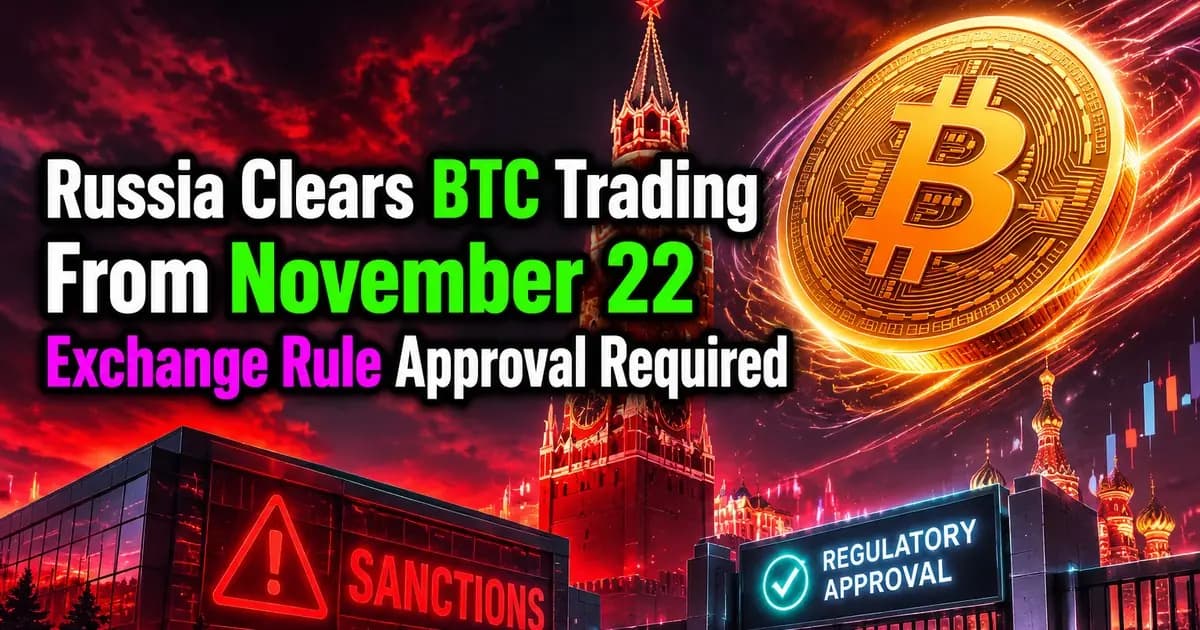
The Bank of Russia said on November 11 that exchanges may begin organized cryptocurrency trading on November 22, 2026, after securing approval for their trading rules. The Russia Bitcoin trading framework brings BTC▲$74,179.00 into the country’s supervised financial markets, while Moscow Exchange still targets December 1 for its launch.
The opening comes with restrictions: ordinary investors face an annual purchase limit through each intermediary, and Russia’s largest exchange and its clearing house remain under US sanctions.
- 🟢Russia Sets November 22 as the Earliest Exchange Opening
- 🎯Moscow Exchange Targets a December 1 Bitcoin Pilot
- 🟠Russia's Crypto Framework Reverses Its Earlier Ban Proposal
- 🟢Russian Retail Buyers Get BTC, ETH and USDT With a Purchase Cap
- ⚠️US Sanctions Create Risks for Moscow Exchange and USDT Users
- 🟠Banks and Rival Venues Prepare Their Own Crypto Services
- 🔷What Happens Next for Russia’s Bitcoin Trading Launch
- ❓FAQ
Russia Sets November 22 as the Earliest Exchange Opening
What Does the Bank of Russia’s New Ordinance Allow?
The central bank’s ordinance allows exchanges to introduce organized cryptocurrency trading from November 22, provided they first agree on their operating rules with the regulator. That approval is a condition for opening a market, rather than an automatic consequence of the effective date.
The Justice Ministry registered the ordinance on November 3, and the regulator published it on November 11. It amends the rules governing organized trading, bringing cryptocurrency transactions into the reporting arrangements already used for other assets.
https://x.com/BitcoinMagazine/status/2120523189411278982
What Must Exchanges Put in Place Before Trading?
Trading venues must register participating brokers, trust managers and central counterparties. They must also maintain registers of orders and completed deals, monitor activity and send trading information to the Bank of Russia.
Price calculations form another part of the requirements. Exchanges must calculate current, weighted-average, market and closing prices, giving the regulator a set of pricing measures alongside the transaction records.
Moscow Exchange Targets a December 1 Bitcoin Pilot
What Has Moscow Exchange Announced?
Moscow Exchange, Russia’s largest trading venue, announced on November 2 that it plans to introduce Bitcoin, Ether and USDT▼$0.9992 transactions on December 1. The initial rollout is planned as a pilot while participating firms connect to the service.
The exchange intends to use its existing stock-market systems. Its proposed cryptocurrency session runs from 6:50 a.m. to 11:50 p.m. Moscow time, with clients able to settle transactions on the same day or the following day.
Who Will Handle Customer Access, Clearing and Custody?
Brokers will provide investor access, while the National Clearing Centre is expected to clear Moscow Exchange’s cryptocurrency deals. A partner settlement digital depository is planned to handle custody and settlement arrangements, with participating firms opening accounts there.
Boris Blokhin, a senior managing director at Moscow Exchange, said in October that the venue expected to operate under its existing permissions without additional licenses. The November ordinance separately requires agreement with the central bank on the rules governing cryptocurrency trading itself.
Russia’s Crypto Framework Reverses Its Earlier Ban Proposal
How Did Russia Move From a Proposed Ban to Exchange Trading?
In January 2022, the Bank of Russia proposed banning cryptocurrency exchanges. It now oversees their entry into a licensed market under Federal Law No. 282-FZ, “On Digital Currencies and Digital Rights,” whose main provisions took effect on September 1.
The law recognizes cryptocurrency as property and establishes licensed roles for exchanges, brokers, managers, depositories and exchange providers. It also opens a supervised channel for cross-border trade, while retaining the prohibition on using cryptocurrency to pay for goods and services inside Russia.
Which Institutions Have Entered the New Framework?
The central bank approved its first operators in October, initially admitting four cryptocurrency exchange providers and five digital depositories. The registrations included Sberbank and VTB, alongside firms specializing in digital asset infrastructure.
Registered digital depositories can record ownership and transfers of cryptocurrencies and digital rights. Cryptocurrency exchange providers can buy and sell digital currencies on their own behalf outside organized trading, giving the framework a separate route for transactions away from an exchange order book.
Officials have also worked on a self-regulatory body for cryptocurrency exchanges and digital depositories. The exchange ordinance adds trading supervision to that wider effort to establish the institutions needed for a domestic market.
Russian Retail Buyers Get BTC, ETH and USDT With a Purchase Cap
Which Assets Can Non-Qualified Investors Buy?
A separate ordinance published on November 6 approves Bitcoin, Ether and Tether’s USDT for non-qualified investors. That asset list takes effect on November 17, ahead of the November 22 organized-trading framework.
The central bank selected eligible assets using liquidity, market capitalization, average daily trading volume and at least five years of pricing history on foreign exchanges. Ordinary investors can purchase through a broker, trust manager or registered cryptocurrency exchange office, either on an exchange or over the counter.
How Does the 300,000-Ruble Limit Apply?
Non-qualified investors may purchase up to 300,000 rubles of cryptocurrency a year through each intermediary, roughly $3,600. The limit applies to purchases through that intermediary; it is not a separate allowance for each approved cryptocurrency.
Qualified investors can access all cryptoassets without that purchase cap. Both qualified and non-qualified investors must pass a knowledge test and review a risk disclosure before trading.
For Bitcoin, the policy creates another regulated route for domestic buying. Its reach among ordinary savers will depend partly on the purchase ceiling and whether the new services attract traders who already use offshore venues.
US Sanctions Create Risks for Moscow Exchange and USDT Users
Why Does the Sanctioned Clearing House Matter?
The US Treasury sanctioned Moscow Exchange and its clearing house in June 2024. Sberbank has faced full US sanctions since April 2022, placing major institutions involved in Russia’s planned cryptocurrency rollout under restrictions.
Moscow Exchange’s proposed cryptocurrency deals would clear through the same sanctioned clearing house. According to BeInCrypto, traders fear those restrictions could push prices on Moscow venues below global prices.
That makes the sanctions position part of the practical market story alongside domestic authorization. Russian regulatory permission governs the launch, while the planned clearing arrangements retain the exchange’s exposure to US restrictions.
What Does Tether’s Freeze History Mean for USDT?
In March 2025, Tether froze $23 million linked to Garantex, a sanctioned Russian cryptocurrency exchange, while assisting the US Secret Service. The action provides a concrete example of issuer intervention involving Russian-linked funds.
Tether chief executive Paolo Ardoino said the company can track transactions and freeze USDT associated with illicit activity. PSB chairman Petr Fradkov also warned in August that Tether can block tokens at any address.
USDT’s inclusion on Russia’s approved retail list therefore comes with issuer restrictions as well as domestic trading rules. It offers exposure to a token tracking the US dollar, but its issuer follows US sanctions when freezing funds.
Banks and Rival Venues Prepare Their Own Crypto Services
What Are VTB, Sberbank and SPB Exchange Planning?
VTB plans to open cryptocurrency services in November, while Sberbank targets December 1. Moscow Exchange’s planned pilot falls on the same date as Sberbank’s intended rollout, putting banks and exchange infrastructure on parallel launch schedules.
SPB Exchange, the St. Petersburg venue, has said it wants to begin organized cryptocurrency trading by the end of the year. It is building its own settlement digital depository, adding another planned venue and custody arrangement to the domestic market.
Why Does the Timing Matter for Existing Russian Traders?
Domestic institutions are preparing these services as access to some overseas platforms narrows. KuCoin became the third major exchange to restrict users in Russia and Belarus within two weeks.
The regulated alternatives will offer access through Russian intermediaries under the central bank’s testing, purchase and reporting requirements. For non-qualified investors, the initial choice is limited to BTC, ETH▲$2,074.04 and USDT; qualified investors receive broader asset access.
The competitive question is whether those domestic services can attract activity from offshore desks. Launch timing, the retail purchase ceiling and sanctions-related pricing concerns all feature in the transition described by market participants.
What Happens Next for Russia’s Bitcoin Trading Launch
Which November and December Milestones Come First?
The immediate sequence begins on November 17, when the approved retail asset list takes effect. November 22 then marks the date exchanges may start organized cryptocurrency trading once their rules have been agreed with the Bank of Russia.
Moscow Exchange’s December 1 pilot is the next scheduled exchange milestone. The venue has been testing transactions with professional market participants ahead of that rollout, as crypto.news details.
For BTC holders watching the policy, the next concrete developments are exchange rule approvals, operating services and the connection of participating firms. Those steps turn the new legal route into a market where eligible customers can place trades.
What Deadline Applies After the Initial Launches?
Registered institutions must bring their operations fully into line with the new legislation by September 1, 2027. Their obligations include transaction records and the operational requirements attached to their roles in the market.
The initial launches therefore sit within a longer implementation schedule. Exchanges, brokers and depositories must coordinate customer access, trading, custody and settlement while meeting the central bank’s supervision requirements.
FAQ
Can Russians Buy Bitcoin on November 22?
Eligible investors may use an exchange that has agreed its cryptocurrency trading rules with the Bank of Russia once the November 22 framework takes effect. Customers must also meet the knowledge-test and risk-disclosure requirements before trading.
How Much Bitcoin Can a Non-Qualified Investor Buy Each Year?
The annual allowance is 300,000 rubles in cryptocurrency purchases through each intermediary, rather than a fixed number of BTC. Bitcoin, Ether and USDT purchases fall within that monetary limit.
Which Cryptocurrencies Can Ordinary Russian Investors Buy?
The November 17 retail list covers Bitcoin, Ether and Tether’s USDT. The selection criteria include market size, trading activity and a foreign-exchange pricing history of at least five years.
Does Moscow Exchange Launch Bitcoin Trading on November 22 or December 1?
Moscow Exchange plans its own pilot for December 1. November 22 is the effective date of the framework allowing approved exchanges to begin organized cryptocurrency trading.
What Approval Must an Exchange Receive Before It Can Trade Crypto?
An exchange must reach agreement with the Bank of Russia on its cryptocurrency trading rules before opening the market. The November 11 ordinance also requires participant registration, order and transaction records, price calculations and regulatory reporting.
How Will Moscow Exchange Settle and Clear Cryptocurrency Trades?
The planned arrangement uses the National Clearing Centre for clearing and a partner digital depository for custody and settlement. Clients would be able to settle on the trade date or the following day.
How Do Russia’s Trading Rules Treat Domestic Payments and Cross-Border Trade?
The law whose main provisions took effect on September 1 retains the ban on cryptocurrency payments for goods and services inside Russia. It separately establishes a supervised channel for cross-border trade.
This article is for information only and is not financial advice.
Related Articles
Coinbase Uses AI to Write 95% of Its Code — AI Agents Replace 1,200 Employees
Coinbase has shifted to using AI for more than 95% of its software code. We break down the details....
CFTC Scrutinizes Kalshi Mention Markets as Sports Word Bets Disappear
According to an NPR report citing two sources with direct knowledge of the investigation, the...
Bitcoin Price at $50K Would Be a ‘Huge Opportunity,’ Fundstrat Says
Fundstrat strategist Sean Farrell says he would buy heavily if the Bitcoin price falls, but not go...
Bitcoin Breaks $65K as Crucial U.S. CPI Report Puts $65,800 Breakout in Focus
Prior to US inflation data for July, bitcoin exceeded the $65,000 mark, continuing a recovering...
Netanyahu Seeks Blockchain Backup as Israel Warns of Banking Sanctions
Israel blockchain plan would prepare an alternative way to move money if banking sanctions hit,...
Market Coverage Cites No J.P. Morgan Target as BTC Trades Near $77K
J.P. Morgan Bitcoin price prediction coverage cites no bank target; BTC trades near $77K as ETF...