Meta description: Samsung crypto wallet launch in 2026 reshapes corporate crypto treasury management with stablecoin payments 2026. Master multi-chain treasury reconciliation and audit-proof reserves.
On November 6, 2026, Samsung’s new crypto wallet brought stablecoin payments to 82 million Galaxy devices in the U.S., integrating Stripe, Coinbase, and Circle. As OneSafe’s content team reported, the move makes stablecoin spending a default option on a mass-market smartphone. For finance leaders, this forces a re-examination of how treasuries handle stablecoin inflows, idle balances, and on-chain audit trails—not in theory, but today.
Table of Contents
- What Just Happened
- Why This Matters Now for Corporate Crypto Treasury
- The Background: How Stablecoin Payments 2026 Surged
- Concrete Implications for Your Treasury
- Recommended Actions for Finance Leads
- What to Watch Next
- Key Takeaways
What Just Happened
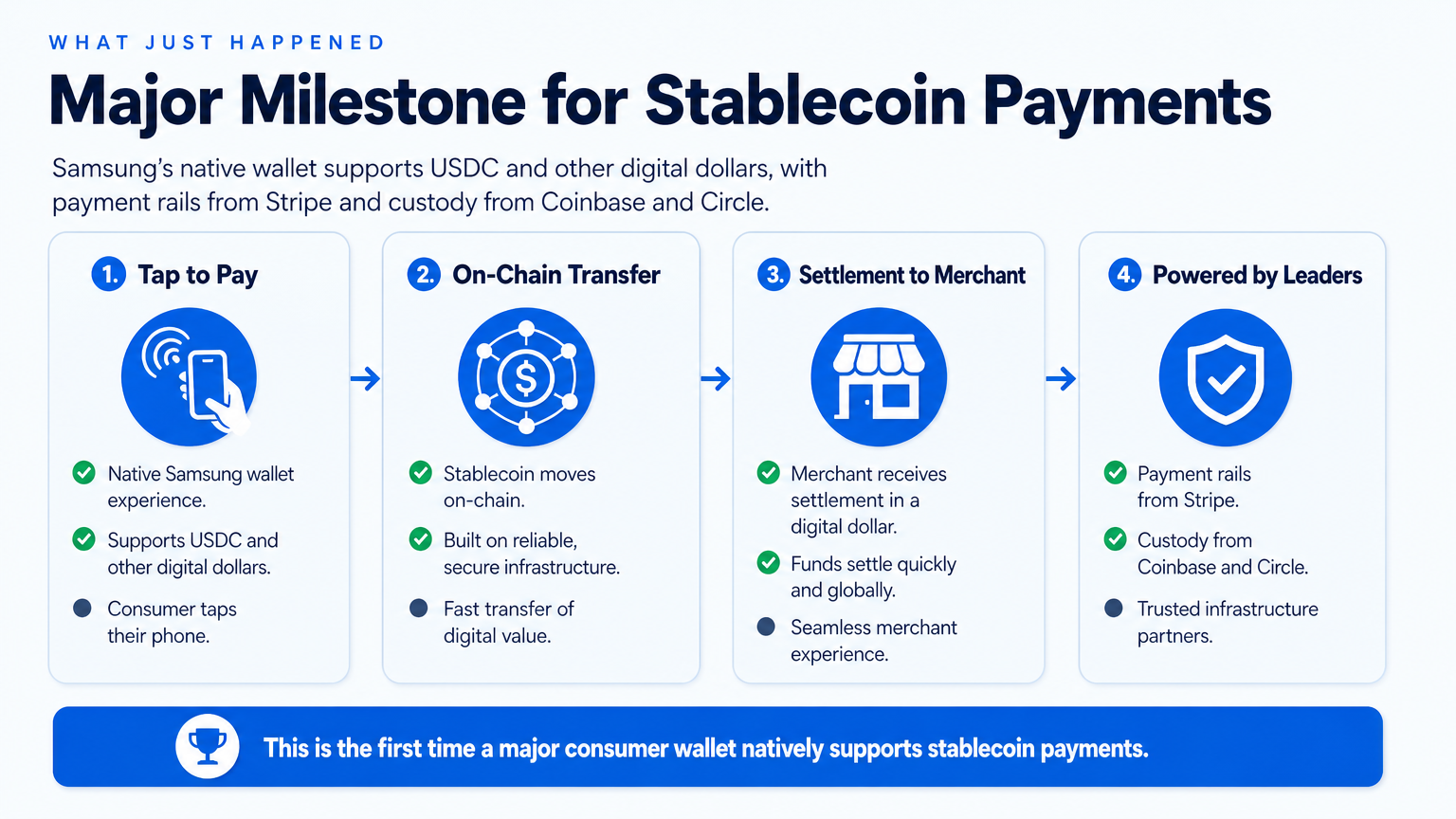
Samsung’s native wallet supports USDC and other digital dollars, with payment rails from Stripe and custody from Coinbase and Circle. A consumer taps their phone, a stablecoin moves on-chain, and a merchant receives settlement in a digital dollar. This is the first time a major consumer-electronics manufacturer has embedded stablecoin spending directly into its OS, bypassing third-party wallets entirely.
Why This Matters Now for Corporate Crypto Treasury
Corporate crypto treasury conversations used to center on rails—which blockchain, which custodian. Samsung’s move shifts the focus to adoption. A treasury that today receives only wires may soon see a material share of inbound payments arrive as on-chain stablecoins, simply because customers used a Samsung phone. Treasury teams now must answer: Can we receive USDC? Where does it settle? How do we record and report it? And can idle stablecoin balances earn yield while we decide?
The boardroom reality is stark. With Stripe’s payout infrastructure and institutional-grade custody, a payment from a Samsung user can land in a USDC wallet 24/7 within minutes. Cash forecasting and liquidity buffers change overnight. A treasury that treats crypto as a separate, speculative side project is now behind.
The Background: How Stablecoin Payments 2026 Surged
Three trends converged to make this inevitable:
- Supply and velocity exploded. Total stablecoin market cap crossed $200 billion in early 2026, with quarterly transfer volumes regularly surpassing $1 trillion. A Federal Reserve note from March 30, 2026, found that payment stablecoins can cut cross-border costs by up to 80% with guardrails.
- Payment giants entered. Stripe reintroduced crypto payouts in 2024 and expanded stablecoin settlement options; PayPal launched its stablecoin in 2023; Visa and Mastercard integrated USDC settlement. Samsung ties these threads together at the device level.
- Consumer familiarity grew. Circle’s Q3 2026 revenue hit $865 million, largely from reserve interest, signaling transactional—not speculative—usage.
Concrete Implications for Your Treasury
Rethinking Idle Stablecoin Balances
A corporate treasury that receives USDC typically parks it like fiat, but stablecoins are inherently yield-bearing because the reserves (short-dated Treasuries, cash equivalents) earn interest. Leaving a significant USDC balance idle means leaving revenue on the table. Treasury teams can deploy idle stablecoins through regulated yield products that invest in Treasuries, permissioned on-chain lending protocols, or automated sweep platforms. Each carries counterparty, smart-contract, and liquidity risks; a $2M monthly inflow held for two weeks at 3.5% annual yield represents $11,667 in lost potential earnings per month. Active crypto treasury management now requires treating stablecoins as a productive asset class with careful risk limits.
Yield arrangements are not FDIC-insured, and regulation around earning interest on stablecoins is unsettled. The Fed’s March 2026 note warns that yield-bearing stablecoins could blur the line between money market funds and bank deposits, potentially triggering securities or banking regulation.
Yield arrangements are not FDIC-insured, and regulation around earning interest on stablecoins is unsettled. The Fed’s March 2026 note warns that yield-bearing stablecoins could blur the line between money market funds and bank deposits, potentially triggering securities or banking regulation.
Multi-Chain Treasury Reconciliation Becomes Non-Negotiable
Samsung’s wallet works with Stripe, which routes payments across multiple blockchains (Ethereum, Solana, Polygon L2s, etc.). An incoming stablecoin might arrive on different chains, each with its own format, finality, and fee structure. Traditional reconciliation relies on end-of-day batch files; on-chain reconciliation requires real-time multi-chain data ingestion, normalization, and mapping to internal ledgers. Without automated reconciliation middleware, treasury teams drown in spreadsheets. Gas spikes, L2 finality delays, and multi-chain treasury fragmentation demand both the right tool and upskilled staff who understand the difference between a Solana slot and an Ethereum block.
Audit-Proof Reserves: Proving On-Chain Holdings to Auditors
Proving ownership and control of on-chain assets to auditors without exposing private keys or wallet addresses requires a new playbook. The emerging best practice for audit-proof reserves includes:
- Generate a cryptographic proof: Use a Merkle-tree commitment to all balances held in corporate wallets, signed by a trusted third party or MPC key share.
- Provide a signed attestation from the custody provider or quorum without revealing keys.
- Link on-chain activity to the ERP: A crypto subledger integrated with the general ledger exports a complete, time-stamped audit trail with block explorer links and masked counterparty tags.
Auditors at Big Four firms have invested in blockchain assurance tools since 2023, but treasury teams should discuss the format for proof of reserves upfront—well before the first stablecoin payment lands.
Recommended Actions for Finance Leads

What to Watch Next
The regulatory clock ticks fast. A Federal Reserve framework for payment stablecoin oversight from March 2026 left yield-on-stablecoin rules unanswered, but with Samsung’s move a political talking point, a floor vote could come by early 2027. Florida passed its own stablecoin regulation in 2026—a signal that state-level action may outpace federal legislation. Meanwhile, the Chainalysis breach in 2026 underscored that even sophisticated custody providers are targets, making rigorous security scrutiny of any third-party yield platform essential.
B2B stablecoin payment share is projected to exceed 25% of cross-border B2B payments by 2027, according to Stablecoin Payment Statistics 2026. Treasuries that build multi-chain reconciliation, yield protocols, and auditor-ready reserve proofs now will be ready for the next wave—whether it comes from Apple, Google, or a social platform.
To keep your finance team informed on these fast-moving treasury topics, consider Joyrise, which plans, writes and publishes illustrated SEO articles to your Webflow blog every day.
Key Takeaways
- Samsung’s 82-million-device stablecoin rollout turns USDC into a consumer payment rail that will flow into corporate treasuries—ready or not.
- Idle stablecoin balances must be treated as deployable assets: evaluate yield options today, before volume arrives.
- Multi-chain treasury reconciliation is now non-negotiable; automate it before month-end close breaks.
- Design an auditor-ready audit-proof reserves process now, in collaboration with external auditors.
- Watch regulatory developments on stablecoin yield and state-level legislation, as rules may change within months.
Explore how a unified fiat-and-crypto treasury platform can help manage stablecoin flows, reconciliation, and compliance at OneSafe.
Get started with Crypto in minutes!
Get started with Crypto effortlessly. OneSafe brings together your crypto and banking needs in one simple, powerful platform.