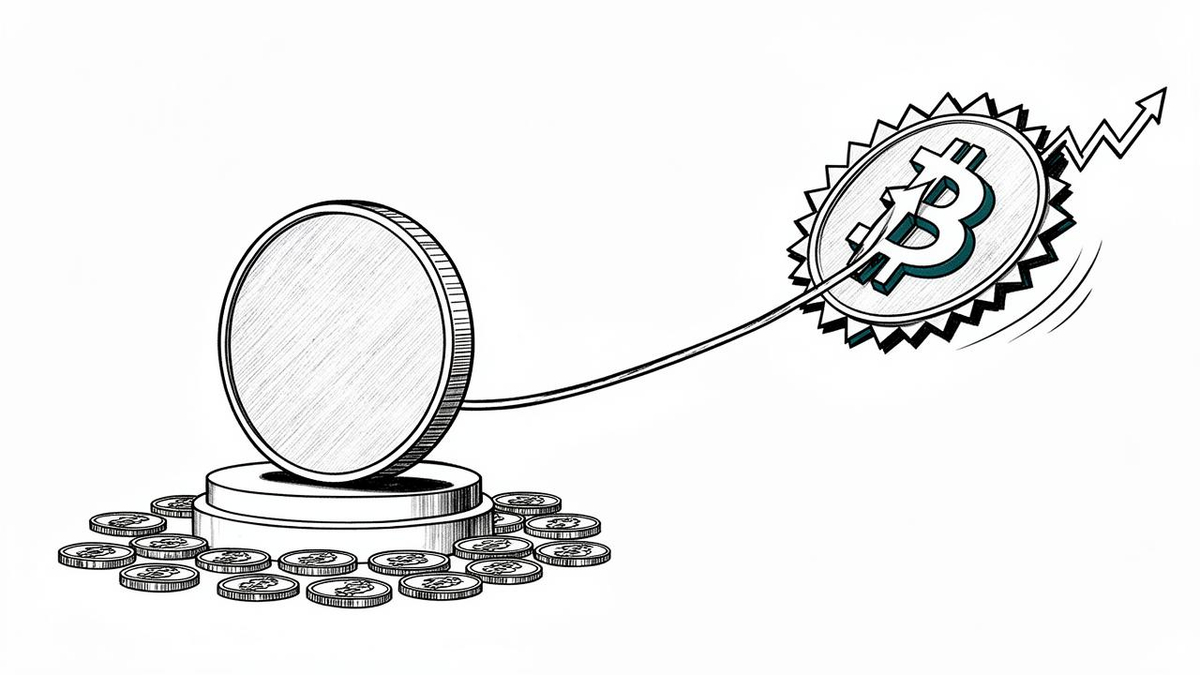
Peter Schiff is using the crypto market's recent rebound to make a familiar argument in a new form: investors who expect Bitcoin to rise can simply buy Solana instead. The claim rests on the fact that major digital tokens tend to move together, and recent trading offers partial support for it. But a closer look at the numbers shows that correlation is not the same thing as substitution, and that the two assets differ on supply, volatility and the reasons anyone holds them.
Schiff made the point in a Nov. 21 post about Bitcoin. "If you think Bitcoin will go up, you can buy Solana instead," he wrote, adding that this "makes Bitcoin less scarce." The post was framed as a critique of Bitcoin's scarcity narrative rather than a disclosure that he had bought SOL or turned positive on crypto. Schiff had argued earlier in the month, on Nov. 10, that Bitcoin's failure to follow a Wall Street rally left it exposed to further selling.
His latest version of the argument shifts from Bitcoin's relationship with equities to its relationship with other cryptocurrencies. If the whole market moves as one, a trader expecting a broad recovery could hold another large token and still capture the move. For someone whose only goal is to profit from rising crypto prices, that is a reasonable proposition to test. The trouble starts when a tendency becomes an assumption.
What the November tape actually shows
Matching daily closes from CoinGecko for Nov. 3 through Nov. 21 give 18 completed daily returns. Bitcoin and Solana moved in the same direction on 15 of those 18 days, and the correlation between their daily returns came in at roughly 0.88. That is a strong association within the sample, though it says nothing about causation and even less about the next rally.
The cumulative result was less flattering to the substitution thesis. Bitcoin fell from $77,385 to $60,121, a loss of 22.3%. Solana dropped from $92.78 to $70.20, a decline of 24.3%. An unleveraged $10,000 position in each would have ended the period at $7,769 for Bitcoin and $7,566 for Solana, before trading costs, taxes or staking rewards.
Note: Figures use matching completed daily closes from CoinGecko; the partial Nov. 22 observation is excluded. Returns are unleveraged and exclude trading costs, taxes and staking rewards.
Solana's day-to-day swings were about 38% wider than Bitcoin's on a standard-deviation basis, meaning equal dollar positions did not carry equal observed risk. Individual sessions show why counting green and red days can mislead. On Nov. 17, Bitcoin's close rose about 0.07% while Solana gained roughly 5.03%. On Nov. 14, both fell, but Bitcoin lost about 6.1% against Solana's 10.2% decline.
Measured in Bitcoin terms, the gap is starker. The SOL-to-BTC ratio fell about 2.6% over the stretch, so a Solana holder could book a dollar profit and still trail someone who simply stayed in Bitcoin if BTC rallies faster.
The 2023 counterexample cuts both ways
The strongest historical case for Schiff's idea comes from a rising market rather than a falling one. CoinGecko's 2023 annual report recorded a 155.2% gain for Bitcoin and a 917.3% gain for Solana. Both rose sharply, but the spread was wide enough to make the choice between them the dominant factor in the result.
That year's Solana rally was tied to its own ecosystem developments, including recovery from the aftermath of FTX's collapse, renewed interest in the network and airdrops. Those are Solana-specific catalysts, not a mechanical response to Bitcoin's price. A single exceptional year does not establish what SOL will return in the next recovery, but it does show that a substitute chosen for its upside can behave very differently from the asset it is meant to replace.
Scarcity, demand and the supply question
Schiff's final claim crosses from market performance into the meaning of scarcity. Investors can put money into another cryptocurrency, but doing so does not increase the number of bitcoins the Bitcoin network issues. Bitcoin's published monetary rules describe declining issuance and a ceiling of 21 million BTC. Solana transactions create no units inside that supply, and SOL cannot be presented to the Bitcoin network as native BTC.
What competition can affect is demand. A buyer with a fixed sum can choose Solana, Bitcoin, gold, equities or cash, and that competition influences what any one asset is worth. A fixed supply is compatible with falling prices when demand weakens; the 21 million cap puts no floor under the market price and offers no guarantee of outperformance. Bitcoin.org's own explanation ties value to people's willingness to use and accept bitcoin, which leaves the demand question open.
Solana's issuance works differently. Its model includes continuing issuance with a terminal inflation rate of 1.5%, rather than an eventual end to new coins. In August, a proposal to slow inflation faster passed with about 67% support, backing a doubling of the annual reduction in the inflation rate from 15% to 30%. That changes how quickly issuance approaches the existing floor, not whether Solana acquires a Bitcoin-style maximum. Approval, client implementation and activation are separate steps, and the vote alone does not establish the inflation rate in force on any later date.
For holders, staking adds another variable. A person holding unstaked SOL receives no rewards from new issuance, while a staker can earn them. Rewards raise the token count without fixing dollar value, so a falling market can leave a staker with more SOL and a smaller portfolio. Any comparison with Bitcoin should use consistent periods and state the rewards, costs and conditions involved.
A weekend bounce that did not hold
The debate over Schiff's claim lands in a market that has been badly bruised. Solana led a weekend rebound after a leverage flush swept crypto, trading near $70.86 on Nov. 21, up about 3.7%, more than double Bitcoin's gain of roughly 1.4% near $60,300. Ether rose about 2.2% to around $1,690, and XRP added a similar amount near $0.93.
The bounce followed a sell-off that pushed Bitcoin below $57,000, its lowest since September 2024, from around $63,000 on Nov. 18. CoinGlass data showed about $2.4 billion in futures liquidations over 24 hours, with Bitcoin accounting for more than $1 billion and Ether $545 million. Of roughly $1.8 billion in leveraged positions erased, about $1.3 billion were bullish bets. Glassnode said the drop cleared the largest cluster of leveraged longs on its Bitcoin liquidation heat map, between $59,000 and $62,000, removing what it called "a large source of forced selling."
The relief did not last. Solana has since slipped back below $70 and trades well under both its 50-day average near $89.60 and its 200-day average around $94.77, with the monthly loss at about 33%. Its relative strength index sits near 26, in oversold territory, while the MACD remains below its signal line and the ADX confirms a downtrend still driven by sellers. The nearest mapped support is far below, near $42, and the first real ceiling stands around $97.60. Fewer forced sellers can slow a decline; they cannot reverse one on their own.
What the switch does and does not buy
The evidence leaves a qualified case for the trade and a much weaker one for treating SOL as Bitcoin itself. Someone expecting a broad crypto recovery can express that view through Solana, accepting that the outcome may be better or worse than holding BTC. What they cannot do is acquire a claim on bitcoin, a redemption right for BTC, or a return fixed to Bitcoin's price.
For a holder whose purpose is native Bitcoin under Bitcoin's issuance rules, SOL does not meet the requirement. It cannot settle a bitcoin-denominated obligation without first being sold at whatever terms prevail at the time. Switching also carries costs before either asset moves, including spreads, fees and tax consequences that vary by venue and jurisdiction.
Holding both is a separate decision. The positive relationship observed in November means adding SOL did not reliably offset Bitcoin's decline, even though the positions represent different networks. Whether a different mix reduces portfolio risk would require a longer comparison and a stated investment period; 18 observations are enough to describe one falling stretch of trading and not enough to predict the next cycle. A correlation of 0.88 is not an 88% probability that Solana rises whenever Bitcoin does.
Network risk belongs in the comparison too. Solana suffered a five-hour outage on Feb. 6, 2024, resolved after a software upgrade and a coordinated validator restart. Its Alpenglow upgrade now lists the Votor voting protocol as live since epoch 1064 on Oct. 21, with a finality target of roughly 150 milliseconds, while the planned Rotor block-distribution component remains for a later release. Faster finality can improve the experience of using applications; it is not a promise of a higher token price. Bitcoin's proof-of-work security and Solana's proof-of-stake design carry different costs, incentives and operational dependencies that a shared price chart does not capture.
The practical question for a buyer is therefore harder than whether Bitcoin will rise. It is whether Solana will attract enough demand to match or beat that move, how much extra loss the buyer can absorb if it does not, and which asset the money would otherwise have been in.
Once added, BigGo Finance appears first in Google Search Top Stories, so you get the broadest, most up-to-the-minute, and most comprehensive global financial news first.


