Get the hottest Fintech Singapore News once a month in your Inbox
Singapore experienced an active year in fintech developments, with key activity coming from its financial regulator zeroing in on stablecoins and AI.
The Monetary Authority of Singapore’s proposed stablecoin framework, for example, would create a dedicated MAS-regulated stablecoin and require issuers to hold reserves at least equal to par.
Non-MAS-regulated stablecoins would be classed as digital payment tokens (DPTs) and fall under existing DPT consumer protection safeguards.
Meanwhile, the MAS’s Guidelines on Artificial Intelligence Risk Management, issued in October, give financial institutions phased deadlines running to 2028. It also clarifies that purchasing AI from a vendor does not remove an institution’s accountability.
Digital banking was one of the biggest highlights. GLDB became the first digital bank here to turn a full-year profit in FY2025, while Trust Bank recorded its first profitable month in March 2026. All five banks are inching closer to reaching S$10 billion in deposits together.
The Singapore Fintech Report 2026 showcases these developments and more in visual detail, including 29 regulatory developments tracked across the year.
What are the key takeaways you could find from the report?
MAS Sets Phased Deadlines for AI Risk Management
MAS issued its Guidelines on AI Risk Management on 7 October 2026, setting out expectations across ten key areas, from board oversight and an inventory of AI use cases to human oversight, fairness, and cyber controls.
The guideline also state that its expectations need to be adhered to in newer developments of AI use, like AI agents.
Firms using AI only for low-impact tasks, such as drafting customer emails or summarising internal documents, may apply basic governance policies.
High-risk AI use cases face a tougher bar, including formal independent validation before deployment and contingency plans with fallback options in case the AI fails or expresses unexpected behaviour. AIs with kill-switches need to have clear contingency activation protocols in place that are regularly tested too.
Financial institutions have until 7 October 2027 to put AI oversight and risk management systems, policies and procedures in place, and until 7 October 2028 to meet AI life cycle controls and AI capability and capacity requirements.
Singapore’s Fintech Map Now Spans 505 Companies
Singapore’s latest fintech map for 2026 showcases a vibrant ecosystem, now featuring 505 companies. The payments sector still stands strong with 105 companies, or 21% of fintechs.
Regtech, wealthtech and regulated crypto service providers follow next, with 65, 62 and 44 companies, respectively.
Meanwhile, the categories with the smallest numbers are alternative finance (13), neobanking (8), and digital banks (5).
PayNow Gen2 Sets Priorities for Its Next Phase
PayNow has met its original objective, according to findings revealed in the MAS PayNow Generation 2 Study cited in the Singapore fintech report.
Over 90% of adults are registered for the solution, with the value of payment transactions hitting S$154 billion in 2025. PayNow is also a key part of Singapore’s domestic retail payments infrastructure, which includes Interbank GIRO and FAST.
The PayNow payment scheme is available on 23 participant banks and 6 major payment institutions.
The study, which drew on input from 37 organisations through a series of workshops, surveys, and bilateral discussions, highlighted the need for enhancements.
Four enhancement themes were identified, which will guide PayNow Gen2’s evolution: network coverage, scheme-level and ecosystem enablers, customer payment experience, and contextualised, software-enabled business payments.
The final two themes will guide a set of four near-term enhancements, focusing on Singapore residents and visiting tourists, merchants and businesses, government agencies, and the wider businesses and consumers.
A deeper look at each enhancement, including feedback from local shoppers and visiting tourists, is due in Phase 2 of the PayNow Gen2 study.
Digital Banks Diverge on the Road to Profit
GLDB turned a profit for FY2025, and the remaining four digital banks are on their way there, albeit at different speeds.
GXS Bank posted the heaviest loss of the four at S$132 million, ahead of MariBank at S$55,6 million, Trust Bank at S$53.5 million, and ANEXT Bank at S$49.8 million in FY2025.
GXS Bank’s Group CEO, Lai Pei Si, said that its loan book grew threefold to S$814 million and total income rose to S$44 million as the bank invested in new segments and products.
Trust Bank’s loans crossed S$1 billion, and its non-bank customer deposits of nearly S$4 billion are the largest of any Singapore digital bank.
ANEXT Bank’s deposits crossed S$1 billion for the first time, reaching S$1.15 billion from S$906 million a year earlier, but loans and advances contracted to S$636 million, the first decline after two years of expansion.
GLDB said that it will keep investing in solutions that “make banking simpler yet accessible,” while MariBank plans to expand its offerings to loans, investment, and business banking.
Collectively, all five digital banks are almost touching S$10 billion in total deposits.
Want the Full Picture of Singapore’s Fintech Scene in 2026?
The Singapore Fintech Report 2026 dives into the ten largest funding rounds up to Q3 2026, compares the offerings each digital bank has, and tracks Singapore’s regulatory developments across the year.
Practical explainers sit alongside the data, including a ten-point breakdown on what MAS now expects for firms deploying AI.
Download the Singapore Fintech Report 2026 for an easily scannable read that is full of data and the analysis behind it.

Other Resources You Might Be Interested In
Curious about other Asian fintech startup maps and reports? Here’s a handy guide looking at the fintech startup maps in Asia by country.
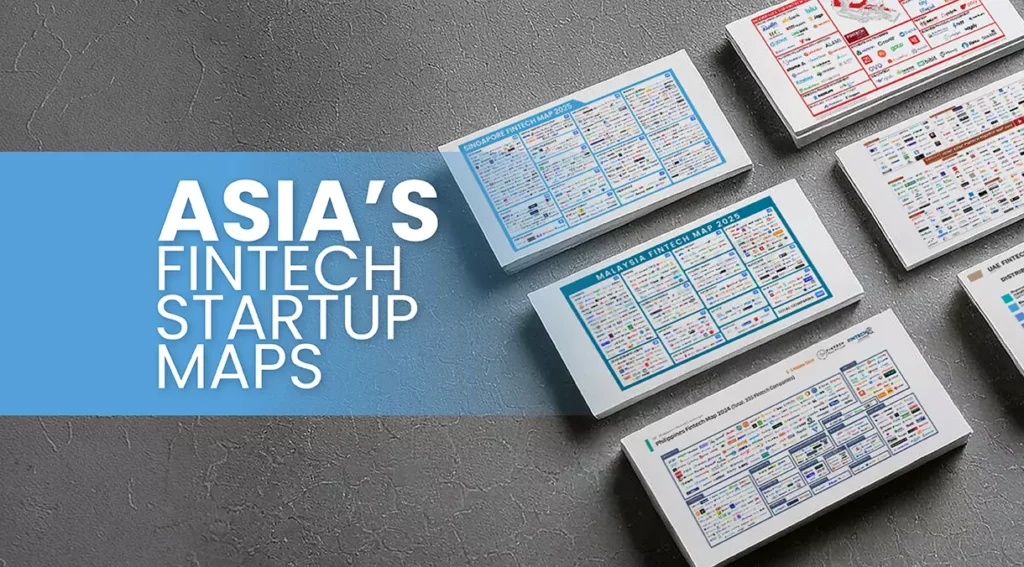
and more fintech reports in Asia by country.
Featured image edited by Fintech News Singapore based on an image by smmedia.io on Magnific