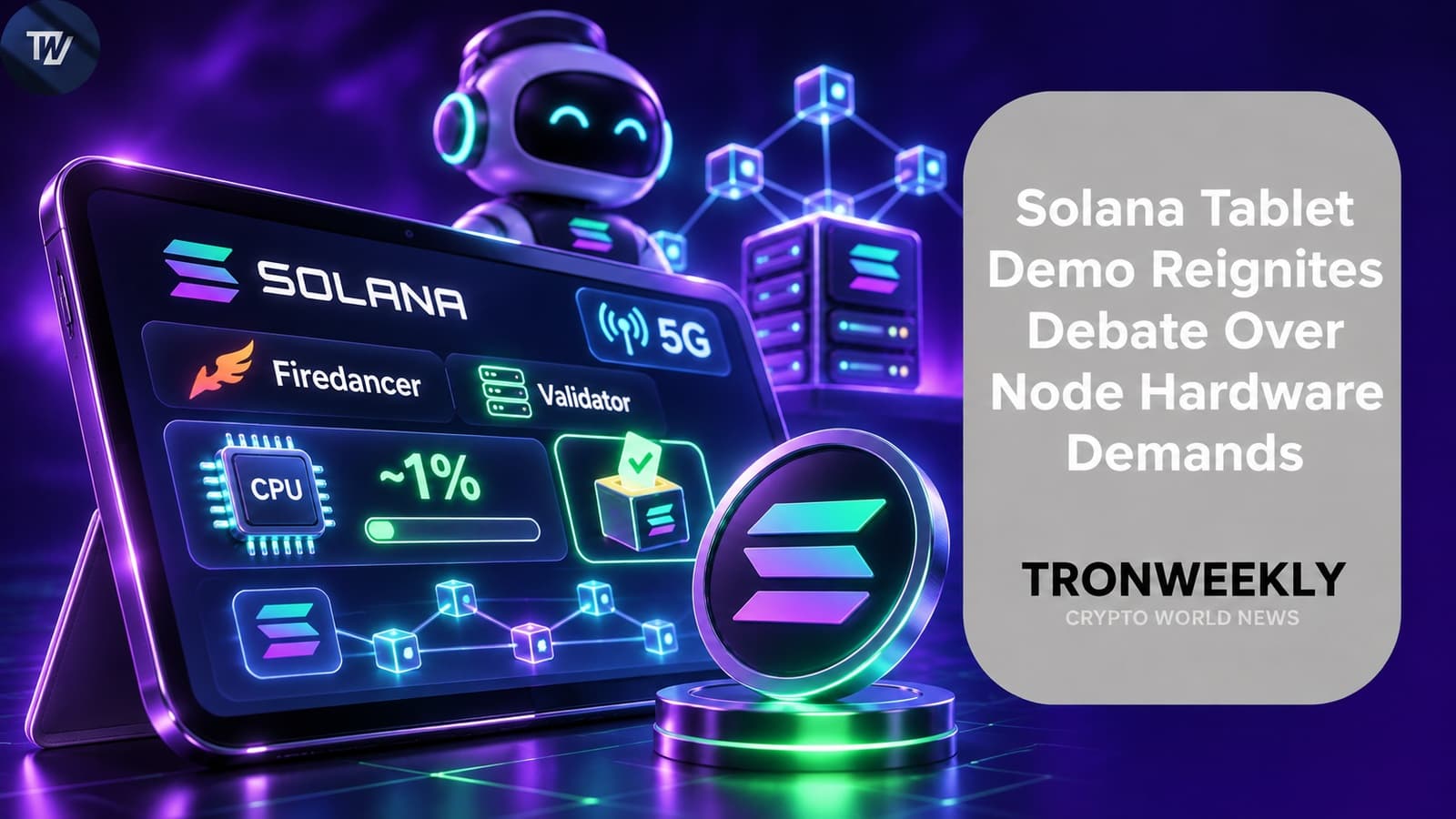
Solana co-founder Anatoly Yakovenko revived a debate over blockchain hardware after a Firedancer developer reported running a mainnet node on a tablet. The setup used less than one CPU core and reportedly reached the latest block within seconds.
Table of Contents
On November 15, Yakovenko answered a 2023 post by Bankless co-founder David Hoffman. He wrote, “We did it,” followed by “sol is money.” Developers had just shared results of the tablet test.
Ritchie Patel, the Firedancer creator, confirmed that the device was connected to the network using 5G connectivity. The report says it took around 10 seconds to sync up with the latest block and start voting.
How the Tablet Ran a Solana Node
Patel also mentioned a Solana mainnet full node working with fewer than one CPU core. He referred to parallel compilation by means of the “make -j” command. The author’s performance report did not include long-term results.
Also Read: Injective Expands US and European Market Access as INJ Price Outlook Improves
Another report from the Block Zero event before Solana Breakpoint 2026 talked about a validator running on one core with 20 GB of memory. The credit for this demonstration goes to engineer Michael McGee. It still required large amounts of memory.
A snapshot is an up-to-date copy of the network state. The node can boot from it without replaying all transactions in history. Hence, the above-mentioned 10-second boot does not refer to booting from the genesis of the chain.
A full node verifies blockchain state. A voting validator takes part in the consensus process. The developers reported that the tablet synced up and started voting. However, the performance under heavy load was not specified.
Firedancer is a separate validator client made by Jump Crypto for Solana. In May, Patel reported that it had handled tens of millions of mainnet transactions. Its gradual rollout proceeded in conjunction with security assessments.
Why Yakovenko Answered a 2023 Critic
In January 2023, Yakovenko made comparisons of the resource requirements of various Ethereum-based networks. He pointed to about 7,000 Ethereum full nodes that were synchronized and 400,000 validators. These numbers referred to various levels of participation.
According to Hoffman, blockchain software should be capable of running on inexpensive computers. Meanwhile, other developers referred to Ethereum software running on Raspberry Pi computers. They asked whether Solana was capable of providing the same.
Yakovenko admitted that hardware efficiency had not been a goal. He believed that a computer with 16GB of RAM and a solid-state drive could receive and validate blocks.
For Hoffman, modest hardware requirements were crucial for any decentralized software. He stated that networks would become less sustainable when individual users would not be able to run their software, referring to minimized blockchains as unstoppable.
The use of the tablet proved that processor requirements were smaller. However, this fact did not prove that all network tasks can be performed by inexpensive consumer computers. CPU usage alone is not enough to prove operational cost requirements.
Production Solana Validators Need More Hardware
Anza suggests a minimum of 12 CPU cores and 256 GB RAM for production validators. The system needs fast storage. For staked validators, the connection speed needs to be at least 2 Gbit/s symmetrically.
There is a difference between the environment of a 5G tablet and that of a server running constantly. This test does not involve voting power and performance during traffic. It does not substitute for any advice on production hardware or evidence of sustained consensus performance.
ARK Invest, in a September report, put the price of Solana RPC, or validator class hardware, at $21,478. They cited the cost of a Bitcoin full node as $289.
Firedancer Work Continues After Network Changes
Alpenglow consensus was launched by Solana in October by switching from on-chain voting transactions to validator communication. Compatibility with Agave software was initially required from the validators. Firedancer and Frankendancer could not be used during the first migration.
Prior to November regulations, Anza required validators to use either Agave 4.4.1 or Firedancer 26.10.6. The message referred to voting validators as well as wallet and exchange nodes. Software compatibility is different from hardware efficiency.
The engineering note of October 29 described memory and network management by Firedancer. Issues related to network information storage as well as VLAN connectivity were fixed. Tablet testing does not demonstrate production efficiency and network handling.
Also Read: OpenAI Unveils ChatGPT Wallet for AI Agent Card Purchases in US
Arslan Tabish is a Technical Reporter and Market Analyst at Tron Weekly with over five years of experience covering cryptocurrency markets and blockchain developments. His reporting focuses on Bitcoin, Ethereum, altcoins, and decentralized finance, alongside NFTs, crypto regulation, policy, and Web3 innovations.
Arslan covers blockchain technology, Layer 2 scaling solutions, and emerging use cases, including AI-driven crypto applications, while delivering clear market analysis on how technical and regulatory developments impact digital asset markets. His work is designed for both beginners and experienced readers, offering accurate, easy-to-understand reporting without speculation or investment guidance.