South Korea Digital Asset Proposal Targets Paid Crypto Advice and Ads
Crypto influencers who sell coin tips or earn exchange commissions in Korea may soon need a government registration.
On November 24, 2026, the Financial Services Commission (FSC) discussed a new law proposal that would reshape the whole crypto industry.
This explains the South Korea Digital Asset proposal and separates what the regulator's own page confirms from what has been reported about the new adviser category.
Source: Wu Blockchain Post
What the FSC Announced on November 24, 2026
According to the FSC's official press release, a Virtual Asset Committee meeting on November 24 discussed a plan to introduce a new legislative proposal on digital assets.
Its goals are to promote innovation and protect users. The release explains that Korea has so far used two laws: one requires service providers to register and follow anti-money laundering duties, and the other protects user assets and fights unfair trading.
The regulator says this approach mostly prevented harm and did not build conditions for a healthy industry.
The South Korea Digital Asset bill has three parts: industry opportunity, a fair and efficient market, and a safe trading environment.
The New Adviser Category: Who Must Register
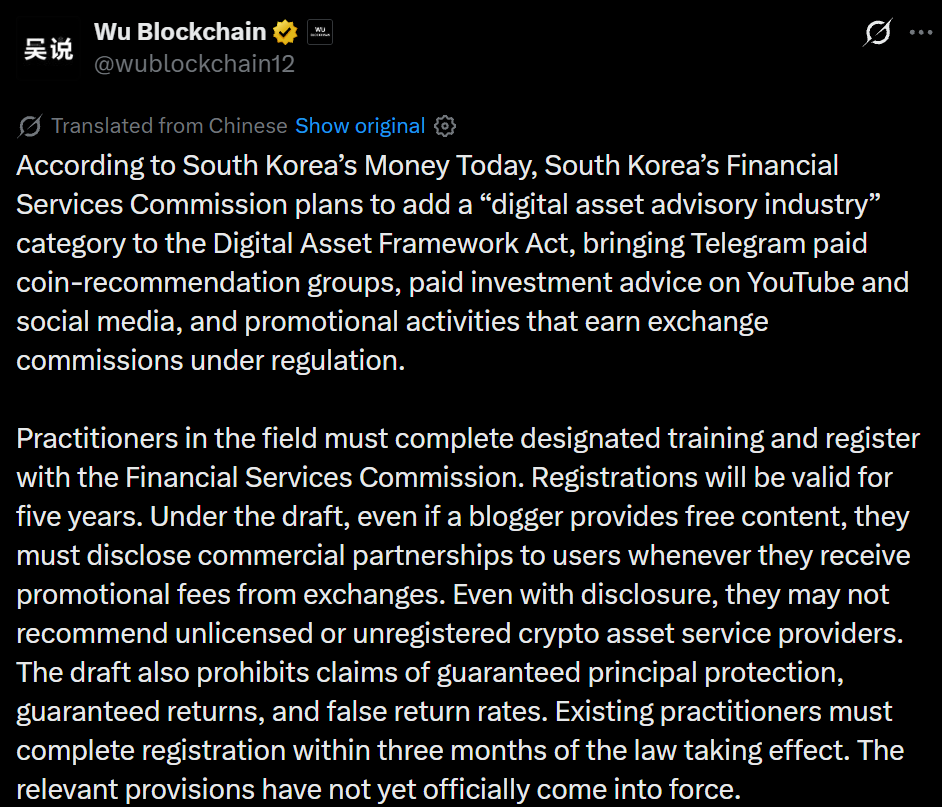
Reports on the draft say a new "digital asset advisory industry" category would be added to the proposed Digital Asset Framework Act.
It would cover paid coin-recommendation groups on Telegram, paid investment advice on YouTube and social media, and promotions that earn exchange commissions.
The South Korea Digital Asset draft would treat these activities as regulated work.
Topic
Reported draft rule
Entry
Complete designated training and register with the FSC
Validity
Five years
Existing practitioners
Register within three months of the law taking effect
Free content
Disclose commercial partnerships whenever exchanges pay promotional fees
Banned
Recommending unlicensed or unregistered providers, guaranteed principal or returns, false return rates
Business Types and Entry Rules
The official release sorts the industry by function, under the principle of "same activity, same risk, same regulation."
Type of provider
Main activity
Entry rule
Trading
Deals on its own account
License
Brokerage
Trades on behalf of others
License
Custody and storage
Holds assets or private keys, offers staking
License
Investment management
Discretionary investing or advice
Registration, KRW500 million minimum capital
Providers handling every token type need at least KRW2 billion in capital, while stablecoin-only providers need KRW1 billion.
Exact amounts will be set by presidential decree later. Companies licensed in trading, brokerage and custody together may be designated as platform operators, which means exchanges.
These operators must also write their own rules for trade execution, token listing, and spotting suspicious transactions.
Stablecoins, Exchanges and Token Sales
The same release covers three market areas:
Stablecoins: Issuers need an FSC license and KRW5 billion in capital. At first, consortiums with more than 50 percent bank ownership may issue them, and fintech firms can be the largest shareholder. Reserves must be at least 100 percent, and no interest can be paid to holders.
Exchanges: Shareholding is capped at 20 percent, or up to 34 percent with FSC approval. Existing exchanges get three years to comply, and smaller ones up to six.
Token sales: Initial coin offerings would be allowed after a white paper is filed with the FSC and accepted. Issuers face strict liability for false or missing information.
User Protection and What Happens Next
Providers would follow the same duties as financial companies, including explaining risks and avoiding unfair solicitation.
They must also keep user assets separate and arrange regular audits. After a hack or system failure, the commission could impose a penalty of up to 10 percent of sales revenue.
It could also freeze accounts or ban trading when unfair trading is strongly suspected, and a whistleblower reward program is planned.
The ban on trading on inside information would also cover former employees who left less than a year ago, and coins still under listing review would fall inside the unfair trading rules.
The regulator says it will actively support the bill's passage at the National Assembly and hopes for quick approval. Until lawmakers pass it, the rules above remain proposals.
The proposal shows how far Korea wants to go: licensing exchanges, tightening stablecoins and, according to reports, putting crypto promoters under registration.
For creators and traders alike, the South Korea Digital Asset rules are worth watching as the bill moves through the National Assembly.
This article is for educational and informational purposes only and is not financial or investment advice. Crypto assets are high risk, their prices can be very volatile, and you can lose some or all of your money. Always do your own research and consider speaking with a licensed financial advisor before making investment decisions.
About the Author Bablu Singh Nirwan
English Blog Writer at coingabbar.com
Bablu Singh Nirwan is a Content Writer with 6 months of experience covering blockchain, cryptocurrency, Web3, and digital finance. He specializes in researching emerging trends, simplifying complex topics, and creating SEO-optimized content. His work focuses on clarity, accuracy, and engaging insights that keep readers informed about the evolving crypto industry.
Frequently Asked Questions (FAQ)