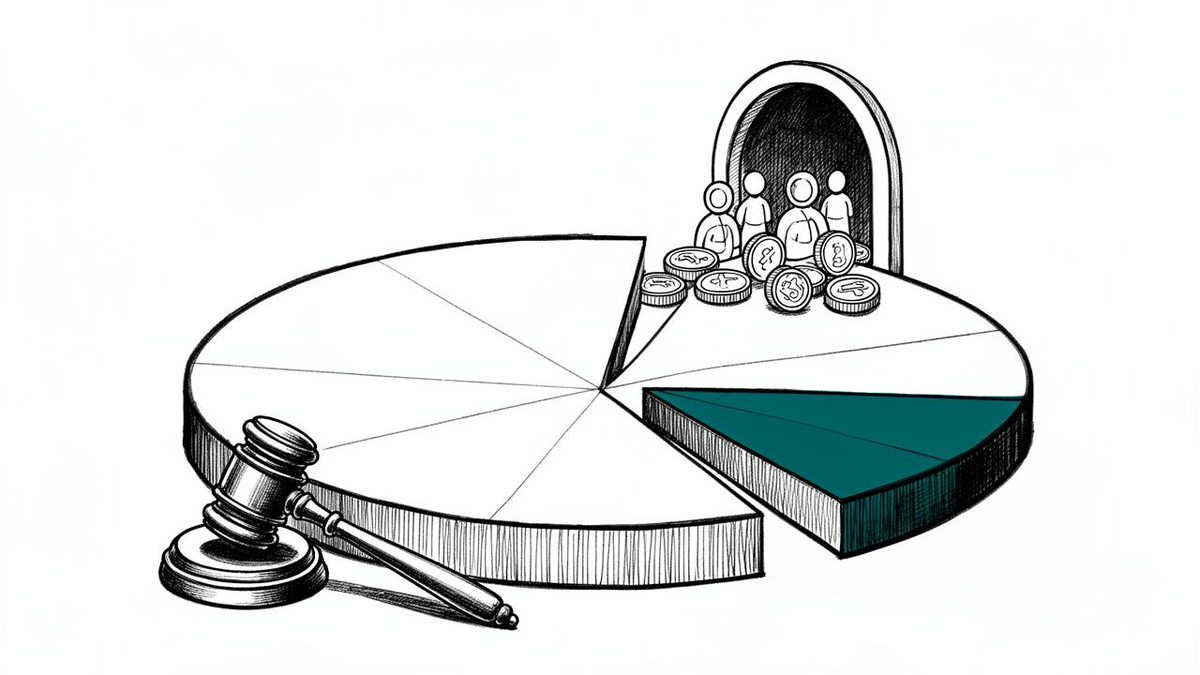
South Korea's financial regulator unveiled a sweeping draft law on Tuesday that would cap major shareholders' stakes in cryptocurrency exchanges, lift a nine-year ban on initial coin offerings and create a licensing regime for won-denominated stablecoin issuers.
The Financial Services Commission's proposal, formally the Act on Innovation in the Digital Asset Industry and User Protection, would in principle hold any single shareholder in a designated digital asset platform operator to 20% of voting shares, with a ceiling of 34% available to investors that obtain separate regulatory approval. Stakes held by related parties would be aggregated, and holdings above the limit would carry suspended voting rights plus corrective orders. The bill does not, however, include a provision forcing investors to sell excess shares.
Existing exchanges would get three years from the date they are designated as platform operators before the ownership rules bite, with smaller venues potentially qualifying for up to three additional years. The government plans to set the market-share threshold separating small exchanges from large ones in consultation with lawmakers and the industry.
"We judged that the public nature and neutrality of virtual asset exchanges are important at this point," Yoo Young-joon, head of the commission's virtual asset division, said at a briefing, citing more than 10 million accounts opened at Korean exchanges. "We need ownership dispersion rules to raise publicness and neutrality."
The 20% figure mirrors the ownership cap applied to alternative trading systems under the capital markets law, while the 34% exception is modeled on the limit for internet-only banks -- a level that also lets a holder block special resolutions at a shareholders' meeting. Officials said the constitutional concerns raised by the National Assembly's legislative research service had been reviewed internally and that the matter would be fully debated in parliament.
Stablecoins and token sales
Under the draft, won-backed stablecoin issuance would initially be confined to bank-led consortiums in which lenders collectively hold a majority. A fintech or technology company could still take the single largest individual stake, officials said, pointing to a hypothetical structure in which four banks hold 15% each, a fintech holds 30% and other investors hold the remaining 10%. Issuers would need a license, paid-in capital of at least 5 billion won (approximately $3.7 million) and regulatory approval of a issuance plan covering supply limits and reserve management.
Reserves would have to be deposited or placed in trust with a custodian bank equal to at least 100% of tokens outstanding, with holders entitled to redemption in cash of equivalent value. Tokens exceeding 1 trillion won (approximately $744.7 million) in circulation would be classified as "major" stablecoins and face additional capital and liquidity requirements. The Bank of Korea would gain the right to demand data and joint inspections, and a tripartite consultative body including the finance ministry would oversee total supply and reserve composition.
Foreign issuers such as Circle Internet Group and Tether would be able to issue or redeem won stablecoins through a local branch registered with the commission, while existing dollar tokens could circulate domestically after meeting registration requirements to be spelled out in an enforcement decree.
The bill also ends a prohibition on domestic token sales imposed in September 2017. Issuers, developers, project teams and arrangers would have to file a digital asset white paper with the commission disclosing the amount issued, use of proceeds and risk factors, alongside a summary prospectus for retail users. Exchanges would face parallel disclosure duties for assets they list, including trading support reports and immediate notice of hacks, supply changes or system failures. Omissions or false statements would trigger damages liability, fines and criminal penalties.
Governance and market conduct
Exchanges would be required to seat outside directors in a majority of board seats, establish audit committees and compliance officers, and absorb into formal operating rules the listing, matching and market-surveillance functions currently handled by the industry's self-regulatory body, DAXA. Officials said DAXA's rules could be converted into exchange operating rules but that it was too early to say whether the group would become a statutory association.
A separate draft published the same day would extend financial-institution-grade internal controls and IT security standards to crypto operators, make them strictly liable for user losses from hacks or outages, and allow punitive surcharges of up to 10% of revenue. It would also widen unfair-trading rules to cover tokens under listing review and coin-to-coin trades, treat former insiders as insiders for a year after they leave, allow account freezes of up to six months in suspected manipulation cases and bar suspects from opening accounts for up to five years. A leniency program and whistleblower rewards would be introduced.
Existing operators would have to reapply for licenses under the new framework within a prescribed period, and the law would take effect one year after promulgation, with stablecoin issuance possible only after licensing and product approval.
Note: Currency conversions are approximate.
Market impact
The proposal lands squarely on Korea's two dominant exchanges, Upbit operator Dunamu and Bithumb, whose founding shareholders have long held controlling stakes. A 20% to 34% ceiling could force restructuring at both companies, and the commission said it would examine major shareholders and specially related parties, including friendly holdings such as those of co-founders, when drafting the enforcement decree. The regulator declined to comment on specific companies, but the framework has been widely read as touching Dunamu's ties to Naver Financial.
The bank-first approach to won stablecoins hands the country's lenders an early advantage in a market where dollar tokens dominate, while leaving fintech entrants waiting for a second phase. For global issuers, the registration route preserves access to Korean trading volumes but adds a local licensing layer.
For investors, the bill's most immediate effect is the reopening of domestic token sales under a disclosure regime modeled on securities filings, which could revive a primary market dormant since 2017. Crypto-related equities and exchange-linked shares may see volatility as parliament takes up the bill, since key questions -- including whether ownership limits apply at the holding-company level and how friendly stakes are counted -- have been deferred to legislative debate and subordinate rules.
The commission forecast that the framework would raise trust and transparency in the domestic market. "The bill will serve as an opportunity to enhance the credibility and transparency of our digital asset market and lift the industry's competitiveness a step higher," Chairman Lee Eok-won said, adding that he expected it to contribute to fostering new industries and job creation through fresh capital inflows.
Once added, BigGo Finance appears first in Google Search Top Stories, so you get the broadest, most up-to-the-minute, and most comprehensive global financial news first.


