PiCK
Summary
- The National Assembly and financial authorities said they would swiftly submit the government’s draft Digital Asset Basic Act and support the transition to an institution-led digital asset market through bipartisan agreement.
- Experts said the key to opening the corporate market is not the simple inflow of institutional funds, but the buildout of financial infrastructure such as reliable custody and settlement and market making.
- The financial industry called for regulatory improvements and broader testing opportunities, including tokenized securities (STO), conditional licensing, regulatory sandboxes, and rules defining liability in response to hacking incidents.
Forecast Trend Report by Period
National Assembly, FSC Push Swift Legislation of Digital Asset Basic Act
Experts Say Trust Infrastructure Is Needed to Deploy Institutional Capital
Financial Industry Urges Conditional Licensing, Regulatory Changes
South Korea’s National Assembly and the financial industry agreed that stronger financial infrastructure and regulatory improvements are needed as the digital-asset market shifts toward institutional participation.
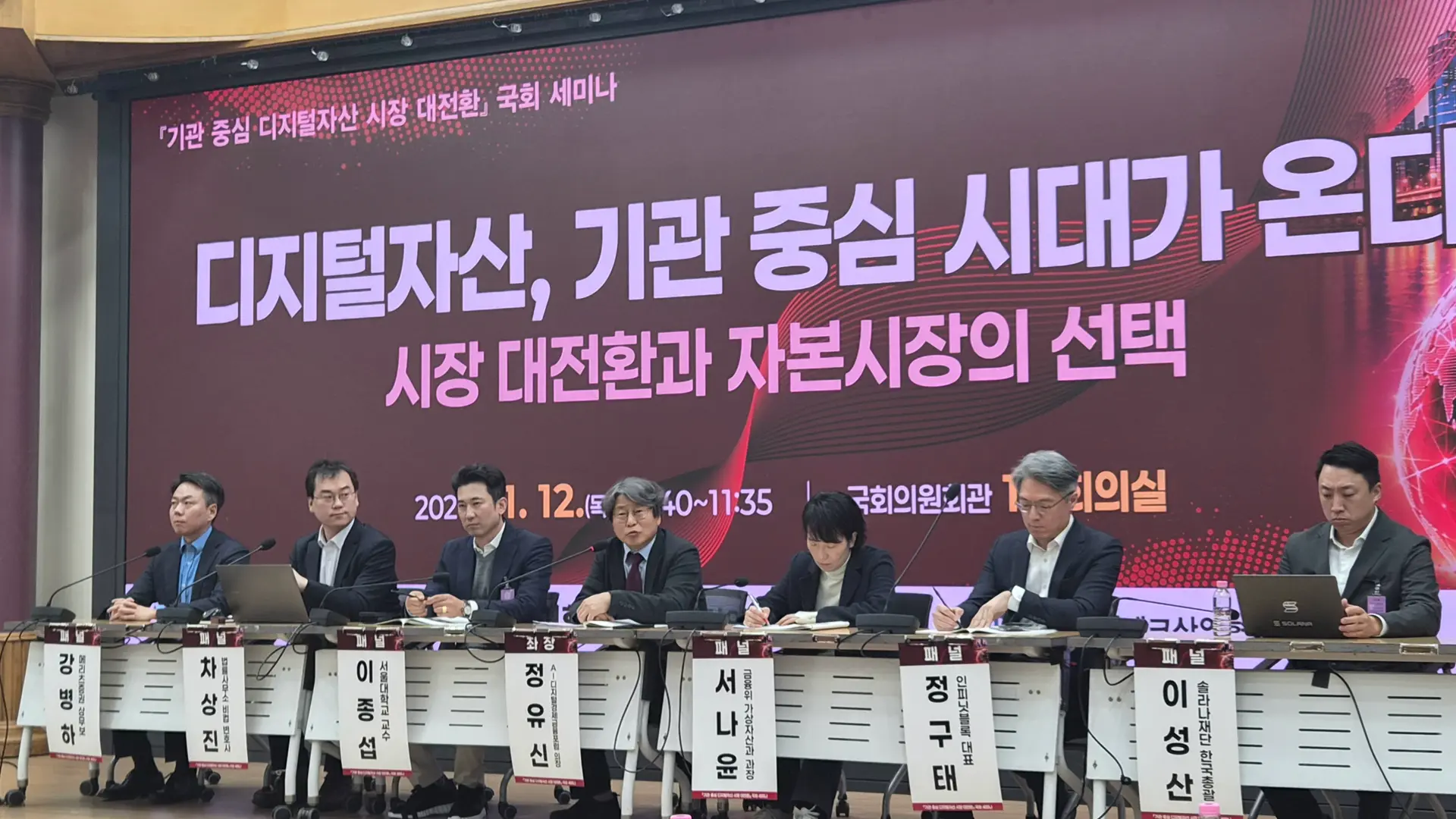
At a seminar titled “Digital Assets: The Institutional Era Arrives” held on Nov. 12 at the National Assembly Members’ Office Building in Yeouido, Seoul, participants discussed broader corporate participation in the digital-asset market, the buildout of financial infrastructure, related legal and regulatory changes, and investor protection.
Speakers said the priority should go beyond simply attracting institutional money to securing trust infrastructure, including market liquidity, custody and settlement.
National Assembly, FSC Stress Faster Basic Act, Broader Institutional Participation
Rep. Choi Eun-seok of the ruling People Power Party, who hosted the seminar, said broader institutional participation in digital assets is about more than a shift in the investor base.
It reflects a restructuring of the financial industry and its competitive landscape as new technology and financial methods merge with traditional capital markets.
Choi said the key is not only to introduce systems at a pace that matches the change, but also to set a consistent policy direction that can respond to a new financial order. He added that South Korea needs to create conditions that allow the industry to prepare for the future from a long-term perspective.
Rep. Yoo Dong-soo of the main opposition Democratic Party, chair of the National Assembly’s Political Affairs Committee, underscored the importance of bipartisan agreement to quickly enact the Digital Asset Basic Act. He said the government’s draft bill is expected to be submitted to the National Assembly soon.
Yoo added that he would work to ensure the framework is properly crafted on the basis of bipartisan consensus. He also said the system must be balanced enough to protect financial consumers while supporting the industry’s growth and competitiveness.
Financial authorities also reaffirmed plans to speed work on the government’s draft Digital Asset Basic Act. Shin Jin-chang, vice chair of the Financial Services Commission, said the agency would accelerate efforts to submit the bill to the National Assembly as quickly as possible after comprehensively reviewing issues discussed at the seminar and elsewhere.
He also said the government would strengthen transparency in digital-asset issuance and distribution, along with security and IT safety. Authorities will pursue a phased market opening in line with the roadmap for corporate participation announced in February 2025, he said.
Experts Call for Institutional Infrastructure as Finance Industry Presses for Rule Changes
Presentations at the seminar focused on building financial infrastructure for the efficient use of institutional capital, expanding market participation, establishing a system for tokenized securities and improving regulation.
Lee Jong-sub, a professor at Seoul National University’s business school, said the core of opening the corporate market is not simply attracting more money but using institutional capital efficiently.
The real value of opening the market should not be judged solely by whether institutional inflows increase in size, Lee said. The focus should be on whether that capital can be used efficiently and productively through trusted infrastructure.
To make that possible, the market needs professional market-making, price and information infrastructure, digital payment and settlement systems, and management and supervisory frameworks, he said.
Koo Tae-in, chief executive officer of InfinitBlock, said trust in an institution-led digital-asset market will require broader cooperation between financial companies and virtual-asset service providers, the introduction of conditional licensing, and pilot programs for new services through financial regulatory sandboxes.
Referring to recent hacking incidents, Koo said authorities need to clarify not only technical safety standards but also the scope of operators’ liability and their internal control systems. He added that the domestic market structure, concentrated in a small number of won-based exchanges, needs to be improved and that specialist firms should be supported in entering the market.
Kang Byung-ha, a managing director at Meritz Securities, said the digital-asset market is shifting from one led by retail investors and exchanges to one driven by financial institutions and corporations. He pointed to tokenized securities, or STOs, as a key area in that transition.
If South Korea falls behind in introducing tokenized securities, domestic capital could flow out without creating channels for overseas capital to come in, Kang said. He called for a regulatory framework that meets global standards.
Kang also pointed to a regulatory environment that makes it difficult even for domestic financial firms to conduct small-scale test transactions. He said authorities should expand opportunities to verify the safety of new financial products.
Financial authorities said the industry requests raised at the event would be reviewed during discussions on the Digital Asset Basic Act. Seo Na-yoon, head of the Virtual Asset Division at the Financial Services Commission, said key review items include the roles of market makers and liquidity providers, as well as ways to expand cooperation between financial companies and virtual-asset service providers.
Seo added that authorities are reviewing ways to set rules in the bill on security management and operators’ liability in the event of hacking incidents. She said the bill would be prepared as quickly as possible so it can be discussed in the National Assembly.
Suehyeon Lee