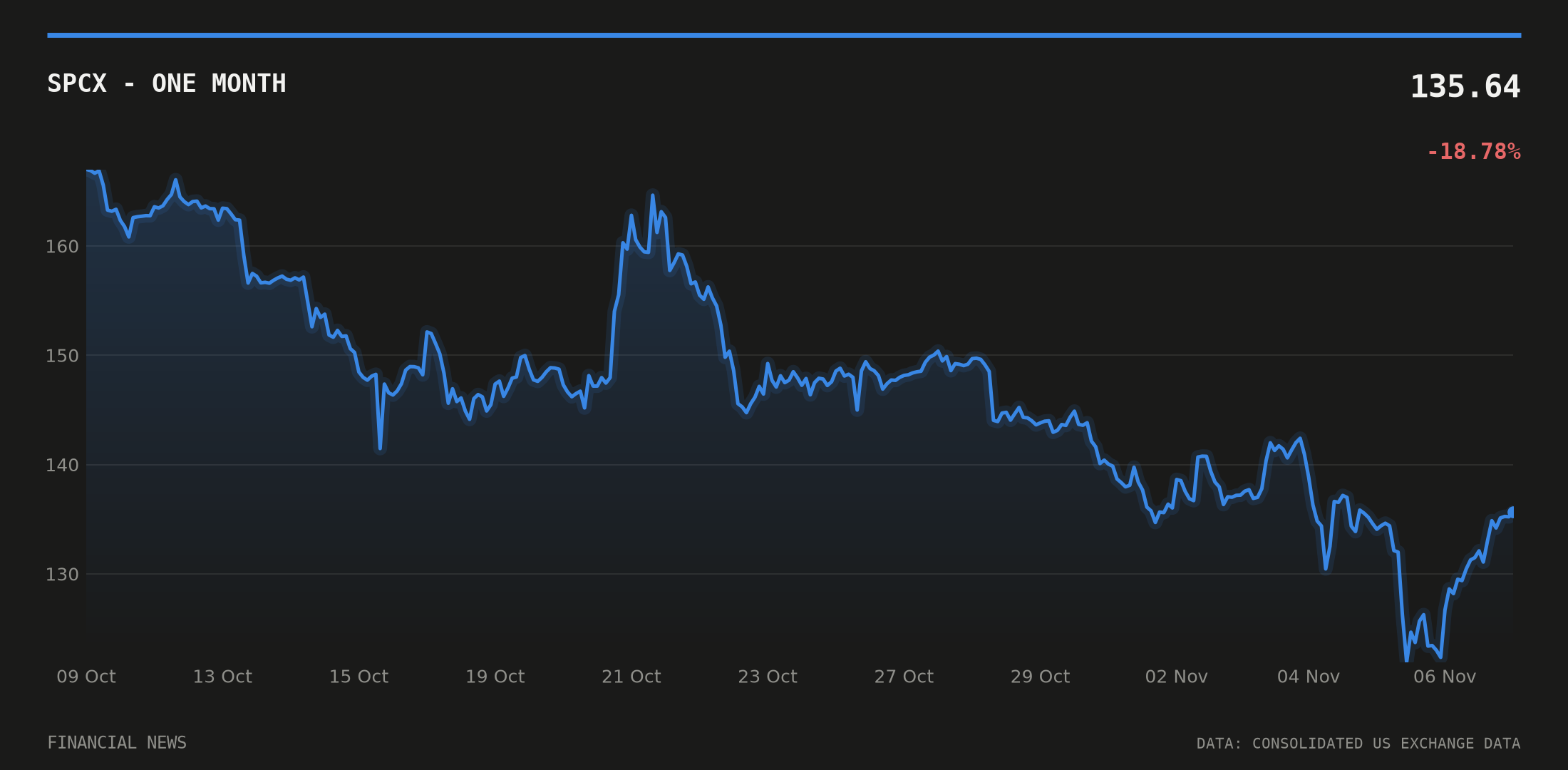
SpaceX (NASDAQ: SPCX) faces its largest lockup expiration since June’s record-breaking IPO on 8 December 2026, when the main 180-day restriction on insider share sales lifts. The event is the last of 17 scheduled release steps written into the IPO prospectus dated 11 June 2026.
Roughly 1.3 billion shares already came free in an October tranche alone – stock worth about $176bn at Friday’s close of $135.64, according to lockup-tracking data and consolidated exchange pricing. That gives a sense of the scale moving through the float before the December date even arrives.
What the SpaceX lockup expiration actually releases
SpaceX listed on 12 June 2026 in what was billed as the biggest IPO on record, with shares closing up 19% at $161 on debut, as CNBC reported at the time. The standard 180-day lockup that followed is now entering its final phase.
Ahead of the 8 December date, SpaceX had already released 328.4 million shares on 9 October, roughly 1.3 billion more on 22 October, and a further 328.4 million on 24 October, according to lockup-calendar tracking. Coverage from Fool.com has framed the December release as ‘nearly the biggest share unlock in IPO history’ – a comparison that could not be matched against any primary ranking of historical lockups and should be treated as a media characterisation rather than a confirmed record.
What is documented is the mechanics: SpaceX’s registration structured the unwind in stages rather than a single cliff-edge release, which is one reason the float has been absorbing new supply since October rather than all at once in December.
Short sellers aren’t positioning for a drop
If traders expected the unlock to crush the share price, positioning data doesn’t show it. FINRA’s daily short-sale volume data put SPCX’s short-sale ratio between 0.377 and 0.573 across the ten trading sessions from 26 October to 6 November – a range that shows no build-up in bearish bets heading into the lockup.
The stock itself has been choppy rather than collapsing. SPCX closed at $135.64 on 7 November, up 3.48% on the day but down 7.95% over the preceding 20 trading sessions, having ranged between $121.92 and $164.64 in that window, according to consolidated exchange data. Trading volume sat only marginally above its 20-day average, at 1.04 times the norm – not the signature of panic selling.
From quarterly loss to a sharp profit swing
The lockup clock is ticking against a backdrop of volatile but improving underlying numbers. SpaceX’s 10-Q filing for the quarter ended 30 June 2026 showed revenue of $7,814m and a net loss of $541m, or 9 cents a share diluted, filed with the SEC on 4 August 2026.
The following quarter told a different story. For the three months to 30 September 2026, SpaceX reported revenue of $14,575m and net income of $4,404m, or 35 cents a share diluted, according to the 10-Q filed on 22 October 2026. Revenue nearly doubled quarter on quarter, and the company swung from loss to a substantial profit inside three months.
That swing gives early shareholders – many of whom have now held unlockable stock since June – a stronger earnings backdrop than the one that greeted the IPO, even as the share price sits well below its 20-day high.
What comes next
The 8 December date is now the clearest marker on the calendar for SPCX watchers. Whether the remaining lockup tranches trigger selling pressure, or continue to be absorbed as October’s releases were, will likely depend on how holders – not just short sellers – choose to act once restrictions lift. FINRA’s short-sale data, updated daily, remains one of the more direct ways to track whether that calculus changes before the date arrives.
This article is for information only and is not investment advice or a recommendation to buy or sell any asset. Markets move quickly; figures are correct as sourced at the time of writing. Always do your own research before making financial decisions.