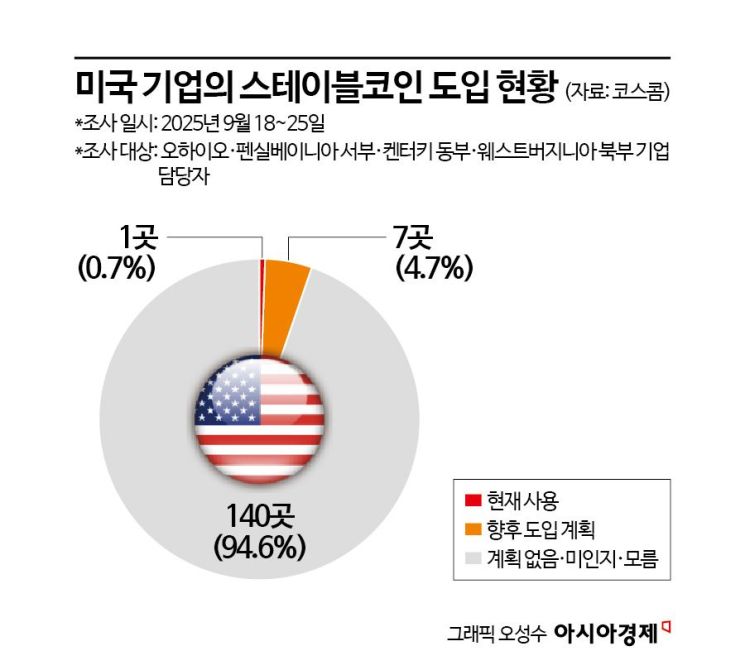
U.S. stablecoin adoption rate remains just above 5%
System integration and costs remain major hurdles
Likely to gain traction through existing financial networks, including credit cards
The issuance of stablecoins and payment infrastructure are expanding rapidly. However, adoption by mainstream businesses remains limited by unclear economic benefits compared with existing payment methods and the burden of system integration. Analysts say future market growth is likely to depend more on securing genuine business demand than on expanding supply.
According to KOSCOM on Nov. 5, a survey released in September 2026 by the Federal Reserve Bank of Cleveland found that of 148 participating businesses, only one was currently using stablecoins and only seven said they planned to adopt them. The survey covered a limited set of businesses and regions, and its figures combine current use with planned adoption, so they cannot be generalized as the adoption rate among all U.S. businesses. Even so, the findings can serve as a reference point showing that expectations on the supply side do not automatically translate into business demand.
Businesses’ reluctance to adopt stablecoins comes down to pricing and integration challenges. Last month, U.S. payments publication PYMNTS noted that the stablecoin industry’s key challenge was securing business demand, not a lack of supply. KOSCOM pointed out that businesses hesitate to adopt stablecoins because of unclear economic benefits and operational burdens, rather than technology.
When evaluating a new payment method, businesses consider not only processing speed but also fees, the ability to recover funds, accounting treatment, internal controls, and whether counterparties will accept it. Even if stablecoins support 24-hour fund transfers and rapid settlement, incentives to adopt them will remain limited unless they demonstrate an advantage in total costs or operational efficiency. In addition, integrating payments with treasury management systems (TMS), enterprise resource planning (ERP) systems, accounting, and regulatory compliance procedures can involve additional costs and operational burdens. Accordingly, a key consideration is how seamlessly stablecoins can be integrated into existing corporate financial operations.
Insufficient demand from counterparties is also seen as a structural constraint on wider adoption. Business-to-business payments depend not only on whether the sending company uses stablecoins but also on whether the recipient accepts them. If the recipient does not want stablecoins or needs to convert them immediately into fiat currency, additional conversion and redemption steps may reduce the expected efficiency.
KOSCOM stressed that market growth and business adoption rates should be assessed using different indicators. Outstanding issuance, on-chain transaction volume, and payment processing volume, commonly used to gauge growth potential, respectively indicate supply, fund transfers on the blockchain, and payment activity classified according to specific criteria. It is difficult to interpret all three as measures of the same economic activity. On-chain transaction volume may include transfers between exchanges, transfers between a company’s own wallets, and liquidity reallocations that do not involve purchases of goods or services. High transaction volume does not necessarily mean that businesses are making more payments using stablecoins. Surveys of adoption intentions and payment activity statistics also measure different things. To assess market maturity, it is necessary to consider together the number of businesses using stablecoins for payments, the share of recurring transactions, the value of business payments, and cost savings compared with existing payment methods.
Stablecoins are seeing increased use in some payment areas. Blockchain data provider Allium said in its third-quarter report, released on Oct. 15, that payment volume from January through September 2026 reached $482 billion, up 45% from the same period a year earlier. Payment volume for September alone hit a monthly record of $72 billion. Visa said it had more than 160 stablecoin-linked card programs and that transaction volume had increased by about 200% year over year. It also reported that business and commercial card programs accounted for about 17% of transaction volume on stablecoin-linked cards. However, these figures are based on Visa’s stablecoin-linked card transactions and should not be interpreted as the penetration rate across the entire business payments market. KOSCOM analyzed that the cases of Allium and Visa suggest demand may be concentrated in certain payment environments rather than being uniform across all businesses. These include cross-border fund transfers, payments to overseas business partners, and transactions affected by limits on the operating hours of existing financial networks.
Ultimately, wider business adoption is likely to depend on the extent to which stablecoins are integrated with existing financial systems. Business payments require multiple stages to work together, including issuance, transfers, receipt of funds, conversion into fiat currency, accounting, and regulatory compliance. This is why existing financial institutions and payment providers remain important. The burden of adoption would be reduced if businesses could benefit from stablecoin payments through existing financial services without having to build their own digital asset operating systems. Global payment providers such as Visa are also seeking to connect stablecoins with existing payment networks in response to business demand. The market is expected to develop by integrating with existing banking and payment infrastructure, rather than growing solely through independent blockchain payment networks.
Hot Picks Today
- The Era of Getting 200 Million Won After 30 Years Is Over... A Japanese Bank's "Perpetual Department Head" Who Just Clocked In Cries Out
- Spain Hit by Its Worst Tragedy... Lee Kangin, Moreno and Real Madrid Join Soccer World in Mourning
- They Said, “Make It Your Home for Life” - Then Suddenly Kicked 200 Passengers Off... What Happened to the Around-the-World Cruise?
- "130 Rice Bowls Sold Out in a Day"... 'Unfiltered Face' Adds 8 Million Won to Night Market Sales: China's Bungeunwoo
KOSCOM said, “The sustainable growth of the stablecoin industry depends not on expanding issuance or technological infrastructure, but on whether businesses can secure clear economic incentives to replace existing payment methods. Financial institutions and payment providers need to assess business viability in payment areas where genuine demand exists.”
© The Asia Business Daily. All rights reserved. Unauthorized AI training and use prohibited.