For businesses already routing cross-border invoices through stablecoin payments, the November 4 news out of Washington landed differently than for the broader crypto market. Democrats swept the midterms, yet the same day industry experts told CoinDesk that tokenization and stablecoin payment businesses could keep advancing under existing laws (Cryptonews.net, November 4, 2026). That reframes the next 90 days for any finance lead or founder treating stablecoins as a settlement tool, not a speculative asset.
Table of Contents
- What just happened after the 2026 midterms
- Why stablecoin payments stay on existing rails
- Background: what an operator needs to know about payment stablecoins
- The decision framework: what this means in the next 90 days
- Fee and speed math: stablecoin settlement vs wires and FX
- What to watch next and open questions
- Key Takeaways
What just happened after the 2026 midterms
The dated news signal and what it didn’t say
On November 4, 2026, a CoinDesk report aggregated by Cryptonews.net quoted Peter Curley of Ondo Finance and Aaron Kaplan of Prometheum making the same case: tokenized securities and stablecoin payments already have an existing regulatory path. Curley said the SEC and CFTC “have already made substantial progress without new legislation.” For payment stablecoins, transfer and settlement activities that don’t require new securities-law rulemaking can keep operating under the anti-money-laundering, money-transmitter, and sanctions frameworks already applied. The same report stressed that Washington’s broader digital-asset agenda faces a tougher landscape after the Democratic sweep (Reuters, November 4, 2026). A comprehensive crypto market-structure bill is dimmer. But stablecoin payment regulation 2026 is not riding on a single big bill; it’s built on existing agency authority, state money-transmitter licenses, and federal stablecoin frameworks like the GENIUS Act.
Did the 2026 midterms change stablecoin payment rules?
No. The midterms did not alter any payment-specific stablecoin rule. The OCC, state regulators, and FinCEN continue to apply the same compliance obligations to fiat-backed stablecoin transactions that apply to money transmission. What changed is the political likelihood of new, separate crypto-wide legislation, while payment stablecoins midterms commentary confirms existing rails are sufficient for operators who already meet KYB, transaction-monitoring, and sanctions-screening standards.
Why stablecoin payments stay on existing rails
A payment stablecoin—typically a dollar-pegged instrument like USDC—functions as a bearer claim on high-quality liquid reserves, settled on a blockchain in minutes. That separates it legally and functionally from volatile tokens. This divide is why the November 4 statements singled out stablecoins as less vulnerable: they are already mapped onto money-transmitter law.
Any business using stablecoins for payments must maintain the same compliance infrastructure as a money-services business: customer identification, sanctions screening, transaction monitoring, and suspicious activity reporting. There is no “stablecoin loophole.” That’s why the GENIUS Act codifies a baseline that many stablecoin payment compliance programs already meet: 1:1 reserve backing, monthly attestations, and redemption policies.
What compliance steps are required for stablecoin business payments?
Before the first vendor payment, complete KYB on the paying entity and the beneficiary; screen both against current OFAC and sanctions lists; implement transaction monitoring tied to wallet addresses and on-chain transaction hashes; keep an audit trail of reserve attestations and off-ramp records; and file suspicious activity reports when required. If you maintain a public Webflow blog for payment policy updates, Joyrise plans, writes and publishes illustrated SEO articles to your Webflow blog every day and lets you read your first article before you pay.
The unresolved layer is separate. A central bank research note treats payment stablecoins as a potential run-risk and monetary-policy question, while issuers like Circle present them as mature institutional settlement rails. Both can be true at different layers. Systemic-policy concern doesn’t change day-to-day operational reality for a mid-market business paying a supplier in Colombia. A treasurer managing a USDC wallet faces settlement finality, not monetary policy. Demand reserve attestations and issuer transparency, and treat stablecoin settlement rails like any other third-party payment infrastructure.
Can stablecoin payments continue under existing laws?
Yes. Stablecoin payments remain legal for businesses that comply with KYB, AML, and sanctions requirements, provided they use a regulated on/off-ramp and avoid prohibited jurisdictions. The Stablecoin Regulation: OCC Final Rules Impact page details how the OCC has clarified that national banks can participate in stablecoin payment networks.
Background: what an operator needs to know about payment stablecoins
When you send USDC to a vendor’s wallet, the transaction settles on-chain in seconds. The funds are backed 1:1 by reserves, and the vendor can redeem USDC for local fiat through an exchange or a platform supporting fiat to USDC conversion—often within hours. In correspondent banking, the same cross-border payment might touch three intermediary banks, take two to four business days, and incur unpredictable FX markups. Stablecoin rails collapse that to a single step with transparent fee and known FX rate.
For corridors with thin banking relationships, high intermediary fees, or lengthy settlement cycles, stablecoin cross-border payments deliver speed and cost predictability. A May 2025 test from Colombia showed a USDC settlement reaching the beneficiary in under two hours, with total cost of roughly 0.5% including on-ramp and off-ramp fees (Stablecoin Payments: USDC Settlement Test in Colombia). A traditional wire to the same market often cost 3–5% in total FX and fees and took three days. That means a parallel settlement rail without a multi-currency bank account in every destination country: hold USDC in a single account, pay suppliers directly to wallets, and let suppliers handle final fiat conversion locally.
The decision framework: what this means in the next 90 days

After the November 4 signal confirmed stablecoin payment regulation 2026 remains anchored in existing law, use this framework.
Step 1: Map high-friction payment corridors. List every cross-border route where settlement takes more than two days or total costs exceed 2% of invoice value. Mark routes where the beneficiary country already has active crypto exchanges or stablecoin on-ramps.
Step 2: Choose a fiat-plus-stablecoin account structure. You don’t need a traditional bank. A crypto-friendly business account combining fiat sub-accounts with free USDC deposits and withdrawals—like OneSafe, which supports free USDC transfers, ACH, wire, FX, and a 0.15% fiat deposit/withdrawal fee—can replace multiple banking relationships. Free on-chain USDC transfers keep settlement costs negligible.
Step 3: Set role-based permissions and custody before scaling. Designate at least two authorized signers, set daily transfer limits, and require multi-factor authentication for every withdrawal. Use institutional-grade custody, such as Fireblocks, so no single individual holds the private key.
Step 4: Keep compliance evidence as current as your KYB. Retain the beneficiary’s verified identity, a sanctions screening log timestamped within 24 hours of the transaction, the on-chain transaction hash, and the off-ramp fiat record. Match the standard you keep for a wire transfer.
How do I start using stablecoin payments without a bank?
Open a crypto-friendly business account with a multi-currency wallet, USDC on/off-ramps, and compliance infrastructure. Fund a USDC wallet from fiat, send a small test payment to a known beneficiary wallet, verify settlement time and fee, then document the process. KYB onboarding can be completed within a week with a provider that streamlines digital onboarding; no bank branch visit is required.
Fee and speed math: stablecoin settlement vs wires and FX
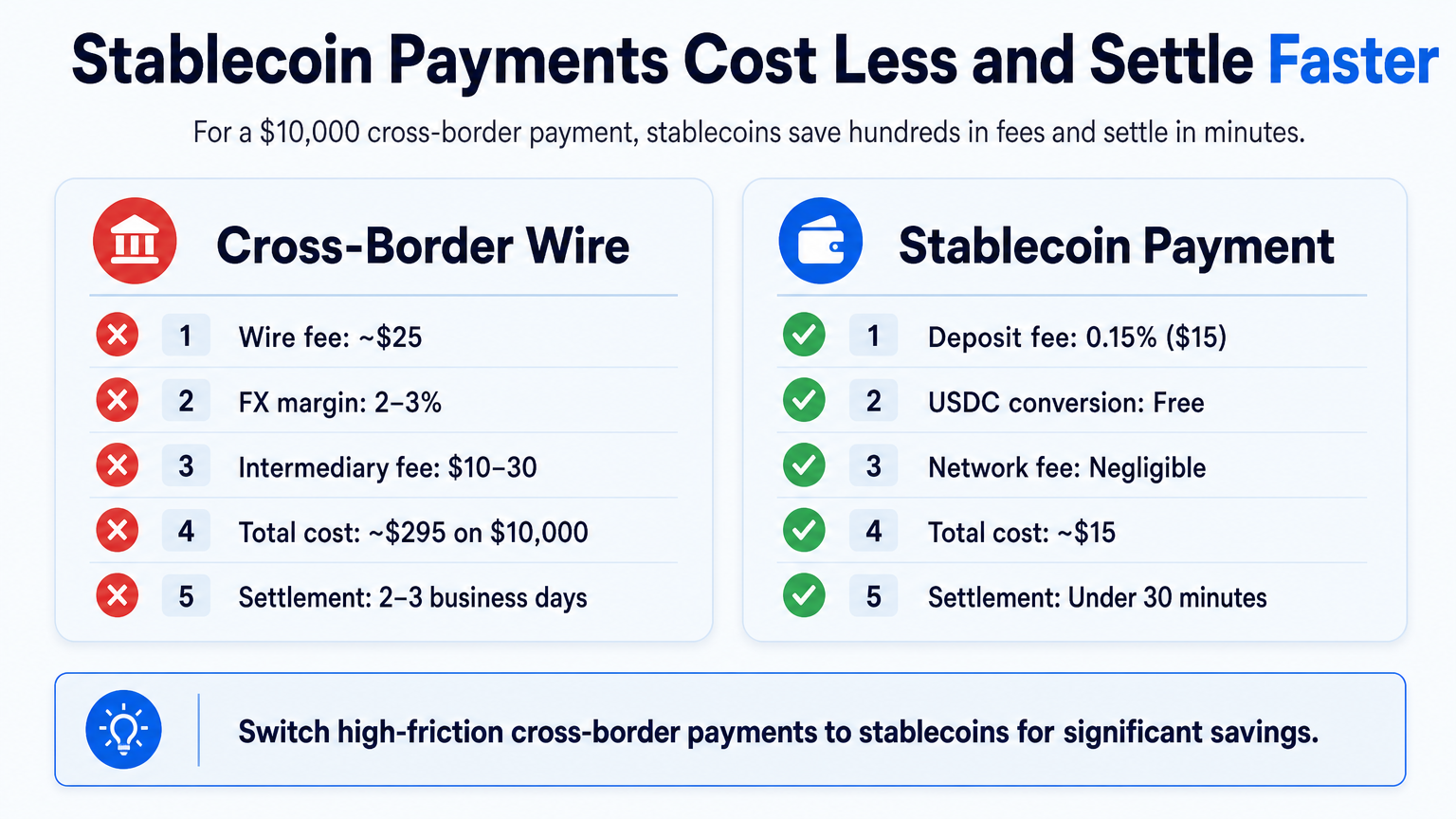
For a $10,000 invoice to a supplier in Mexico, a traditional wire might cost $25 in wire fees, apply a 2.5% FX margin, and deduct $20 intermediary fee: $295 total, settling in 2–3 business days. A stablecoin route via a fiat-plus-stablecoin account costs 0.15% to deposit ($15), converts to USDC free, sends on-chain with negligible network fee, and settles in under 30 minutes. The difference narrows if the supplier can’t off-ramp cheaply, but the business side still avoids the FX spread and correspondent-bank drag.
Stablecoin payment fees are dominated by on/off-ramp costs. With free USDC transfers, the variable cost is the fiat conversion percentage, often 0.15%–0.25%, or a flat fee. Cross-border wires bundle a flat fee ($10–$50), SWIFT intermediary charge ($10–$30), and 1%–3% FX markup. For payments above a few thousand dollars, stablecoin is consistently cheaper.
Assumptions: platform fees like 0.15% deposit/withdrawal, free USDC, $25 wire withdrawal fee. Actual costs vary by provider and destination.
What to watch next and open questions
Agency guidance and whether a federal payment stablecoin framework arrives
The OCC’s notice of proposed rulemaking from early 2026 and ongoing staff guidance remain the most concrete federal signal. The GENIUS Act payment stablecoins pathway could still pass as a standalone bill detached from broader crypto legislation—watch committee markups in Q1 2027. The practical impact would be a single federal reserve-and-redemption standard rather than the current state money-transmitter patchwork.
State restrictions and OFAC scope
Some states, including New York, maintain their own BitLicense and stablecoin listing requirements. A Democratic-led Congress may strengthen sanctions-related enforcement. Expect OFAC to add more specific stablecoin-wallet screening obligations. Your compliance partner must update screening lists daily and match every transaction hash to those lists.
Reserve transparency and redemption risk
If an issuer’s reserve composition shifts or daily redemptions spike, payment operators could face a temporary liquidity mismatch. For a business holding USDC for a few hours between settlement and off-ramp, this risk is very small—provided attestations show highly liquid, short-dated Treasury holdings. Before holding more than a day’s operating float in stablecoins, review the latest monthly reserve report and ensure redemptions are processed within T+1.
What should DAOs do to manage stablecoin payments securely?
A DAO’s stablecoin payment operation fails most often on key custody and permissions. DAO stablecoin payments should be routed through a platform that enforces role-based access controls and holds assets with institutional custody. Assign a multi-signature treasury committee with at least three signers, set daily payment limits on-chain, and use a segregated account structure separating operational liquidity from longer-term treasury. Integrate automated payment workflows so contributor payments, grants, and vendor invoices are approved on a schedule, not individually. The compliance footprint is identical to any business: KYB on all payees, OFAC screening, and an audit trail tying each governance vote to the resulting on-chain transaction.
Key Takeaways
- The November 4, 2026, midterm signal confirms stablecoin payments can continue under existing money-transmitter and AML laws without waiting for new legislation.
- Map high-friction cross-border corridors and route them through a fiat-plus-stablecoin account with free USDC transfers and transparent on/off-ramp fees.
- The cost advantage over wires and FX is consistent for payments above a few thousand dollars, especially in emerging-market corridors.
- DAOs and businesses alike need role-based permissions, multi-signature custody, and the same compliance evidence as a wire before scaling on-chain payments.
- Watch agency guidance and the GENIUS Act for a unified federal standard, but don’t delay building payment operations behind regulatory uncertainty that has already been clarified.
Ready to bring stablecoin payments into your business treasury without replacing the fiat rails you already trust? Open a crypto-friendly business account with OneSafe and start settling cross-border payments in minutes.
Get started with Crypto-custody in minutes!
Get started with Crypto-custody effortlessly. OneSafe brings together your crypto and banking needs in one simple, powerful platform.