On November 12, 2026, Anchorage Digital confirmed that Visa and its eligible partners can now settle VisaNet obligations in Western Union’s USDPT stablecoin. The quiet addition makes USDPT the sixth stablecoin Visa supports for settlement and puts a globally recognized remittance brand directly on the card network’s rails. For finance teams managing cross-border stablecoin payments, the signal lies not in the headline but in how the underlying plumbing of global commerce is changing.
Table of Contents
- Visa Opens Settlement to Western Union’s USDPT Stablecoin
- Why This Matters for Cross-Border Stablecoin Payments
- Stablecoin Payments Move from Infrastructure Experiment to Standard
- What This Means for Treasury and Payment Operations
- What to Watch Next
- Key Takeaways
Visa Opens Settlement to Western Union’s USDPT Stablecoin

Anchorage Digital, the federally chartered bank that mints USDPT for Western Union, stated that Visa and eligible partners can now discharge their VisaNet balances using the stablecoin. The move adds Western Union’s token to a list of previously approved settlement assets, expanding the menu of digital dollars that institutions can use to clear daily obligations without relying on correspondent banking rails.
The flow is straightforward: an eligible issuer or acquirer holds USDPT with a qualified custodian and sends it on-chain at settlement time. Because the token is 1:1 redeemable for US dollars (check USDPT market data for live stability), the transfer functions as settlement-final money, replacing slow, multi-intermediary wire transfers.
Why This Matters for Cross-Border Stablecoin Payments
Western Union, operating in 200‑plus countries and territories, designed USDPT for payment flow. The stablecoin, launched on Solana as part of Western Union’s digital asset network, brings a distinct profile to Visa’s settlement roster. Accepting it signals that card networks now treat enterprise‑grade stablecoins as interchangeable with traditional settlement cash, provided the issuer and custody framework meet risk standards.
Operationally, this translates to lower‑cost, near‑instant cross‑border settlement. Instead of navigating multiple intermediary banks and time‑zone windows, a stablecoin transfer settles on‑chain in seconds with a transparent audit trail. For B2B stablecoin settlement, the advantage is that acquirers and issuers who adopt this path can shrink float, cut FX markups, and eventually pass better terms to merchants.
Visa’s expanding list now includes six approved stablecoins. Prior additions, widely reported, were USDC (Circle) and USDP (Paxos). USDPT joins as the latest institutionally minted token. While both are fiat‑backed, USDPT has a design geared for remittance—here’s how USDPT differs from USDC. This curated multi‑stablecoin environment points toward settlement infrastructure where compliant digital dollars coexist.
Stablecoin Payments Move from Infrastructure Experiment to Standard
Visa first piloted stablecoin settlement in 2021 with USDC. By late 2025 it had expanded to multiple tokens and blockchains. The 2026 addition of USDPT is less about technology and more about network effects: a legacy remittance giant’s stablecoin now settles on the planet’s largest card network. For businesses, this blurs the line between remittance corridors and blockchain settlement. You can track the token’s market activity on a USDPT price chart to watch how liquidity develops.
What This Means for Treasury and Payment Operations
For multinationals and high‑growth startups making regular cross‑border payments, stablecoin settlement changes the funding calculus. If an issuer settles in USDPT, the back‑end cost and speed advantages can reduce interchange or fees. Over time, a corporate could fund a dedicated treasury management stablecoins wallet and use it for just‑in‑time settlement, releasing working capital trapped in multi‑day wires.
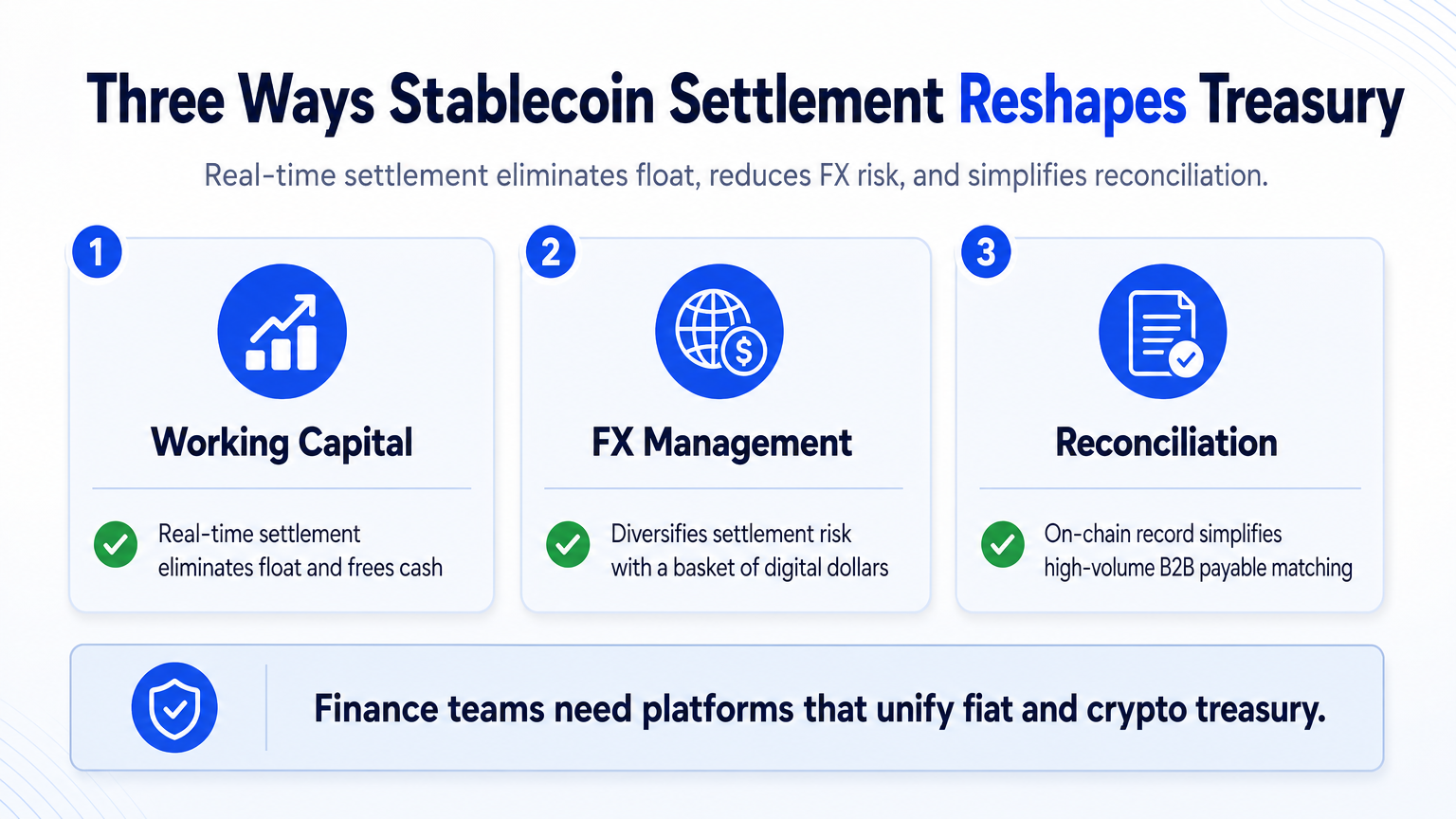
Three areas feel the impact immediately:
- Working capital: Real‑time settlement eliminates float and frees cash.
- FX management: Holding a basket of digital dollars from different issuers diversifies settlement risk and narrows conversion spreads.
- Reconciliation: On‑chain settlement provides an immutable, time‑stamped record that simplifies high‑volume B2B payable matching.
The deeper stablecoin integration into card network rails makes unified fiat‑and‑crypto treasury operations essential. Finance teams can no longer afford fragmented setups; they need platforms that custody both asset classes, automate conversions, and handle payables in a single interface.
What to Watch Next
Businesses can prepare with three concrete steps: assess whether their current banking platforms support stablecoin custody, evaluate which settlement stablecoins their card partners use, and model the working‑capital impact of shifting a portion of settlement liquidity into a stablecoin.
On the regulatory side, the GENIUS Act aims to create a federal framework for payment stablecoins, and state‑level crypto tax proposals add compliance layers. Tracking these developments will shape how companies hold and use assets like USDPT.
Adoption metrics to watch: any quarterly mention of stablecoin‑settlement volume by Visa executives, the number of stablecoin issuers gaining bank‑deposit parity for capital treatment, and growth in corporate cards linked directly to stablecoin wallets. Meanwhile, other crypto payment networks and direct stablecoin APIs continue to build parallel rails, competing with and sometimes integrating into the card network ecosystem.
For content teams supporting this shift, tools like Joyrise—which writes and publishes daily SEO articles to Webflow, WordPress, or Shopify, starting with a free first article—help maintain a consistent educational presence without adding overhead.
Key Takeaways
- Visa added Western Union’s USDPT as a settlement option on November 12, 2026, expanding its approved stablecoin roster to six—the first time a legacy remittance giant’s token enters card network settlement.
- For cross‑border B2B payments, this can cut settlement times, lower FX costs, and simplify treasury workflows, especially if banking partners adopt the new rail.
- Finance teams should integrate fiat and crypto treasury into one platform and monitor stablecoin legislation.
- The move signals that stablecoin payments are now infrastructure, with card networks converging on regulated, bank‑minted digital dollars.
Businesses ready to unify fiat and stablecoin treasury operations can explore OneSafe’s platform for global payments and crypto‑native banking.
Get started with Business in minutes!
Get started with Business effortlessly. OneSafe brings together your crypto and banking needs in one simple, powerful platform.