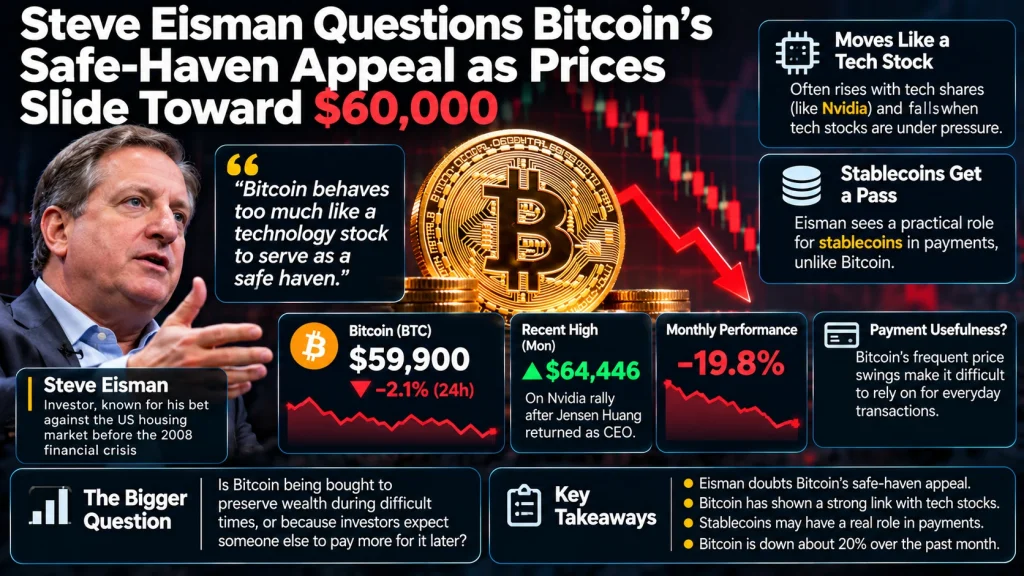
Bitcoin has spent years being promoted as protection against a weakening dollar and mounting government debt. Steve Eisman isn't convinced.
- Steve Eisman expresses skepticism about Bitcoin's role as a hedge against market declines, likening its behavior to that of technology stocks.
- He highlights that Bitcoin often rises and falls in tandem with tech stocks, undermining its perceived value as a protective asset.
- Eisman also questions Bitcoin's viability as a payment method due to its volatile price fluctuations, while showing more support for stablecoins.
- His comments prompt a reevaluation of why investors buy Bitcoin: for wealth preservation or speculative trading.
Bitcoin has spent years being promoted as protection against a weakening dollar and mounting government debt. Steve Eisman isn’t convinced. The investor, whose bets against the US housing market made him famous before the 2008 financial crisis, believes the cryptocurrency behaves too much like a technology stock to serve that purpose.
Speaking on The Diary of a CEO podcast with Steven Bartlett on Monday, Eisman explained why he has stayed away from digital currencies. His concern is less about Bitcoin’s technology than its behaviour when financial markets become unsettled.
He pointed to Nvidia as an example. When the chipmaker’s shares rise, cryptocurrencies often move higher too. When technology stocks come under pressure, Bitcoin frequently suffers alongside them. To Eisman, that makes it difficult to argue that crypto offers meaningful protection from a broader market decline.
Recent trading illustrated his concern. Bitcoin briefly reached $64,446 on Monday as Nvidia shares rallied following the return of Jensen Huang as chief executive. The cryptocurrency couldn’t maintain those gains, however, retreating toward $59,400 during Tuesday’s Asian session.
By the time of the report, Bitcoin was trading around $59,900, down more than 2% over 24 hours. Its monthly losses were approaching 20%.
Eisman also questioned Bitcoin’s usefulness as a payment method. Its frequent price swings, he argued, make it difficult to rely on for everyday transactions.
Interestingly, he wasn’t equally dismissive of every digital asset. Stablecoins, which generally aim to maintain a fixed value against currencies such as the US dollar, received a more favourable assessment. Eisman acknowledged that they could have a practical role in payments.
That distinction is worth considering. A digital asset can have a useful application without necessarily being an attractive investment. Equally, Bitcoin’s tendency to move alongside equities during certain periods doesn’t settle how it might behave over longer timeframes.
For investors, Eisman’s remarks revive an old question about cryptocurrency ownership. Is Bitcoin being purchased for its potential to preserve wealth during difficult times, or because traders expect someone else to pay more for it later?
- Check out our free forex signals
- Follow the top economic events on FX Leaders economic calendar
- Trade better, discover more Forex Trading Strategies
- Open a FREE Trading Account
- Read our latest reviews on: Avatrade, Exness, HFM and XM


