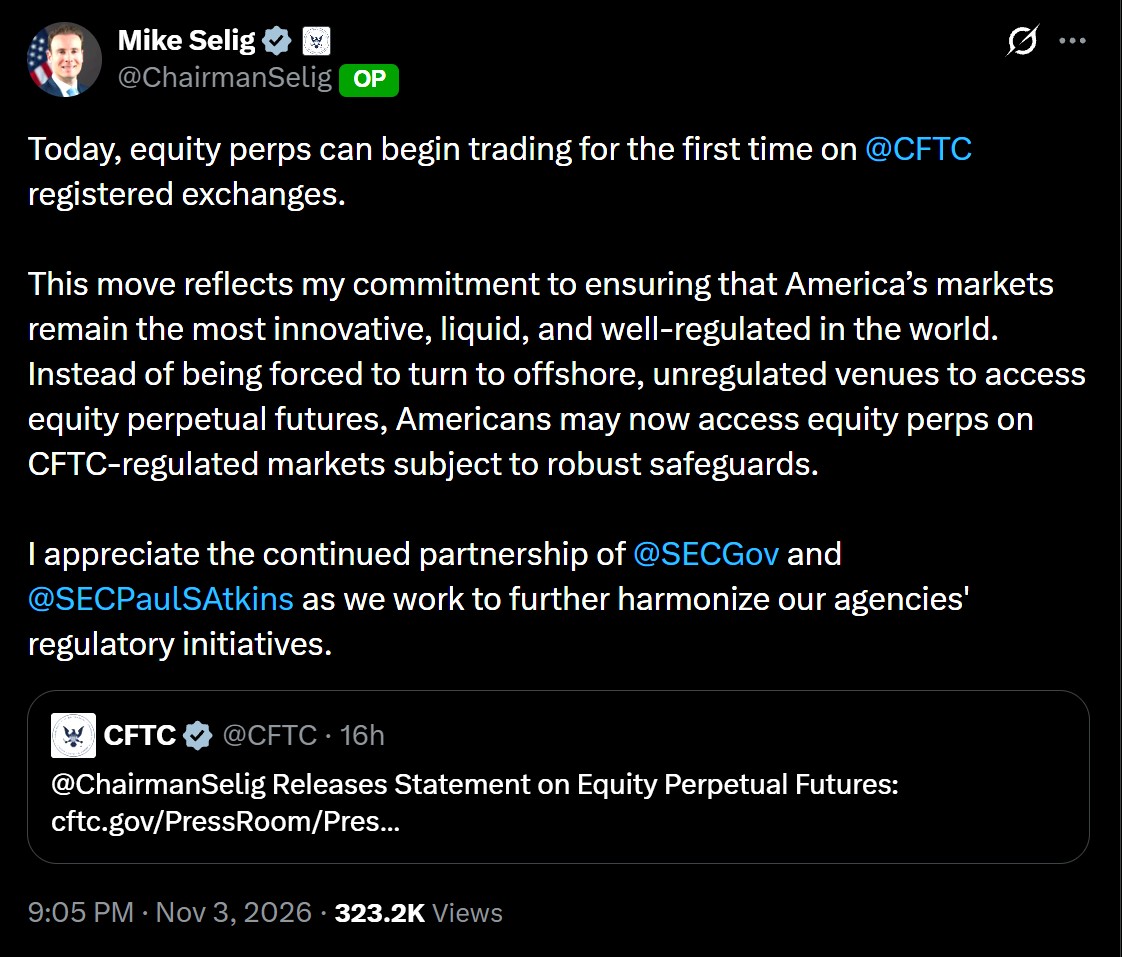
Stock perpetual futures can now trade on US-regulated exchanges after the CFTC cleared them on November 3, 2026. You'd get crypto-style contracts on shares like Nvidia or Tesla, but US margin rules limit leverage to about 6.7x, far below the 20x to 50x offered offshore. No launch date has been set.
Table of Content
Xiaomi 17T vs Galaxy S26 FE (2026): Cheaper Phone Wins
- Oct 31
- 6 mins read
Honor Win RT vs POCO F8 Pro: The $176 Cheaper Phone Has 61% More Battery, but Only the POCO Is Easy to Buy
- Oct 26
- 10 mins read
Sonos Ace Ultra vs Bose QuietComfort Ultra (2nd Gen): Same $449, Different Buyer
- Oct 31
- 5 mins read
Honor WIN2 vs POCO F9 Ultra: Cooling or Cameras in 2026
- Nov 4
- 5 mins read
Honor WIN RT2 vs POCO F9 Pro: 91% More Battery, but Only the POCO Charges Wirelessly
- Nov 4
- 5 mins read
Sponsored
TL;DR
- On Nov. 3, 2026, the CFTC said perpetual futures on individual stocks can trade on US exchanges.
- They count as security futures, so both the CFTC and SEC oversee them, with a 15% minimum margin.
- That margin caps leverage at about 6.7x; offshore platforms have offered 20x to 50x on stocks.
- Kalshi, Coinbase and Kraken-linked Bitnomial filed stock perp products; none has a launch date yet.
- At 6.5x leverage, a 15% drop in the stock can wipe out your margin. This is not financial advice.
A crypto trading product has just been cleared for Nvidia, Tesla and the rest of the US stock market. CFTC Chairman Michael Selig said in a statement on November 3, 2026, that perpetual futures on individual stocks, which the agency calls “Equity Perps,” can begin trading on US-regulated exchanges for the first time. These are contracts that let you bet on a stock’s price, with borrowed money, without an expiry date, and until now Americans could mostly find them only on offshore or crypto platforms. Here’s how stock perpetual futures work, why the US version comes with tighter limits than offshore ones, and what’s still missing before you can trade one.
The CFTC (Commodity Futures Trading Commission) is the federal regulator for futures markets, while the SEC oversees stocks. This product sits between the two, which is part of why it took so long.
Binance Referral Code
$100 Sign-Up Bonus
20% Lifetime Discount on Trading Fees
Code Valid: November 2026
What a Stock Perpetual Future Actually Is
Start with a regular futures contract: an agreement to buy or sell something at a set price on a set future date. When that date arrives, the contract expires, and traders who want to keep their bet have to “roll” into a new one.
A perpetual future, or “perp,” removes the expiry date. You can hold the position for as long as you keep enough money in your account. To keep the perp’s price close to the real stock price, traders pay each other a small funding payment at regular intervals. When the perp trades above the stock price, buyers pay sellers, and the reverse when it trades below.
Perps were born in crypto, where they’re now one of the most traded products. According to DeFiLlama data cited in reports, perpetual futures recorded more than $630 billion in on-chain trading volume over the month to November 3.
Here’s how a stock perp compares with ways you can already bet on a stock:
The key line is the third one: with a perp, you never own the stock. You’re trading on its price movements only.
How the CFTC Got Here: A 10-Month Timeline
The approval didn’t come out of nowhere. Selig’s own statement traces a clear path through 2026:
One detail in that timeline explains the legal mechanics. Selig’s statement says the contracts were “deemed approved” under Regulation 40.3, the process exchanges use to submit new products. By our math, Kalshi’s and Coinbase’s filings landed 46 days before the announcement, which lines up with the CFTC’s standard 45-day review window. In other words, the agency didn’t write a new rulebook. It let existing security futures rules carry the product.
The Leverage Math: Why US Perps Will Be Tamer
This is the part most coverage skips, and it matters most to anyone thinking of trading these.
Because the CFTC classifies stock perps as security futures, they fall under a joint CFTC-SEC margin rule. Since 2020, that rule has set the minimum required margin for security futures at 15% of the contract’s value. Margin is the cash you must put up to open and keep a position.
A 15% margin translates directly into maximum leverage:
- 15% margin: about 6.7x leverage. $1,000 controls a position of about $6,667.
- 15.5% margin, the level reported for Kalshi’s filing: about 6.5x.
- Offshore platforms: stock and index perps on Hyperliquid-based markets have been reported at 20x, and up to 50x on some S&P 500 contracts.
Now here’s the downside math. A leveraged position is wiped out when the price moves against you by roughly 1 divided by the leverage:
Single stocks move 15% more often than many new traders expect, especially around earnings. The investor advocacy group Better Markets warned on November 2 that perps can be automatically liquidated, meaning closed by the exchange, before a customer has time to add funds.
Funding adds a second cost. Coinbase Derivatives reportedly proposed hourly funding payments capped at 0.10%. By our math, that cap allows up to 2.4% a day in a worst case, which is a lot for a position you can hold indefinitely. Typical funding is usually far lower, but it can spike when one side of the market gets crowded.
The US rules make stock perps safer than offshore versions, but “safer” isn’t “safe.” A 6.5x position on a volatile stock is still an aggressive bet.
Who These Are Really For
Selig framed the approval as a way to bring trading back from “offshore, and often unregulated, venues.” That tells you the main audience: traders who already use perps on crypto platforms and want the same tools for Nvidia or Tesla, with US protections like regulated clearinghouses.
There are other uses too:
- Hedging. If you own a stock, you can short its perp to protect against a short-term drop without selling your shares, which could trigger taxes.
- Longer trading hours. Kalshi’s proposal reportedly runs from Sunday evening to Friday afternoon Eastern time, and Kraken’s parent is working toward 24/5 trading. That’s far beyond normal stock market hours.
- Smaller exchanges competing with Wall Street. Kalshi, Coinbase and Kraken are crypto-born companies. If perps catch on, they gain a way into stock trading without becoming stockbrokers in the usual sense.
If you just want to own a piece of a company for the long term, nothing here changes your plan. Buying shares still gives you dividends and voting rights; a perp gives you neither.
What’s Still Unknown
The approval is real, but several big questions are open as of November 4:
- Launch date. No exchange has announced when trading starts.
- Which stocks. Kraken’s filing named 10 US stocks, including Tesla, Nvidia, Apple, Microsoft, and Amazon, and Kalshi’s reportedly covers 58 stocks and ETFs, but final lists aren’t confirmed.
- Who can buy. Access will depend on brokers and on suitability checks, which neither agency has detailed.
- Tokenized rivals. ICE and OKX are separately working on round-the-clock tokenized stocks, digital tokens that track shares, which large companies including Nvidia, Microsoft and Alphabet have opposed. The fight over 24/7 tokenized shares shows how contested after-hours stock trading still is.
November 3 opened the door, but the real test is the first listing. Watch for margin levels, funding caps, and which brokers offer access, because those three details will decide whether US stock perps become a hedging tool or a high-risk product aimed at retail traders.
Binance Wallet Referral Code
100 USDT Sign-Up Bonus
20% Lifetime Discount on Trading Fees
Code Valid: November 2026
This article is for information only and is not financial advice. Leveraged products can lose more than you expect, quickly.
FAQs
Are perpetual futures the same as CFDs?
They’re similar but not the same. A CFD (contract for difference) is usually an agreement with a broker that pays the price change of an asset, and CFDs are banned for retail traders in the US. A perpetual future trades on an exchange, clears through a clearinghouse and uses funding payments to track the price. Both let you bet on prices without owning the asset.
Do I pay taxes on futures differently from stocks in the US?
Often, yes. Many regulated futures get special tax treatment, but security futures on single stocks are generally taxed more like stock trades, with gains depending on how long you hold. Rules for a new product can be complex, so check with a tax professional before trading, and keep records of funding payments, which can affect your results.
What happens to a perpetual future if the company is acquired or goes bankrupt?
That depends on each exchange’s contract rules, which haven’t all been published. Dated security futures usually have procedures for mergers, splits and delistings, such as adjusting or closing the contract. Expect perps to follow similar playbooks, but read the contract terms before trading, because a sudden halt can leave a leveraged position exposed.
Can I lose more than I deposit with stock perps?
Exchanges try to prevent it by liquidating positions automatically when margin runs low. In a very fast market, though, prices can jump past the liquidation level, especially around news or between sessions. Depending on the exchange’s rules, you could owe the difference. Using low leverage and stop orders reduces, but doesn’t remove, that risk.
What is a funding rate, in simple terms?
It’s a small regular payment between buyers and sellers of a perp that keeps its price close to the real asset. When more people bet on prices rising, the perp tends to trade above the asset, and buyers pay sellers. When sentiment flips, sellers pay buyers. Over long holding periods, these payments can add up to a meaningful cost.
Vincee Cole is a technology journalist with four years of experience covering the full spectrum of modern tech — from consumer devices, artificial intelligence, to quantum computing, blockchain, and digital assets. His reporting cuts through complexity to deliver stories that are sharp, grounded, and relevant to both general readers and industry insiders. Previously, he worked with fintech research teams across Southeast Asia, analysing how emerging technologies are reshaping financial systems at scale.
Samsung's 17-Inch Foldable Tablet Has a Laptop Problem
- Nov 5
- 5 mins read
Read more
Samsung's 17-Inch Foldable Tablet Has a Laptop Problem
- Nov 5
- 5 mins read
Anthropic's IPO Hits a Rocky Road: Revenue Is Up 12x, but It Just Posted a $23 Billion Loss
- Nov 4
- 7 mins read
Brazil's Largest Crypto Exchange Froze Withdrawals After a $46 Million Hack
- Nov 4
- 7 mins read
Apple Still Can't Say When It'll Have Enough iPhone Duo Units
- Nov 4
- 6 mins read
Sennheiser MTW5 Review 2026: Sound, ANC and Battery Swap
- Nov 4
- 5 mins read
The OnePlus Turbo 7 Could Copy the Ace 7's Best Specs. The Hard Part Is Leaving Room on Price
- Nov 4
- 7 mins read
Karbonn Is Back With Two Rs 12,000 Phones. The Catch Is They're Missing 5G
- Nov 4
- 6 mins read
Binance Is Reopening Withdrawals One Coin at a Time After a $6.3 Billion Hack
- Nov 3
- 6 mins read