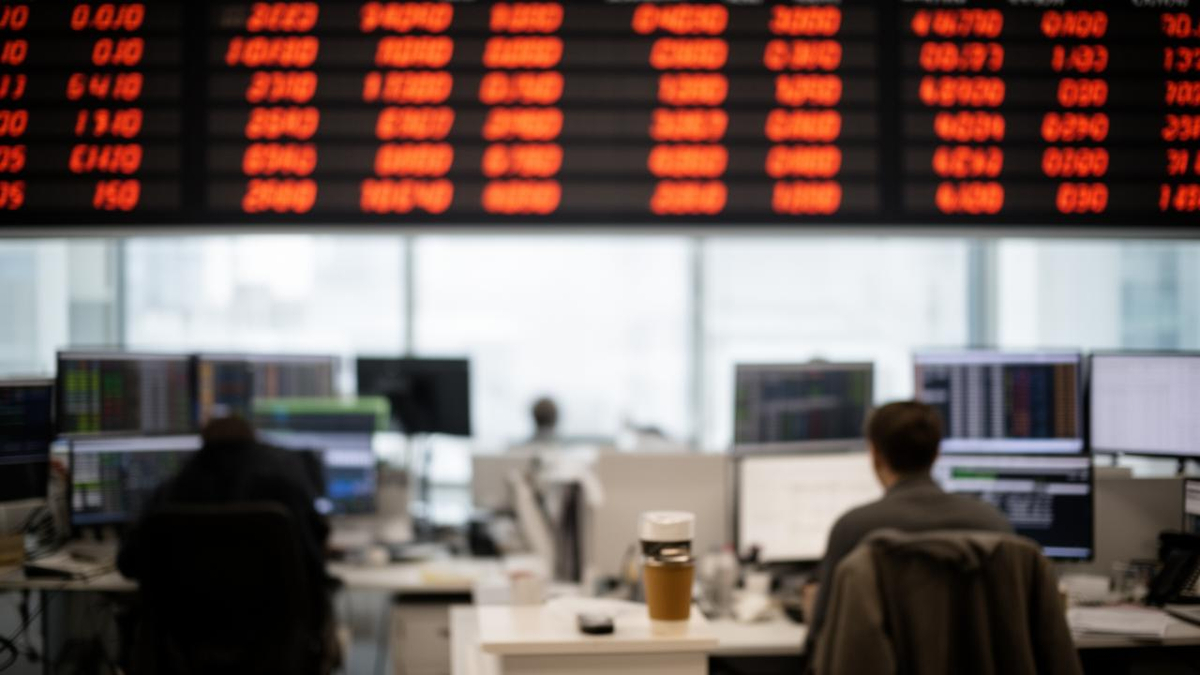
Stocks, gold and crypto assets are collapsing at the same time, leaving investors with nowhere obvious to hide. As risk aversion spreads, money is clearly draining out of equity funds and crowding into cash-like products such as short-term government bonds and money market funds (MMFs).
According to the Korea Exchange on the 26th, the KOSPI closed the previous session at 4,697.51, down 308.52 points (6.16%) from the prior trading day. On a closing basis, that is the lowest since Jan. 13 (4,692.64), roughly 10 months ago. The index had surged 6.32% the session before on news of Nvidia CEO Jensen Huang's return, reclaiming the 5,000 level, only to give back all of those gains in a single day. The tech-heavy KOSDAQ also closed down 15.24 points (2.29%) at 650.64.
The selloff was concentrated in large-cap semiconductor names. Samsung Electronics fell 9.87% to close at 170,700 won (approximately $130), while SK Hynix dropped 11.05% to 1.03 million won (approximately $770). Both were their lowest closes since March 31 and April 10, respectively. Samsung Electronics' market capitalization slid to 997.9598 trillion won (approximately $742.8 billion), falling below the 1,000 trillion won (approximately $744.3 billion) mark. Selling was so heavy that a sell-side sidecar was triggered just eight minutes after the KOSPI opened.
The trigger was the previous day's U.S. stock market. Nvidia fell 5.9% and Micron plunged 11%, delivering a shock to memory chip stocks. SK Hynix's U.S. American Depositary Receipts (ADRs) also dropped 9.9%. Lee Kyung-min, a researcher at Daishin Securities, said "AI investment sentiment contracted again, erasing the prior day's gains," adding that "Anthropic's shares trading below their IPO price also deepened doubts about the growth prospects of the AI industry." Kim Seok-hwan, a researcher at Mirae Asset Securities, predicted volatility could persist for the time being, citing corporate governance controversy after Nvidia's board reversed a prior decision and public hearings in the U.S. Congress.
Supply and demand are also unfavorable. Foreign investors net sold 1.9085 trillion won (approximately $1.4 billion) on the main KOSPI market that day. They had turned net buyers the prior session for the first time in eight trading days, but flipped back to selling after just one day. So far this month, foreign net selling on the main board has reached 15.8198 trillion won (approximately $11.8 billion). Over the same period, net buying by retail investors and institutions amounted to just 2.4526 trillion won (approximately $1.8 billion) and 5.13 trillion won (approximately $3.8 billion), respectively.
The market is watching whether South Korean financial authorities' easing of buyback limits will provide a spark for a rebound. Through the previous session this month, there were 72 disclosures of share buybacks on the KOSPI and KOSDAQ markets, 2.8 times the 26 recorded in the same period last year. On the 23rd, when the easing was decided, and the 24th, the first day the rule took effect, 13 companies decided on new share purchases. Cheil Worldwide disclosed a direct buyback worth 60 billion won (approximately $44.7 million), while Hecto Financial and Hecto Innovation announced purchase plans of 2.3 billion won (approximately $1.7 million) and 1.6 billion won (approximately $1.2 million), respectively. Access Bio signed a trust agreement for a 10 billion won (approximately $7.4 million) buyback.
Gold, a traditional safe haven, is also failing to hold up. According to the Korea Gold Exchange, the purchase price of one don (3.75 grams) of pure gold was 668,000 won (approximately $500) the previous day, down 22,000 won (3.19%) from 690,000 won (approximately $510) the session before. Compared with the peak of 1.121 million won (approximately $830) on Jan. 29, that is a 40.4% decline. The international spot gold price also fell about 1% from the prior session to $3,522.74 per troy ounce as of 5:22 p.m. the previous day.
Crypto assets are no different. Bitcoin slid to the $59,000 line the previous morning, surrendering the $60,000 mark again. That is roughly 79 million won. The price is down more than 2% from 24 hours earlier and more than 8% from a week ago. Bitcoin, which had crashed to the $55,000 range on the 21st, rebounded to the $63,000 range on the 23rd but has lost momentum again.
The biggest driver is money leaving U.S. spot exchange-traded funds (ETFs). On the 23rd, $569.7 million flowed out in a single day, and cumulative outflows this month reached $4.71 billion, surpassing the record for the largest monthly outflow. Lee Hwan-wook, a researcher at Yuanta Securities, said "this correction stems not from macroeconomic factors but from a demand exodus specific to crypto assets," forecasting that "in the short term, prices will remain weak amid demand flight and record fund outflows."
Rising U.S. Treasury yields and expectations of further rate hikes are also weighing on risk assets broadly. Higher rates dampen sentiment toward stocks and crypto assets and reduce the relative appeal of gold, which pays no interest. The Donald Trump administration's moves to impose additional tariffs are also cited as a factor raising uncertainty. There are concerns that if tariffs push up consumer goods prices and intensify inflationary pressure, the Federal Reserve's tightening stance could last longer.
With major assets weakening across the board, money is moving into cash-like products. According to Hana Securities, since early last month the balance of South Korean equity funds has shrunk by about 50 trillion won (approximately $37.2 billion), while domestic bond fund assets and MMF balances have grown by 7 trillion won (approximately $5.2 billion) and 51 trillion won (approximately $38.0 billion), respectively. Kim Sang-man, a researcher at Hana Securities, said "the preference for safe assets triggered by the risk-asset correction is playing out in money flows in textbook fashion."
Experts recommend a cautious approach that checks the macroeconomic environment and supply-demand conditions rather than jumping to conclusions about direction. Hong Jin-hyun, a researcher at Samsung Securities, said "the influence of the halving cycle has not completely disappeared, so a trend reversal is possible," while advising that "rather than aggressive investment, a cautious approach is needed — closely monitoring the macroeconomic environment and market supply-demand to confirm direction."
Once added, BigGo Finance appears first in Google Search Top Stories, so you get the broadest, most up-to-the-minute, and most comprehensive global financial news first.