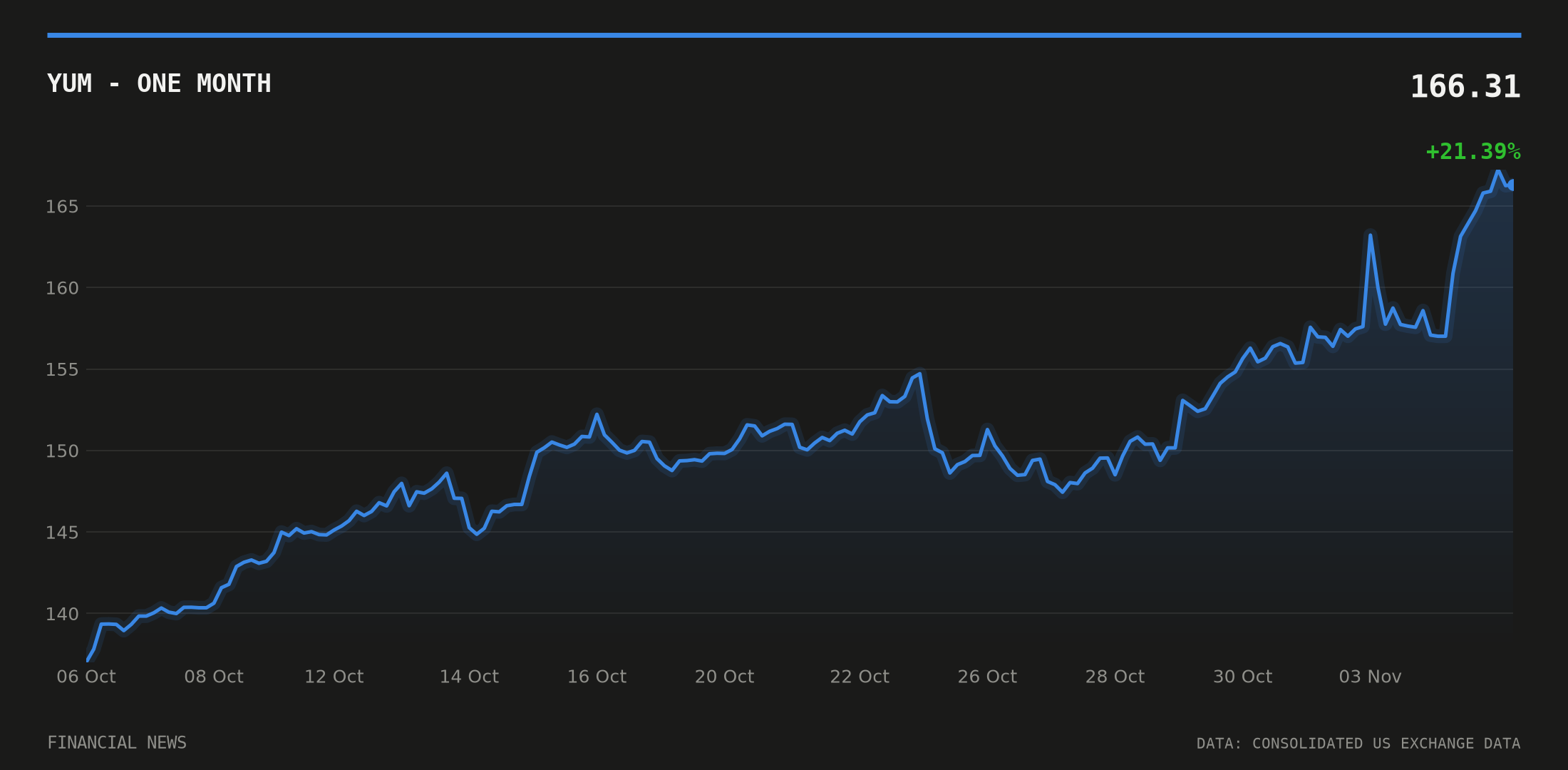
Yum! Brands (YUM) is telling investors that a Taco Bell recovery is outpacing expectations. Its own third-quarter filing tells a different story: US comparable sales at the chain fell 4% in the three months to September, hit by a cyclospora outbreak linked to lettuce.
The gap between the two accounts matters. The “recovery” cited in recent coverage refers to unaudited, verbal trends management described for the four weeks since the quarter closed – not the reported results of the quarter itself.
What the quarter actually showed
Yum’s Q3 2026 release, filed with the SEC, put adjusted earnings per share at $1.56, ahead of the $1.51 analysts had pencilled in, according to Seeking Alpha. Revenue of $2.06bn missed the $2.07bn consensus.
Taco Bell’s US comparable sales dropped 4% in the quarter, even as international sales at the brand rose 5%, CNBC reported. KFC did the heavy lifting instead: comparable sales there rose 1% and system sales grew 6% on an ex-currency basis, according to a transcript carried by The Motley Fool.
Four weeks of talk, one quarter of data
The turnaround narrative rests on remarks chief executive Chris Turner made in Yum’s earnings release, where he said Taco Bell’s US business has been outpacing the quick-service industry on same-store sales “since the end of September” – after the reporting period had already closed, according to the 8-K filed with the SEC.
Chief financial officer Ranjith Roy added detail on the call: Taco Bell’s comparable sales are running about 1% higher quarter-to-date in the fourth quarter, and rose 3% in the most recent four weeks against the same period a year earlier, CNBC reported. Those figures are management commentary, not audited results, and cover roughly a month of trading.
Yum also pointed to loyalty data as evidence the brand is rebuilding faster than the headline comparable-sales figures suggest. Membership in Taco Bell’s loyalty programme grew 25% year-on-year, and loyalty members returned to the brand twice as fast as non-members after the safety disruption, according to the Motley Fool transcript.
Pizza Hut sale clouds the headline EPS
The quarter’s reported numbers were also distorted by the completed sale of Pizza Hut. The divestiture generated a pre-tax gain of roughly $1.7bn, pushing GAAP diluted earnings per share to $5.92 for the quarter, versus the $1.56 adjusted figure that strips out the one-off, the 8-K filing shows. That leaves Yum as a three-brand business – KFC, Taco Bell and Habit Burger & Grill – just as it is asking investors to look past a soft quarter at its largest division.
Shares closed at $166.31 on 4 November, up 1.95% on the day and 12.06% over the preceding 20 trading days, according to consolidated exchange data cited in the company’s disclosures. Four Yum executives, including Turner, filed Form 4 notices with the SEC on the same day, though the filing indices did not detail the size of the transactions, per EDGAR records.
Rates add pressure to the valuation case
The backdrop for the stock’s run-up is a market still pricing in higher-for-longer borrowing costs. The 10-year US Treasury yield stood at 4.95% on 3 November, up from 4.91% the prior session, according to data from the Federal Reserve Bank of St. Louis. Higher yields raise the discount rate applied to future earnings growth, a factor that weighs more heavily on a stock being valued on a projected turnaround than on delivered results.
Yum’s quarterly net income has been rising steadily through the current fiscal year, reaching $432m in the first quarter of 2026 and $853m in the second, though the latter included the Pizza Hut gain now flowing through comparisons, according to the company’s 10-Q filings. Investors will get the next hard data point on the Taco Bell recovery when Yum reports full fourth-quarter results, the first period that will capture a complete set of audited comparable-sales figures since the lettuce-linked outbreak.
This article is for information only and is not investment advice or a recommendation to buy or sell any asset. Markets move quickly; figures are correct as sourced at the time of writing. Always do your own research before making financial decisions.