On November 19, 2026, Tether made a strategic investment in SCRYPT, a Swiss institutional platform for stablecoin trading and liquidity, as reported by CoinMarketCap. The move puts the world’s largest stablecoin issuer squarely behind a payments infrastructure builder — and signals that stablecoin payments are entering a new, more deliberate phase of institutional adoption.
Table of Contents
- What Just Happened: Tether Investment SCRYPT to Push Stablecoin Payments
- The Background: How Stablecoin Payments Work Today (And Why They Still Aren’t Mainstream)
- What This Means for Global Businesses and DAOs That Rely on Fiat and Crypto
- What Changes for Payments Teams Right Now — And What Doesn’t
- Open Questions (And What Smart Finance Leaders Should Watch Next)
- Key Takeaways
What Just Happened: Tether Investment SCRYPT to Push Stablecoin Payments
On Thursday, November 19, 2026, Tether announced it had taken a stake in SCRYPT, a multi-jurisdictional licensed platform for trading, custody, and asset management across fiat, stablecoins, and digital assets (CoinMarketCap, November 19, 2026). Neither side disclosed the amount. SCRYPT is expanding into third-party payments, and the investment explicitly aims to make stablecoin rails easier for banks, brokers, and fintechs to use.
“Our investment reflects a straightforward view: when settlement takes minutes instead of days, money moves at the speed of business, not the speed of banks,” Tether CEO Paolo Ardoino said. SCRYPT already connects fiat and stablecoin rails for institutions; now it gains USDT’s issuer backing at a moment when real-world payment use is accelerating. For a deeper breakdown, see Stablecoin Payments: What Tether’s SCRYPT Stake Means.
The Background: How Stablecoin Payments Work Today (And Why They Still Aren’t Mainstream)

A stablecoin is a digital token designed to hold a steady value against a reference asset, usually the U.S. dollar. Unlike bitcoin, stablecoins combine blockchain settlement speed with fiat price stability. The two largest dollar-pegged stablecoins are USDT (Tether) and USDC (Circle), each with over $100 billion in combined market capitalization. They are increasingly used for real-world payments beyond trading and DeFi, as real-world uses of stablecoins in payments, trading, and DeFi are expanding rapidly.
Stability comes from a 1:1 reserve of high-quality assets per token. For fiat-backed stablecoins like USDC and USDT, the issuer holds cash, short-term Treasuries, and other liquid instruments. Regular attestations — not always full audits — aim to confirm those reserves. That credibility is the first thing a corporate treasury team will examine.
USDC (Circle) publishes monthly attestations, holds most backing in short-duration U.S. Treasury bills, and actively pursues regulatory approval. USDT (Tether) publishes quarterly attestations, with reserves now less concentrated in commercial paper. USDT remains the dominant stablecoin by trading volume but faces more regulatory scrutiny. For businesses deciding which to accept, the choice often hinges on counterparty risk, regulatory posture, and banking partner convenience.
The Friction in Cross-Border B2B Payments
Cross-border payments crypto are still dominated by SWIFT, with two—five business days of settlement and layers of intermediary bank fees, FX markups, and unpredictable deductions. A $10,000 wire from the U.S. to a European supplier might lose $50–$120 and arrive with an unclear final amount. Treasury teams manually reconcile every deduction.
Stablecoins settle in minutes on-chain, with fees often under $1 for a $10,000 transfer. But both sender and receiver still need an on‑ramp (fiat‑to‑stablecoin) and off‑ramp (stablecoin‑to‑fiat) unless balances are kept in stablecoins permanently. Traditional crypto payment processors often operated as siloed tools. The “missing middle” is a unified platform that treats fiat and stablecoin balances as a single financial operation — exactly what stablecoin payment processing infrastructure is now making possible.
Where Stablecoins Fit: On-Ramps, Off-Ramps, and the Missing Middle
A cross‑border B2B payment of $10,000 from a U.S. company to a European vendor illustrates the gap. Compare a conventional bank SWIFT wire to a USDC payment executed through a hybrid neo‑banking platform that handles both fiat and crypto natively.
Figures based on typical bank fees and OneSafe’s published pricing: fiat deposit/withdrawal 0.15%, wire withdrawal $25, wire deposit $10, crypto on/off‑ramp conversion spread ~0.25%, free USDC deposits/withdrawals.
When the recipient holds stablecoins and delays off‑ramping, costs drop near zero. For DAOs and Web3 companies already holding USDC in treasury, that’s a structural advantage for global cash management. Businesses seeking stablecoins in banking use cases are beginning to leverage this model to upgrade cross‑border settlement.
What This Means for Global Businesses and DAOs That Rely on Fiat and Crypto
Can stablecoins be used for B2B payments? Yes, and adoption is accelerating. Several banks and fintechs run pilots. In November 2026, PNC Bank expanded its stablecoin payment pilot for corporate clients (see Stablecoin Payments: What PNC’s Pilot Means for Your Business). Companies pay international suppliers, settle inter-entity transfers, and manage payroll for distributed teams in USDC. The prerequisite is a compliant on/off‑ramp — exactly the layer Tether is building through SCRYPT.
The catch: compliance and complexity. Stablecoin payment regulation is evolving fast. The U.S. GENIUS Act proposes federal rules for issuers, including reserve and AML requirements; the SEC defends its authority over certain stablecoin arrangements (see SEC Defends Stablecoin Regulation: Key Takeaways). Canada’s 2026 proposed rules would require registration (see Canada Proposes New Rules for Stablecoin Payments). Operating a stablecoin payment flow without a licensed partner creates compliance risk. Any adoption must run through regulated infrastructure that handles KYB, transaction monitoring, and tax reporting in one place.
Volatility is not a concern for properly backed USD‑pegged stablecoins. The complexity comes from parallel crypto wallets, keys, and tax implications. Without a unified tool, finance teams run two separate treasury operations. A hybrid, neo-banking for stablecoins platform merges multi‑currency accounts, ACH, wires, and crypto custody in a single dashboard. A payments team can convert USD to USDC instantly, pay a vendor in minutes, and let the vendor auto‑convert to local currency at receipt — all reconciled through accounting integrations. That’s stablecoin payment processing designed for business reality, as outlined in Stablecoin Payments Explained: A Guide for Businesses.
What Changes for Payments Teams Right Now — And What Doesn’t
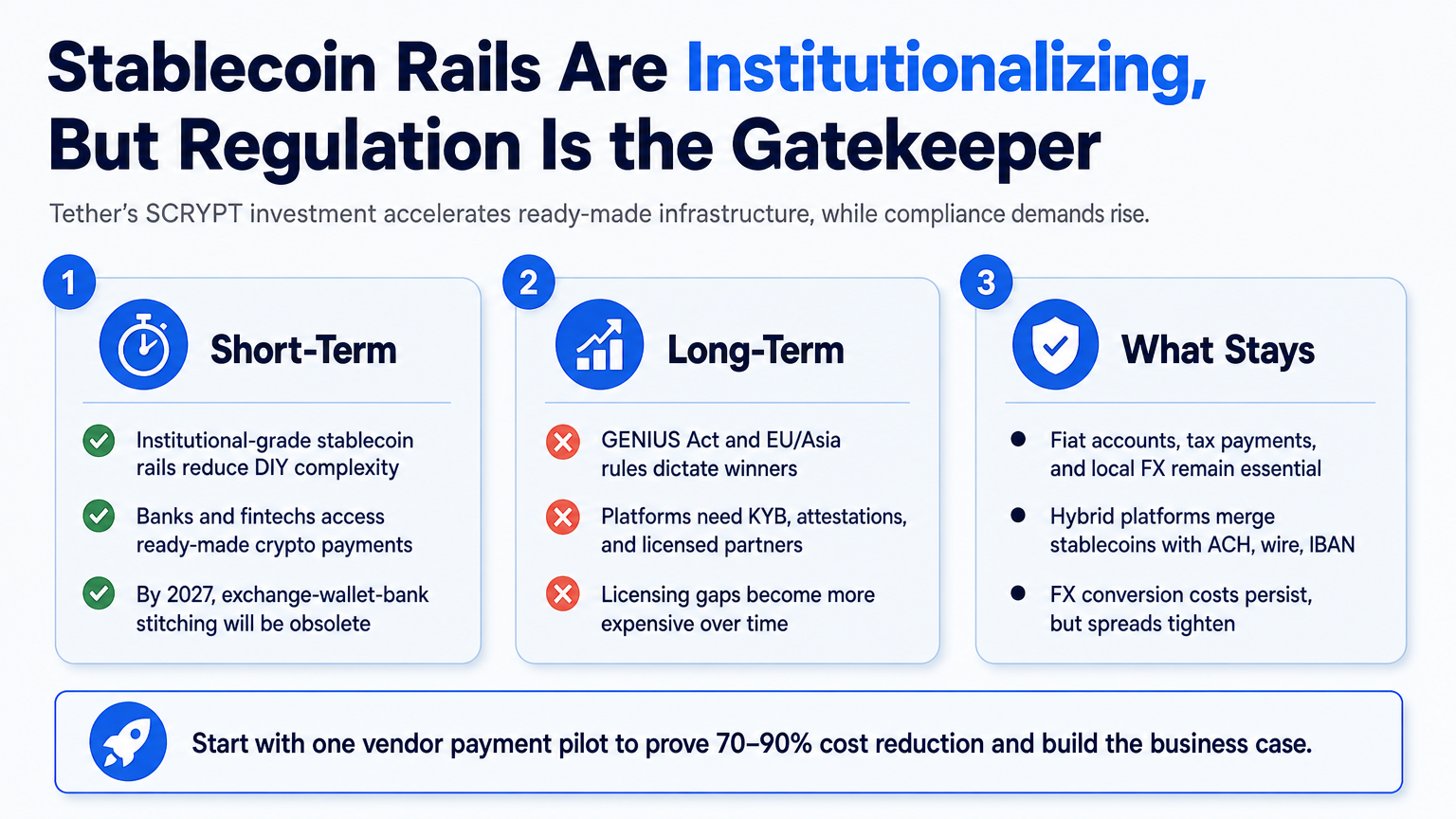
Short‑Term: More Institutional Infrastructure, Less DIY
Tether’s investment accelerates institutional‑grade stablecoin rails. SCRYPT’s stack — payments, custody, 24/7 FX — gives banks and fintechs a ready‑made crypto payment platform. By late 2027, stitching together an exchange, wallet, and bank will be obsolete. The 2026 World Bank report endorsing stablecoins for cross‑border cost reduction signals this is permanent.
Long‑Term: Regulation Will Decide the Winners
The platforms that dominate B2B stablecoin transactions will adapt fastest to regulatory requirements. The GENIUS Act’s final form and EU/Asia rules will dictate acceptable stablecoins and compliance standards. Finance leaders should verify a platform already incorporates KYB, clear reserve attestations, and licensed banking partners. Licensing gaps become more expensive as regulation tightens.
What Stays the Same: Bank Partnerships and FX Still Matter
Most businesses still need fiat accounts, tax payments, and local‑currency conversion. Stablecoin rails make those relationships more efficient, not obsolete. A hybrid platform that blends stablecoin settlement with direct ACH, wire, and IBAN access keeps treasury tied to the real economy. FX conversion remains a cost center, but hybrid platforms execute it at tighter spreads.
Ready to launch your stablecoin strategy?
Start with one high‑frequency cross‑border vendor payment that bleeds fees via SWIFT. Onboard the vendor on a hybrid platform with standard KYB (usually within a week) and run a USDC test payment. Track all‑in cost, settlement time, and reconciliation effort. The resulting 70–90% cost reduction builds the business case. Getting started with USDC payments is as practical as opening a bank account, once the right platform is in place.
Open Questions (And What Smart Finance Leaders Should Watch Next)
Tether’s SCRYPT stake closes one gap — institutional liquidity — but raises wider questions:
- Will USDC issuer Circle respond with similar investments? The competitive dynamics in stablecoin payment processing will intensify.
- How will the GENIUS Act treat payment‑focused stablecoin platforms? The SEC’s posture (see Stablecoin regulation: what ‘equal footing’ means for you) suggests conversion‑facilitating platforms could face securities regulation if not structured carefully.
- Will CBDCs compete or coexist with private stablecoins? The World Bank’s 2026 endorsement implies coexistence.
- For treasury teams, audit readiness is key: can stablecoin flows produce the same trail as a wire? Platforms with integrated accounting and tagging will win.
- Staying current on these shifts can consume content resources. Some teams use tools like Joyrise, which analyzes your site, then writes and publishes SEO articles to Webflow, WordPress or Shopify every day — your first article is written before you pay — though the strategic work for finance leaders remains external.
Key Takeaways
- Tether’s undisclosed investment in SCRYPT (November 19, 2026) signals that stablecoin payment infrastructure is being built for institutions, not just crypto‑native users.
- A $10,000 cross‑border payment can cost over $200 via SWIFT, but under $60 using USDC through a hybrid fiat‑crypto platform, with settlement in minutes.
- Stablecoin payments for business require a regulated on/off‑ramp; DIY approaches create compliance and reconciliation headaches that a unified neo‑banking platform resolves.
- USDC and USDT dominate, but regulatory acceptance is uneven — choose based on transparency, jurisdiction, and bank partner compatibility.
- Short‑term play: pick one vendor payment, execute it via stablecoin, and measure the operational lift to build the case for wider adoption.
Get started with Business in minutes!
Get started with Business effortlessly. OneSafe brings together your crypto and banking needs in one simple, powerful platform.