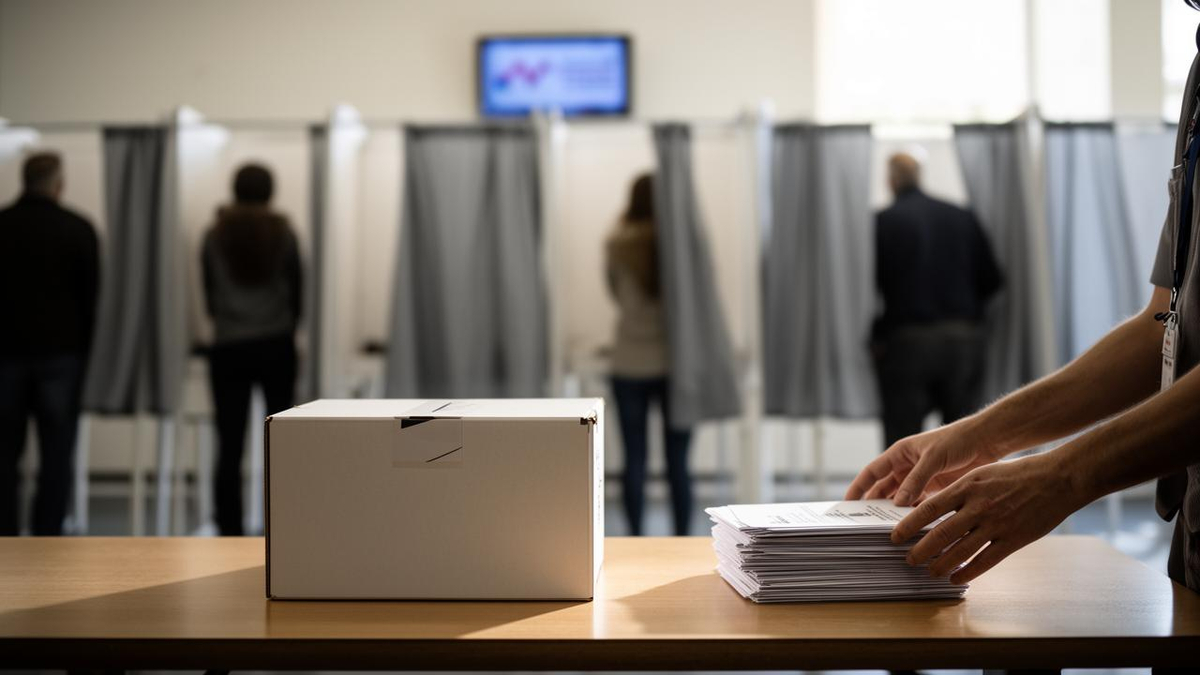
Voting in the U.S. midterm elections took place on November 3, with vote counting beginning on November 4 Japan time. This is the first major referendum on the second Trump administration, and the balance of power in Congress will shape policy direction over the next two years. Ahead of the vote count, the Dow Jones Industrial Average of major companies closed down 197.26 points (0.38%) from the previous day's close at 51,786.72 on November 3, a modest decline. Apple (AAPL), which reported earnings the previous day, and materials-related stocks were sold, while Microsoft (MSFT) and semiconductor giant Nvidia (NVDA) were bought, supporting the market.
The Dow opened on November 3 at 51,932.63, down 51.35 points from the previous close. Apple fell 1.90% from the previous day's close after its earnings report released after the previous session's close showed some guidance below market expectations. Market participants believe the election outcome could affect Japanese stock markets and the yen-dollar exchange rate, with attention focused on the Nikkei Stock Average's movement in Tokyo trading on November 4.
Pre-election polls showed growing support for the Democratic Party, driven by dissatisfaction with the Trump administration over rising prices. Democrats are seen as more aggressive on regulating artificial intelligence (AI), a sector that has driven both U.S. and Japanese stock markets. Depending on seat outcomes—such as Democrats securing majorities in both chambers—there are concerns this could lead to stock declines, particularly in AI and semiconductor shares. Conversely, if Republicans, who support the Trump administration, maintain majorities in both chambers, concerns about AI regulation could recede, which some see as positive for stocks.
In the Senate (100 seats), about one-third—35 seats—are up for election. Before the election, Republicans held 53 seats and Democrats 47 (including 2 independents). For Democrats to capture a majority, they must defend all their own seats and pick up 4 additional seats. Each state is allocated two senators, with the entire state serving as the electoral district. According to the final assessment by the Cook Political Report, a nonpartisan election analysis outlet, of the seats up for election, 14 Democratic seats and 15 Republican seats are rated as "solid," "likely," or "lean" for one party, with the remaining 6 "toss-up" seats likely to decide the outcome.
All six of these toss-up seats are currently held by Republicans, and many are in states Trump won handily in the 2024 presidential election. For this reason, Democratic victories were initially seen as difficult, but pre-election polls show Democrats performing well. If the races are as close as the polls suggest, results may take time to determine.
In the House (435 seats), all seats are up for election. Before the election, Republicans held 219 (including 1 independent) and Democrats 214—a 5-seat difference. Pre-election polls indicate Democrats are likely to capture a majority. According to the Cook Political Report's final assessment, Democrats are rated "solid," "likely," or "lean" in a total of 222 House seats, exceeding the 218 needed for a majority. Another 18 seats are rated as "toss-ups" against Republicans. Meanwhile, Republican "solid," "likely," or "lean" seats total only 195.
House elections in 2020, 2022, and 2024 were all closely contested for three consecutive cycles, with about a week needed to determine which party won a majority. This time too, results could be delayed, but if Democrats perform as polls suggest, results may be determined faster than in previous cycles.
Note: Seat counts are based on each article's descriptions. The Senate Democratic figure of 47 includes 2 independents.
Markets are focused on the possibility that the election results could be widely contested or that President Trump might not accept the outcome. Some analysts warn that such a scenario could lead to a sharp rise in U.S. Treasury yields and worsen stock market volatility in the coming days. AI-related stocks have driven both U.S. and Japanese markets, so if regulatory tightening becomes more likely, it would probably dampen investor sentiment.
In November 3 trading, the tech-heavy Nasdaq Composite fell 1.07% to 25,164.32, and the S&P 500 dropped 0.51% to 7,541.40. Both indexes rose as much as 1.4% and 1.1% respectively after the open but reversed course in the afternoon as concerns about the AI trade resurfaced. The Dow had closed up 213.67 points (0.41%) at 51,983.98 the previous day as investors sought safety.
Among individual stocks, Nvidia and Meta Platforms (META) both fell 1%, while Apple and Microsoft each dropped 2%. Meanwhile, Sherwin-Williams (SHW) and Home Depot (HD), buoyed by solid earnings, rose more than 3%, helping support the market.
Investors are watching the vote count and assessing how the congressional balance of power will affect AI regulation, semiconductor policy, and fiscal management. Results in close races are expected to take time, and trading in the coming sessions, including in Tokyo, is likely to remain volatile and sensitive to election coverage.