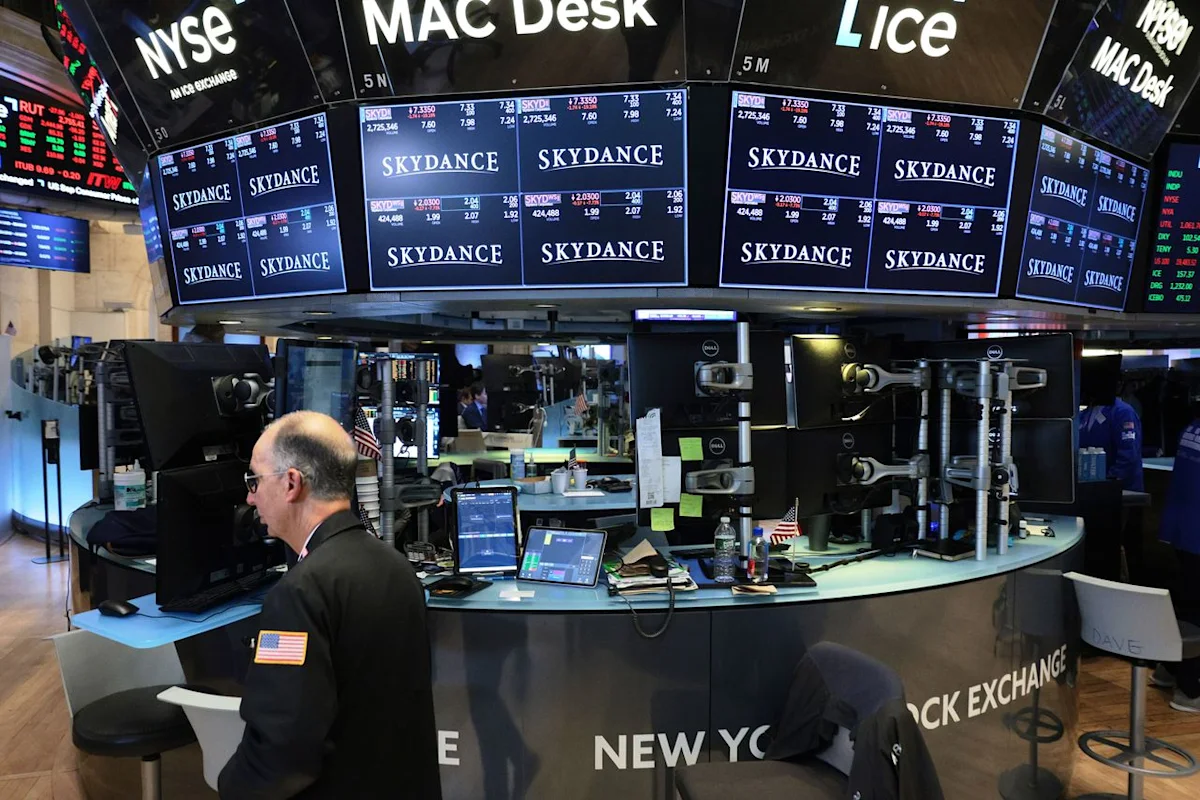
U.S. stocks ended sharply lower on Friday, extending a broad sell-off that pushed the S&P 500 to its longest losing streak since 2020. The benchmark fell for a seventh consecutive session, while both the S&P 500 and the Dow Jones Industrial Average entered correction territory.
For the week ending November 20, the S&P 500 declined about 8.6%, the Nasdaq 100 fell 10.4%, and the Dow dropped 8%. The Russell 2000, which tracks smaller companies, lost 7.5%.
Friday’s losses were widespread. The Dow closed at 48,147.33, down 2%, while the S&P 500 fell 3.7% to 6,910.39. The Nasdaq 100 dropped 5.6% to 25,028.98. Exchange-traded funds tracking the indexes also declined: the SPDR S&P 500 ETF (SPY) lost 3.7%, the SPDR Dow Jones Industrial Average ETF (DIA) fell 2%, and the Invesco QQQ Trust (QQQ) slid 5.6%.
Semiconductor shares were among the hardest hit. The VanEck Semiconductor ETF (SMH) and iShares Semiconductor ETF (SOXX) each fell close to 8% on Friday and ended the week down between 17% and 18%.
The sell-off reflected growing unease about technology valuations and the outlook for artificial intelligence investment. Nvidia’s earnings were strong, but investor concerns about congressional scrutiny of the company’s chip-export policies and a reported SEC investigation into its accounting practices weighed on sentiment. Anthropic’s shares fell 8.5% in their second trading session, despite the strong demand that had surrounded the AI developer’s initial public offering.
The decline in Anthropic shares added to doubts about riskier assets, while investors also assessed signs of a possible slowdown in data-center investment and AI-related funding. Richard Saperstein of Treasury Partners described the market’s moves as an “AI repricing,” citing slower data-center buildouts, reduced funding for AI projects and a more modest outlook for technology earnings.
President Donald Trump also threatened U.S. companies building data centers overseas, adding another source of uncertainty for firms planning major technology infrastructure investments.
Volatility rose sharply, pushing the market’s fear index to levels last seen in April 2025. The anxiety extended beyond U.S. equities, weighing on commodities, cryptocurrencies and emerging-market stocks. Investors also reduced expectations for a 25-basis-point Federal Reserve rate cut next month.
Bitcoin traded near $59,000 after falling almost 5% on Friday. The cryptocurrency recorded a seventh consecutive weekly decline, its longest such stretch since the downturn in April 2022. Strategy (MSTR), the largest corporate holder of Bitcoin, fell 30.3% for the week, making it the worst-performing stock in the Nasdaq 100 and the underlying QQQ ETF.
In other company news, Zscaler (ZS) shares rose as much as 20% in after-hours trading on Friday following reports that CrowdStrike (CRWD) was in discussions to acquire the cybersecurity company. Separately, Michael Burry, known for his bet against the U.S. housing market ahead of the 2008 financial crisis, reportedly took profits on half of his bearish positions against Nvidia and a semiconductor-sector ETF.
Despite the week’s declines, retail investor sentiment at Friday’s close was bullish on QQQ, bearish on DIA and neutral on SPY.