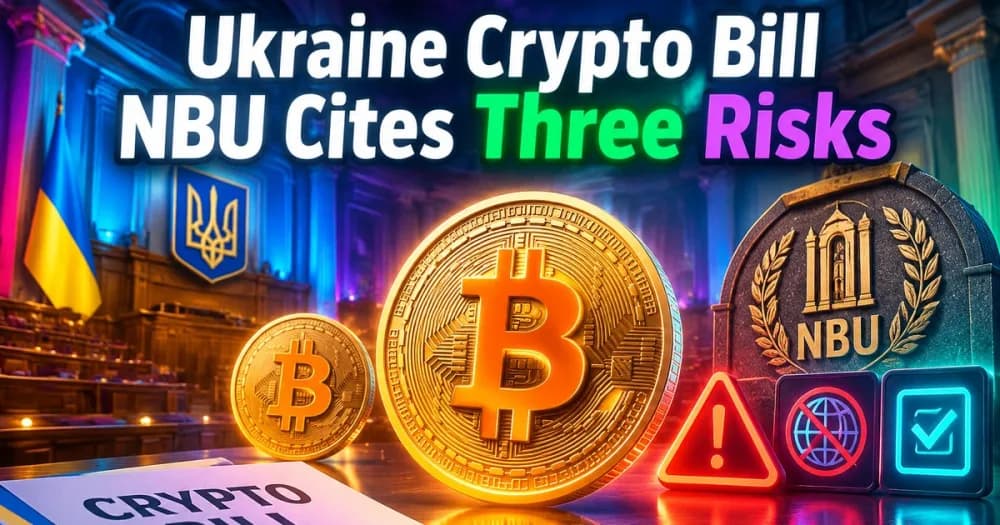
The National Bank of Ukraine said on November 5 that it cannot support the Ukraine crypto bill No. 10225-d in its current form, citing three risks to monetary sovereignty, financial stability and economic security. The position puts pressure on lawmakers to revise the bill before a final vote.
The central bank backs regulating crypto under an approach based on the European Union’s MiCA framework, international standards and International Monetary Fund recommendations. Its objection is to the current draft, not to building a legal framework for crypto trading and taxation.
- 🟣The NBU's Opposition Puts Ukraine Crypto Bill Legalization Effort Back Into Revision
- 🛡️Foreign Tokens Raise Concerns Over Oversight and Regulatory Gaps
- 🛡️Operator Limits Could Leave Market Access to Regulator Discretion
- 🔸The Bill's Next Stage Hinges on Whether Lawmakers Change the Safeguards
- ❓FAQ
The NBU’s Opposition Puts Ukraine Crypto Bill Legalization Effort Back Into Revision
The central bank said the final version failed to reflect several fundamental agreements reached in discussions with lawmakers, regulators and crypto industry representatives. It received the text late Tuesday, shortly before a parliamentary committee approved it for a second reading, and called the drafting process insufficiently transparent.
Regulators worry the bill could open the market without giving them adequate tools to address risks. Per CoinDesk’s account of the dispute, the bank wants changes before lawmakers proceed with rules for crypto trading and taxation.
Foreign Tokens Raise Concerns Over Oversight and Regulatory Gaps
One sticking point: the bill could let foreign-issued tokens into Ukraine even when they aren’t properly supervised in their home countries. Some could function like electronic money, the bank warned, which could affect monetary sovereignty and financial stability.
The regulator wants authority to assess those tokens and restrict their circulation when necessary, the same powers it holds over tokens issued in Ukraine. Simplified access for foreign assets, it argues, could let them skip requirements applied to comparable Ukrainian assets, creating inconsistent rules and openings for regulatory arbitrage.
The bank’s position, published by UA News, points to foreign-token entry, uneven requirements and operator authorization as the central issues it wants addressed.
Operator Limits Could Leave Market Access to Regulator Discretion
The NBU originally wanted to let any trading-platform operator in, as long as it met the requirements. It later accepted a compromise limiting the first phase to three legal entities chosen through competitive bidding.
The final draft, though, sets no precise number of operators for the first five years. That call would instead fall to the National Securities and Stock Market Commission, named in the bill as the main regulator of Ukraine’s crypto market. Leaving the number to the commission’s discretion, the NBU warned, could invite market concentration and corruption in the authorization process.
The Bill’s Next Stage Hinges on Whether Lawmakers Change the Safeguards
The NBU wants lawmakers to address its concerns before moving forward, especially by clarifying its powers over foreign tokens and setting clear operator-access rules. That leaves the framework facing a revision demand even after a parliamentary committee has already cleared it for a second reading.
Ukraine’s earlier virtual-assets law, signed by President Volodymyr Zelenskyy in March 2022, never took effect because it depended on changes to the tax code that never came. That history means the current bill’s path to an operating framework depends not just on parliamentary progress but on the fine print needed to actually put its provisions into force.
The immediate test is whether lawmakers revise the safeguards the NBU has flagged. The bank isn’t calling for crypto regulation to be scrapped; it just says the current draft doesn’t adequately protect monetary sovereignty, financial stability and economic security.
FAQ
What crypto bill is the National Bank of Ukraine opposing?
The NBU opposes bill No. 10225-d, which would establish rules for virtual assets and crypto-market activity in Ukraine. The bank says its objection applies to the current version and has called for revisions.
What are the three main risks identified by the NBU?
The concerns are foreign tokens entering without adequate oversight, regulatory gaps that could let foreign assets bypass rules, and risks of market concentration or corruption in approving trading-platform operators.
How many crypto trading platforms could operate under the compromise proposal?
The NBU said it had accepted an initial limit of three legal entities chosen through competitive bidding. The final draft does not fix the number allowed during the first five years, leaving that choice to the securities commission.
What tax treatment does the updated bill propose for existing crypto assets?
The updated draft sets a transitional 5% tax rate for existing crypto assets through the end of 2028 and exempts crypto-to-crypto trades from tax. The initial draft proposed an 18% personal income tax on crypto gains plus a 5% military levy.
Why did Ukraine’s 2022 virtual-assets law never take effect?
President Volodymyr Zelenskyy signed the law in March 2022, but it depended on changes to the tax code that were not completed. The law therefore did not become operational.
This article is for information only and is not financial advice.
Related Articles
U.S. Banks Push Back Against White House Findings on Yield-Bearing Stablecoins
The American Bankers Association (ABA) has criticized a report from the White House Council of...
SEC Gives U.S. Crypto Companies the Green Light to Operate Nationwide
U.S. crypto regulation underwent a significant shift in 2026, but not as broadly as a nationwide...
Canada’s Crypto Regulation Takes a New Turn: Key Regulatory Changes Explained
Contents🛡️Canada’s Latest Crypto Regulation: What Changed?🛡️How Crypto Is Regulated in...
Polymarket Faces Czech Block Over Unlicensed Gambling
Czech authorities have added Polymarket to the country’s blacklist, giving internet providers 15...
Coinbase: Progress on CLARITY Act Expected in Next 48 Hours
Coinbase Chief Legal Officer Paul Grewal stated that progress on the CLARITY Act is expected within...
FCA Publishes Final Crypto Regulations — What UK Firms Can Expect
The UK’s Financial Conduct Authority (FCA) has published the final version of its crypto...