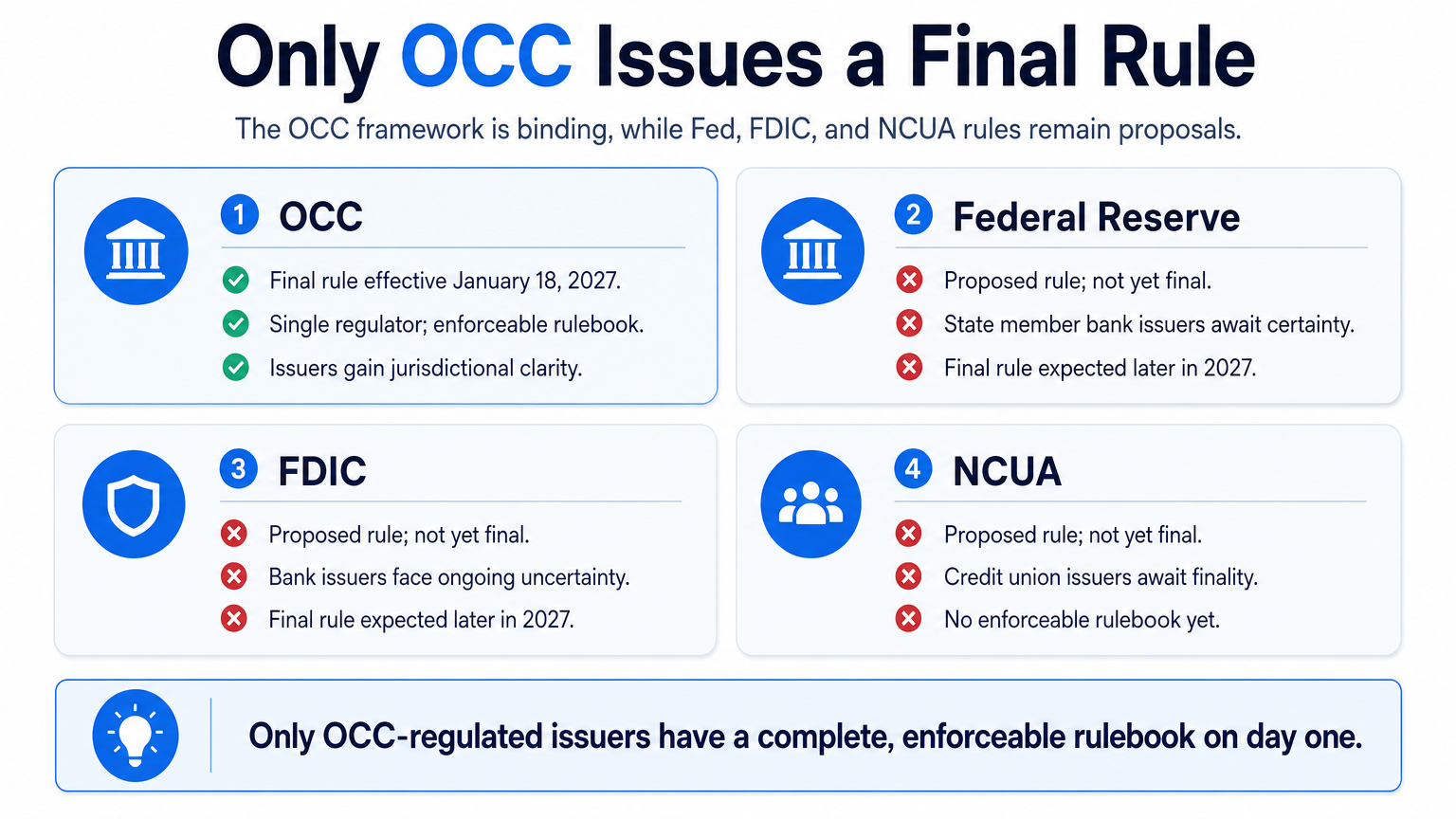
The OCC issued its final rule implementing the GENIUS Act for permitted payment stablecoin issuers (PPSIs) and foreign payment stablecoin issuers within its jurisdiction. The OCC is the first federal payment stablecoin regulator to finalize its framework for licensing and supervision. The OCC also issued guidance on the process for filing applications and requesting waivers of the GENIUS Act or final rule requirements and released revised weekly and quarterly reporting forms and instructions. The final rule will take effect on January 18, 2027, the same day the GENIUS Act becomes effective.
The rulemaking is the primary data point to understand the structure of the payment stablecoin regulatory regime under the GENIUS Act. Proposed rules establishing standards for payment stablecoin issuers under the supervision of the Federal Reserve, FDIC, and NCUA have not yet been finalized, but borrow heavily from the OCC's approach. For that reason, banks, trust companies, fintechs, and foreign banking organizations deciding where to house a stablecoin business now have a final set of OCC rules to measure against the other agency proposals.
This post looks at what changed from the proposed rule, and at what the final rule means for institutions under OCC supervision as well as institutions considering a federal charter. We also flag several questions that the final rule leaves open and that we expect to shape the market in its first year.
Overview of the Final Rule
The final rule creates a new 12 C.F.R. Part 15 for most of the OCC's regulatory framework for payment stablecoin activities by entities under its jurisdiction, with conforming amendments to the OCC's capital (Part 3), prompt corrective action (Part 6), assessment (Part 8), and practice and procedure (Part 19) rules.
Part 15 applies to national banks, federal savings associations, and federal branches and their subsidiaries; nonbank entities seeking to become federal qualified payment stablecoin issuers; foreign payment stablecoin issuers that register with the OCC; and state qualified issuers over which the OCC has regulatory or enforcement authority.
The final rule covers permissible activities, reserves, redemption, risk management, supervision and reporting, custody, licensing and registration, and capital and operational backstop requirements. Bank Secrecy Act and sanctions requirements remain the subject of a separate OCC rulemaking proposed in June 2026, which would require OCC-supervised PPSIs to comply with AML/CFT program, economic sanctions program, and reporting requirements and create a supervision and enforcement framework for OCC-supervised PPSIs' AML/CFT programs.
Key Changes From the Proposed Rule
The final rule adopts a framework that is more flexible and driven by supervision than the proposed rule. Most significantly, the OCC eliminated the rebuttable presumption relating to interest and yield, narrowed the quantitative reserve requirements, and instead emphasized stress-testing and monetization obligations as core safeguards. The OCC also removed the automatic seven-day redemption extension and simplified the capital definition to focus on GAAP tangible equity. At the same time, the OCC added a reservation of authority that lets it waive or modify Part 15 requirements, added an explicit safety-and-soundness licensing factor, and repeatedly stated that it will address hard questions through applications and supervision rather than the text of the final rule. The practical result is a framework that is easier to enter on paper but that places significant weight on the OCC's case-by-case judgment.
The following are several major changes from the proposed rule.
Issue
Proposed Rule
Final Rule
Licensing
Four statutory review factors.
New safety-and-soundness review factor addressing run risk and redemption capacity; express authority to conditionally approve; applications not substantially complete are returned 60 days after notice.
Interest and yield
Rebuttable presumption that arrangements with affiliates or related third parties that pass interest or yield to holder of payment stablecoin violate the statutory yield prohibition.
Presumption eliminated. The OCC will apply the yield prohibition case-by-case and retains anti-evasion authority. No list of permitted or prohibited arrangements.
Reserve diversification
Option A (principles-based general requirement plus optional safe harbor) or Option B (mandatory minimums): 10% daily liquidity, 30% weekly liquidity, 40% per institution, 50% cap on daily liquidity at one institution, 20-day weighted average maturity.
Hybrid approach: principles-based standard plus 5% daily liquidity and a 40% single-counterparty limit (with exceptions for U.S. government exposures, qualifying custodians, and centrally cleared repurchase agreements and reverse repurchase agreements). Weekly liquidity, 50% cap, and weighted average maturity dropped; stress-testing and monetization requirements added.
Minimum insured deposits
Issuers with $25 billion or more outstanding would hold 0.5% of reserves (up to $500 million) as insured deposits.
Eliminated.
Redemption under stress
Automatic seven-calendar-day extension of period for timely redemption when redemptions exceed 10% of outstanding issuance in 24 hours.
Automatic extension eliminated. Notice to the OCC within 24 hours; issuer may request an extension, which the OCC expects to grant "sparingly."
Capital
Common equity tier 1 and additional tier 1 capital; $5 million floor during the three-year de novo period; quarter-end compliance.
GAAP tangible equity less deductions; $5 million floor extended beyond the de novo period; compliance required at all times, with 24-hour notice of any shortfall.
Operational backstop
12 months of expenses in limited pool of highly liquid, low-risk assets; funding source not specified.
Same calibration, but up to 50% may be funded with qualifying five-or-more-year subordinated debt; backstop deducted from capital; limited cure for temporary disruption or operational event.
Multiple brands and Special Purpose Vehicles (SPVs)
Requested comment on a one-brand-per-issuer limitation.
No single-brand restriction. Rule accommodates multiple SPV issuers with streamlined licensing.
Supervision
12-month full-scope exam cycle, or 18- to 36-month cycle for smaller issuers.
12-month full-scope exam cycle, or 18- to 24-month cycle for smaller issuers, supported by weekly and quarterly reporting.
Assessments
Discount of at least 35% (up to 55%) applied only to required reserve assets.
Discount no longer capped at required reserves; foreign issuers initially not subject to semiannual assessments.
Comparison of Final Rule to Proposed Frameworks of Fed, FDIC, and NCUA
The other primary federal payment stablecoin regulators' rulemakings are still at the proposal stage. Because the Fed, FDIC, and NCUA proposals were each modeled in significant part on the OCC's proposed rule, the final rule now diverges from them in several places.
Three differences stand out. First, on yield, the OCC is now the outlier: Every other agency proposed the rebuttable presumption, so a bank subsidiary's yield-sharing arrangements may be evaluated differently depending on whether its parent is a national bank, a state member bank, or a state nonmember bank, unless the other agencies follow the OCC in their final rules. Second, on capital, the Federal Reserve has proposed a standardized risk-based framework rather than the individualized approach the OCC retained, which may matter to state member banks comparing a national charter. Third, on multibrand issuance, the OCC expressly declined to follow the FDIC's approach of requiring segregated reserve pools for each brand absent written approval, opting instead to evaluate segregation case by case during licensing.
Until the other agencies finalize their rules, institutions should treat these differences as live and should watch for some convergence toward the OCC's final positions, although the Federal Reserve is likely to keep its separate approach.
Issue
OCC
Federal Reserve
FDIC
NCUA
Interest and yield
No rebuttable presumption; case-by-case review with anti-evasion authority.
Rebuttable presumption.
Rebuttable presumption.
Rebuttable presumption.
Reserve diversification
Principles-based, plus 5% daily liquidity and 40% single-counterparty limit.
Principles-based; reserves expected to be "predominantly" U.S. Treasury securities; no quantitative limits or minimum deposits.
40% limit on exposure to any one eligible financial institution.
Options A/B (10% daily, 30% weekly, 40% per institution, 50% cap on daily liquidity at one institution, 20-day weighted average maturity).
Capital
Individualized; GAAP tangible equity less deductions; $5 million floor at all times; 12-month backstop.
Standardized risk-based framework applicable at all times; tangible equity, common equity tier 1 capital, tier 1 capital, and total capital held to satisfy capital requirements for nonreserve assets; $5 million de novo floor; operational backstop considered as an alternative.
Individualized; common equity tier 1 and additional tier 1 capital; $5 million de novo floor; 12-month operational backstop.
Individualized; common equity tier 1 and additional tier 1 capital; $5 million de novo floor; 12-month operational backstop.
Redemption under stress
Notice within 24 hours of spike in redemption requests of 10% of outstanding issuance value in 24 hours; issuer may request extension of period for timely redemption.
Issuer may request discretionary extension for unusual and exigent circumstances.
Immediate notice of 10% spike in redemption requests in 24 hours; issuer may request extension.
Automatic seven-day extension after 10% spike in redemption requests in 24 hours.
Multiple brands and SPVs
No restriction; case-by-case review; SPV structures accommodated.
Considering one-brand limit with streamlined approval process for additional subsidiary if it has previously received approval for a different subsidiary to issue payment stablecoins.
Segregated reserve pool per brand; considering alternative approaches.
Considering one-brand limit with streamlined approval process if an affiliate has already been approved to issue payment stablecoins.
Tokenized deposits or shares
Yield prohibition does not apply to tokenized deposits.
Not addressed.
Tokenized deposits are deposits, treated no differently under FDI Act than other forms of deposits.
Tokenized shares are insured share accounts, treated no differently under FCU Act than other forms of share accounts.
Practical Implications of the Final Rule
- For national banks: Stablecoin issuance must occur through a subsidiary. The GENIUS Act does not permit an insured national bank or federal savings association to issue a payment stablecoin directly, and the final rule confirms that the OCC will not approve direct issuance by an insured institution. What the final rule adds is a clearer path to get there. The capital treatment for the parent is favorable, and the final rule declined to require a source-of-strength or capital maintenance agreement, instead allowing the subsidiary issuer to rely on the parent's risk management framework where that framework addresses Part 15 and the subsidiary's management plays a meaningful role in it. However, the OCC was less accommodating on liquidity: It declined to give reserve deposits held at a parent bank special treatment, noting that those deposits may carry more liquidity risk than other deposits.
Tokenized deposits remain available outside Part 15 and outside the GENIUS Act's yield prohibition and may be the faster and less capital-intensive first step.
- For national trust banks: Direct issuance is confirmed. Uninsured NTBs may elect to follow the Part 15 capital framework instead of Part 3, whether or not the NTB issues a payment stablecoin, but the election now requires the OCC's prior approval, which the OCC will grant or deny within 60 days after receiving a complete request. The OCC has said it may revisit the capital framework for all NTBs, and it plans to propose revised regulatory reporting for those that elect the Part 15 framework.
- For federal branches of foreign banks: An insured federal branch must issue through a subsidiary, while an uninsured federal branch may apply directly to be a federal qualified payment stablecoin issuer.
Capital equivalency deposit remains an open issue. The OCC agreed with commenters that calculating the deposit at 5% of most liabilities "could unnecessarily disincentivize Federal branches from offering stablecoin programs and disadvantage them relative to State branches," and said it is considering a separate Part 28 rulemaking to address the issue.
- For state banks, trust companies, and fintechs: The final rule clarified three federal paths: (1) a nonbank entity may apply directly to be a federal qualified payment stablecoin issuer; (2) an entity that wants an NTB charter and also issues stablecoins must apply for a de novo charter under 12 C.F.R. § 5.20 or a conversion under 12 C.F.R. § 5.24 and separately apply for PPSI approval under § 15.30; and (3) a state qualified issuer that grows past $10 billion in total consolidated outstanding issuance must transition to the OCC framework within 360 days or stop issuing on a net basis, unless it obtains a waiver. A transitioned nonbank issuer that falls back below $10 billion will cease to be supervised by the OCC once the OCC so determines.
Tokenized deposits remain available outside Part 15 and outside the GENIUS Act's yield prohibition and may be the faster and less capital-intensive first step.
Capital equivalency deposit remains an open issue. The OCC agreed with commenters that calculating the deposit at 5% of most liabilities "could unnecessarily disincentivize Federal branches from offering stablecoin programs and disadvantage them relative to State branches," and said it is considering a separate Part 28 rulemaking to address the issue.
The case for a federal license rests on having a single regulator and uniform national rules, but the countereffects are individualized capital, an annual full-scope examination for most issuers, weekly and quarterly reporting, and OCC assessments.
Three Issues to Watch
- Will the Licensing Process Be Ready by January 18, 2027?
It is not yet clear that the OCC's licensing machinery will be fully operational by the GENIUS Act's effective date and ready to process the volume of applications that it receives. The OCC has assumed approximately 10 OCC-regulated bank-affiliated issuers and 12 non-OCC-regulated bank-affiliated issuers, and estimated that roughly $272.3 billion of outstanding stablecoins would enter OCC supervision in 2027. These numbers could prove conservative if fintechs, money transmitters, and trust companies all elect the federal route. The final rule does not say how the OCC will staff the review, how it will sequence applications if filings arrive in a wave, or how it will avoid deemed approvals under the statute's 120-day deadline. The OCC's new authority to return incomplete applications after 60 days may prove useful as a valve.
This could have an effect on fairness. Early market entry often translates into durable name recognition and network effects. The OCC stated that it generally expects to grant waivers of the prior-approval requirement to issuers that are already operating in the United States, but that it has not identified compelling, generally applicable reasons to grant waivers to issuers that are not yet operating, or waivers from other GENIUS Act requirements. Incumbents already issuing in the United States will therefore be able to keep issuing while their applications are pending, while new entrants will have to wait for an approval. That is a defensible prudential choice, but the OCC has not said whether it will process applications in order of receipt, how it will treat related applications, or how it will publicly report on its queue beyond the statutory reports required under Section 15 of the Act.
It is not yet clear that the OCC's licensing machinery will be fully operational by the GENIUS Act's effective date and ready to process the volume of applications that it receives. The OCC has assumed approximately 10 OCC-regulated bank-affiliated issuers and 12 non-OCC-regulated bank-affiliated issuers, and estimated that roughly $272.3 billion of outstanding stablecoins would enter OCC supervision in 2027. These numbers could prove conservative if fintechs, money transmitters, and trust companies all elect the federal route. The final rule does not say how the OCC will staff the review, how it will sequence applications if filings arrive in a wave, or how it will avoid deemed approvals under the statute's 120-day deadline. The OCC's new authority to return incomplete applications after 60 days may prove useful as a valve.
This could have an effect on fairness. Early market entry often translates into durable name recognition and network effects. The OCC stated that it generally expects to grant waivers of the prior-approval requirement to issuers that are already operating in the United States, but that it has not identified compelling, generally applicable reasons to grant waivers to issuers that are not yet operating, or waivers from other GENIUS Act requirements. Incumbents already issuing in the United States will therefore be able to keep issuing while their applications are pending, while new entrants will have to wait for an approval. That is a defensible prudential choice, but the OCC has not said whether it will process applications in order of receipt, how it will treat related applications, or how it will publicly report on its queue beyond the statutory reports required under Section 15 of the Act.
- Stablecoin Innovation Will Continue at the Edges
The final rule is technology neutral, and the OCC has signaled that it will evaluate novel structures through licensing and supervision rather than by rule. We expect product design to move faster than regulation. Custodia Bank and Vantage Bank, for example, have developed a token designed to function as a tokenized deposit while it remains inside the bank and as a stablecoin once it circulates outside the bank. Structures like this sit at the boundary the GENIUS Act draws: A payment stablecoin, by definition, excludes "a deposit … including a deposit recorded using distributed ledger technology," and the OCC confirmed that the yield prohibition does not reach interest paid on tokenized deposits. The FDIC's pending proposal asks the harder question directly: When should a digital asset that represents a claim on a deposit be treated as a tokenized deposit, and when should it be viewed as a payment stablecoin backed by tokenized deposits? How the agencies answer that question will determine whether hybrid products carry deposit insurance, how they are treated in a bank failure, whether yield may be paid on them, and which regulator licenses them.
The final rule is technology neutral, and the OCC has signaled that it will evaluate novel structures through licensing and supervision rather than by rule. We expect product design to move faster than regulation. Custodia Bank and Vantage Bank, for example, have developed a token designed to function as a tokenized deposit while it remains inside the bank and as a stablecoin once it circulates outside the bank. Structures like this sit at the boundary the GENIUS Act draws: A payment stablecoin, by definition, excludes "a deposit … including a deposit recorded using distributed ledger technology," and the OCC confirmed that the yield prohibition does not reach interest paid on tokenized deposits. The FDIC's pending proposal asks the harder question directly: When should a digital asset that represents a claim on a deposit be treated as a tokenized deposit, and when should it be viewed as a payment stablecoin backed by tokenized deposits? How the agencies answer that question will determine whether hybrid products carry deposit insurance, how they are treated in a bank failure, whether yield may be paid on them, and which regulator licenses them.
- Dropping the Yield Presumption Moves the Fight, But Does Not End It
The OCC eliminated the rebuttable presumption, but it did not give up the tool. The OCC emphasized that the yield prohibition is a Section 4 requirement subject to the GENIUS Act's anti-evasion authority. However, the OCC noted that it reads the word "solely" in the statutory yield prohibition under its plain terms, meaning that payments made for other purposes are not barred. The OCC indicated that it will look to the substance of a transaction to determine whether the PPSI is truly paying a yield solely in connection with the holding, use, or retention of a payment stablecoin or whether the transaction was structured to evade the yield prohibition.
The procedural path for contesting a yield determination is not well defined. The appeals process in § 15.30(f) addresses denials of license applications and, by the OCC's own description, is the exclusive internal means of appealing a § 15.30 determination; the OCC's general supervisory appeals process under Part 4 does not apply. An issuer the OCC concludes is evading the yield prohibition would most likely face an enforcement action under the GENIUS Act procedures incorporated into Part 19, with a hearing and, after final agency action, judicial review. The other side of the question is harder. If the OCC concludes that an arrangement is not evasive, the rule gives no formal mechanism to challenge that determination.
Congress is where we expect the yield debate to be decided. Yield became a central point of negotiation in the CLARITY Act. If there is a path forward for market structure legislation, it likely runs through a compromise on yield, and the OCC has said it will revisit the final rule if Congress acts.
The OCC eliminated the rebuttable presumption, but it did not give up the tool. The OCC emphasized that the yield prohibition is a Section 4 requirement subject to the GENIUS Act's anti-evasion authority. However, the OCC noted that it reads the word "solely" in the statutory yield prohibition under its plain terms, meaning that payments made for other purposes are not barred. The OCC indicated that it will look to the substance of a transaction to determine whether the PPSI is truly paying a yield solely in connection with the holding, use, or retention of a payment stablecoin or whether the transaction was structured to evade the yield prohibition.
The procedural path for contesting a yield determination is not well defined. The appeals process in § 15.30(f) addresses denials of license applications and, by the OCC's own description, is the exclusive internal means of appealing a § 15.30 determination; the OCC's general supervisory appeals process under Part 4 does not apply. An issuer the OCC concludes is evading the yield prohibition would most likely face an enforcement action under the GENIUS Act procedures incorporated into Part 19, with a hearing and, after final agency action, judicial review. The other side of the question is harder. If the OCC concludes that an arrangement is not evasive, the rule gives no formal mechanism to challenge that determination.
Congress is where we expect the yield debate to be decided. Yield became a central point of negotiation in the CLARITY Act. If there is a path forward for market structure legislation, it likely runs through a compromise on yield, and the OCC has said it will revisit the final rule if Congress acts.
Key Highlights
- Licensing: New safety-and-soundness factor evaluating whether the applicant's proposed structure adequately addresses run risk and redemption capacity added to the statutory review factors. This factor is a direct attempt by the OCC to mitigate a chief criticism of stablecoins, which has been that they could lead to run risk.
- Yield: The rebuttable presumption is gone, but the anti-evasion authority, the absence of safe harbors, and the OCC's substance-over-form approach mean that yield-sharing arrangements will be examined at licensing and in supervision on a case-by-case basis.
- Reserves: Limits are reduced to 5% daily liquidity and a 40% single-counterparty cap, but issuers must stress test and demonstrate monetization capacity and hold a buffer where the makeup of the reserve asset portfolio requires one.
- Redemption: The two-business-day standard for timely redemption is retained with a clearer start and end point, and the OCC will not require a redemption that would violate other law. No automatic seven-day extension for timely redemption during a period of stress; an issuer must now instead request OCC approval for an extension, which on balance is likely more consumer-friendly.
- Capital transparency: Capital requirements are still individualized, but the OCC published the factors it will consider in setting minimum capital requirements, extended the $5 million floor to the life of the issuer, and will require issuers to disclose their minimum capital and backstop requirements in quarterly reporting.
- Preemption: Federal qualified issuers get preemption of state licensing and exclusive OCC visitorial powers, but state consumer protection law may still apply to every issuer. Boundary questions are left open to case-by-case determinations, so preemption is strongest for federal qualified issuers like NTBs and less settled for subsidiaries of insured national banks.
Looking Ahead
+++
Michael Treves is an associate and Max Bonici and Steve Gannon are partners in DWT's Washington, D.C., office. For questions or more insights, please reach out to the authors or another member of our financial services team. To stay informed, sign up for our alerts.