- live LIVE: US stock futures and crypto stocks rally as Jensen Huang resigns from Nvidia November 11, 2026 Live Updates
- Uniswap, a16z and Paradigm move to stop Illinois from taxing DeFi like brokers 5 minutes ago Regulation
- Nvidia’s Jensen Huang faces third affair allegation just hours after resigning as CEO 45 minutes ago Business
- NYDFS gives crypto firms until May 2027 to police influencers and brand impostors 2 hours ago Regulation
- NYDFS gives crypto firms until May 2027 to police influencers and brand impostors 2 hours ago Regulation
- Japan explores options as it moves to put penalties behind AI law 5 hours ago Regulation
- Russia allows exchanges to launch crypto trading in November 8 hours ago Regulation
- Uniswap, a16z and Paradigm are challenging Illinois’s 0.2% crypto tax, warning it could make DEXs tax-collecting brokers.
- The coalition says autonomous software cannot collect taxes and private-key custody rules could expose users to theft.
- The law taxes crypto exchanges, transfers and custody, even without gains. Its July 2027 rollout is delayed pending litigation.
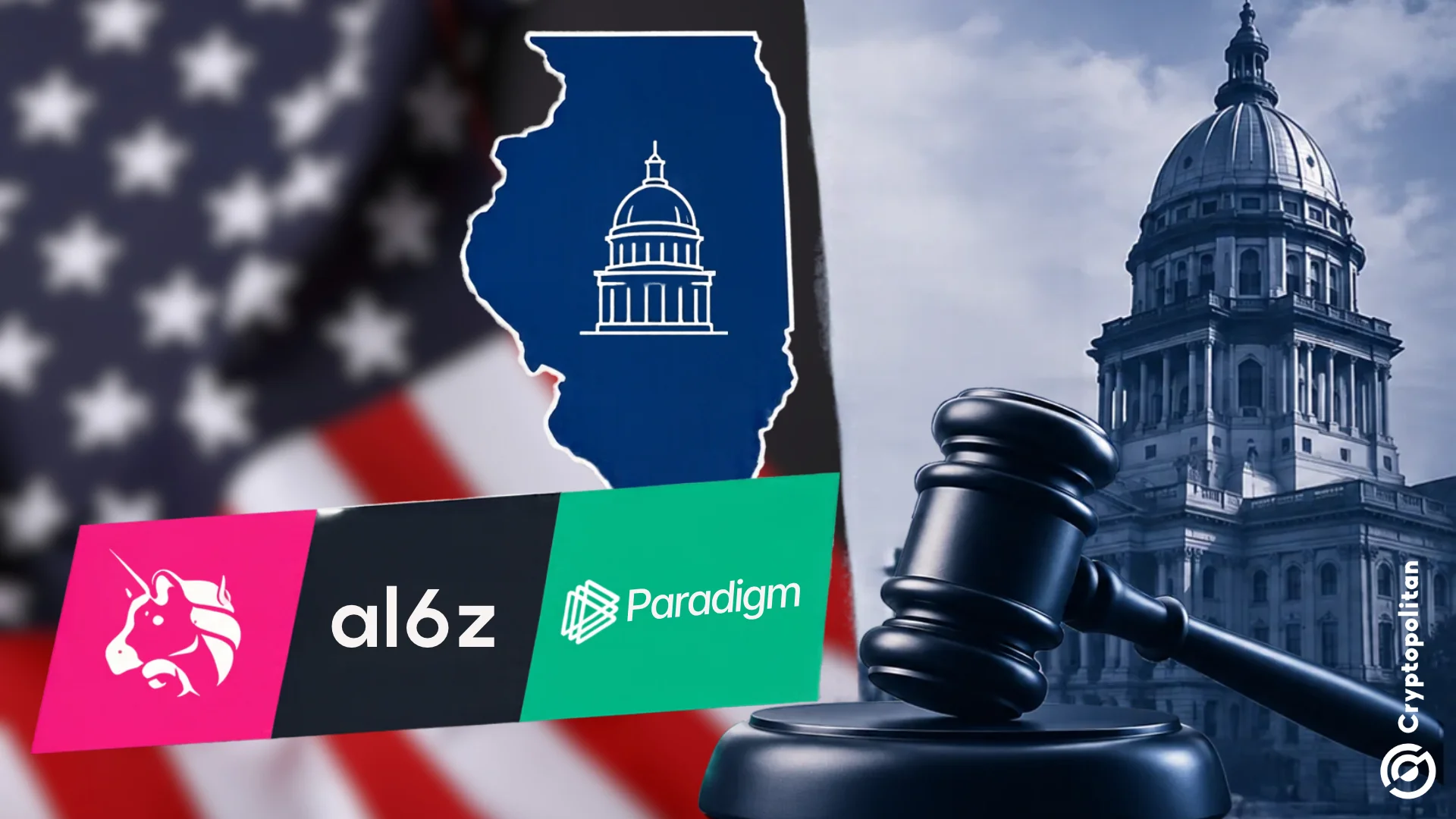
A coalition of DeFi builders led by Uniswap, Andreessen Horowitz (a16z) and Paradigm have filed a court brief supporting the crypto industry’s lawsuit against Illinois’s 0.2% digital asset tax.
The coalition is warning that the state’s draft rules would turn fee-charging decentralized exchanges and their frontends into tax-collecting brokers.
It is like a repeat of a fight that many thought was already won in Washington, but this time around it is at the state level. In April 2025, Congress and President Donald Trump scrapped a federal IRS rule that would have forced DeFi platforms to report user transactions as if they were brokers.
Who signed on, and who else is in the fight?
The brief was filed in the Circuit Court of Sangamon County and backs a challenge brought by the Crypto Council for Innovation (CCI) and the Blockchain Association.
The other signatories to the brief alongside the DeFi Education Fund, a16z, Paradigm and Uniswap, are Aave Labs, Aptos Labs, Aztec Labs, Chainlink Labs, Jito Labs, Orca Creative, Phantom Technologies, Multicoin Capital, the Solana Policy Institute and Stand With Crypto.
The coalition is also not without support from the federal level, as the Blockchain Association said the US Department of Justice filed a statement of interest on November 6, arguing the tax “undermines federal policy and American leadership in digital assets.”
The US Chamber of Commerce and the Securities Industry and Financial Markets Association (SIFMA) also filed their own amicus brief the same day.
The association warned that the levy would go beyond crypto-native firms to reach banks, broker-dealers, and custodians that offer digital asset products.
Why are builders saying that a DEX cannot collect tax?
a16z’s head of policy, Miles Jennings, shared his thoughts on the matter on October 30 after he said that his organization, The DeFi Education Fund, and Uniswap were joining the fight against the tax act.
He said the state’s approach was not possible to comply with, as “autonomous software is not a person that can collect a tax.”
There is also a draft provision in the act that requires brokers to store the private keys of customers, and it was flagged in an October letter. The signatories say that it would expose users to theft.
They asked regulators to swap the term for “public keys” instead.
When was the tax act signed and who is fighting against it?
The legislation that is causing the lawsuits was signed by Governor JB Pritzker as the Illinois Digital Asset Tax Act in June 2026. It was part of the state’s fiscal 2027 budget.
It imposes a 0.2% charge on the value of a digital asset each time an Illinois customer exchanges, transfers, or stores it through a broker.
The charge is there even when there is no sale or gain made by the customer, and it carries a class 3 felony charge for noncompliance.
Stakeholders have since taken the state to court over the law. The first was the Digital Chamber, which sued in July, while CCI and the Blockchain Association followed in September.
In October, the state agreed to postpone the tax from January 1, 2027, to July 1, 2027, while the litigation proceeds.
Where did the DeFi broker rule come from?
In December 2024, at the dawn of the Biden administration, the Treasury Department finalized a rule that would have seen platforms that facilitate digital asset transactions file Form 1099-DA on user activity. This was the DeFi broker rule, and it was to take effect in 2027.
However, the rule will not be activated by the due date, as President Trump killed it when he signed a congressional review act resolution on it on April 10, 2025.
The current dispute in Illinois is going to show if the state can prevail where the federal government had a rethink, or if the industry can wave off a state’s rule that challenges the ways decentralized exchanges currently operate.
The smartest crypto minds already read our newsletter. Want in? Join them.
FAQs
Who filed the brief against the Illinois crypto tax?
A coalition led by the DeFi Education Fund, Andreessen Horowitz, Paradigm and Uniswap, joined by firms including Aave Labs, Chainlink Labs, Phantom Technologies and the Solana Policy Institute, filed an amicus brief in Sangamon County Circuit Court backing the Crypto Council for Innovation and Blockchain Association lawsuit.
What does the Illinois Digital Asset Tax Act do?
Signed by Governor JB Pritzker in June, it imposes a 0.2% tax on the value of a digital asset each time an Illinois customer exchanges, transfers or stores it through a broker, even when no sale or gain occurs. Implementation has been delayed from January 1, 2027, to July 1, 2027.
How does this connect to the federal DeFi broker rule?
In April 2025, Trump signed a Congressional Review Act resolution overturning a Treasury rule that would have required DeFi platforms to report user transactions as brokers. The coalition argues Illinois is reviving that same discarded definition at the state level.
Disclaimer. The information provided is not trading advice. Cryptopolitan.com holds no liability for any investments made based on the information provided on this page. We strongly recommend independent research and/or consultation with a qualified professional before making any investment decisions.
Hannah Collymore
Hannah is a writer and editor with nearly a decade of blog writing and event reporting experience in the crypto space. At Cryptopolitan, Hannah contributes to the news page, reporting and analyzing the latest developments in DeFi, RWA, crypto regulation, AI and frontier tech industries. She graduated from Arcadia university with a degree in Business Administration.
5 Ingenious Applications of ChatGPT And What You Should Do About Them
93% Business Leaders Favor AI-Powered Solutions for Brand Sustainability Management, Reuters
Here’s How Macron Supports France’s Vibrant and Productive AI Ecosystem
Bloomberg Estimates the Generative AI Market to Reach $1.3 Trillion by 2032
- Bitcoin ETF vs. Ethereum ETF: What’s the Difference? November 5, 2025 Learn Crypto: Beginner Guides
- What Is Base? The Ethereum Layer-2 Network Launched by Coinbase October 21, 2025 Learn Crypto: Beginner Guides
- Dogecoin vs. Bitcoin: Key Technical Differences October 20, 2025 Learn Crypto: Beginner Guides
- What Is TVL (Total Value Locked) in Crypto? October 14, 2025 Learn Crypto: Beginner Guides
- How to Read a Crypto Whitepaper? October 13, 2025 Learn Crypto: Beginner Guides
- Ripple vs. XRP vs. XRP Ledger: What’s the Difference? October 13, 2025 Learn Crypto: Beginner Guides