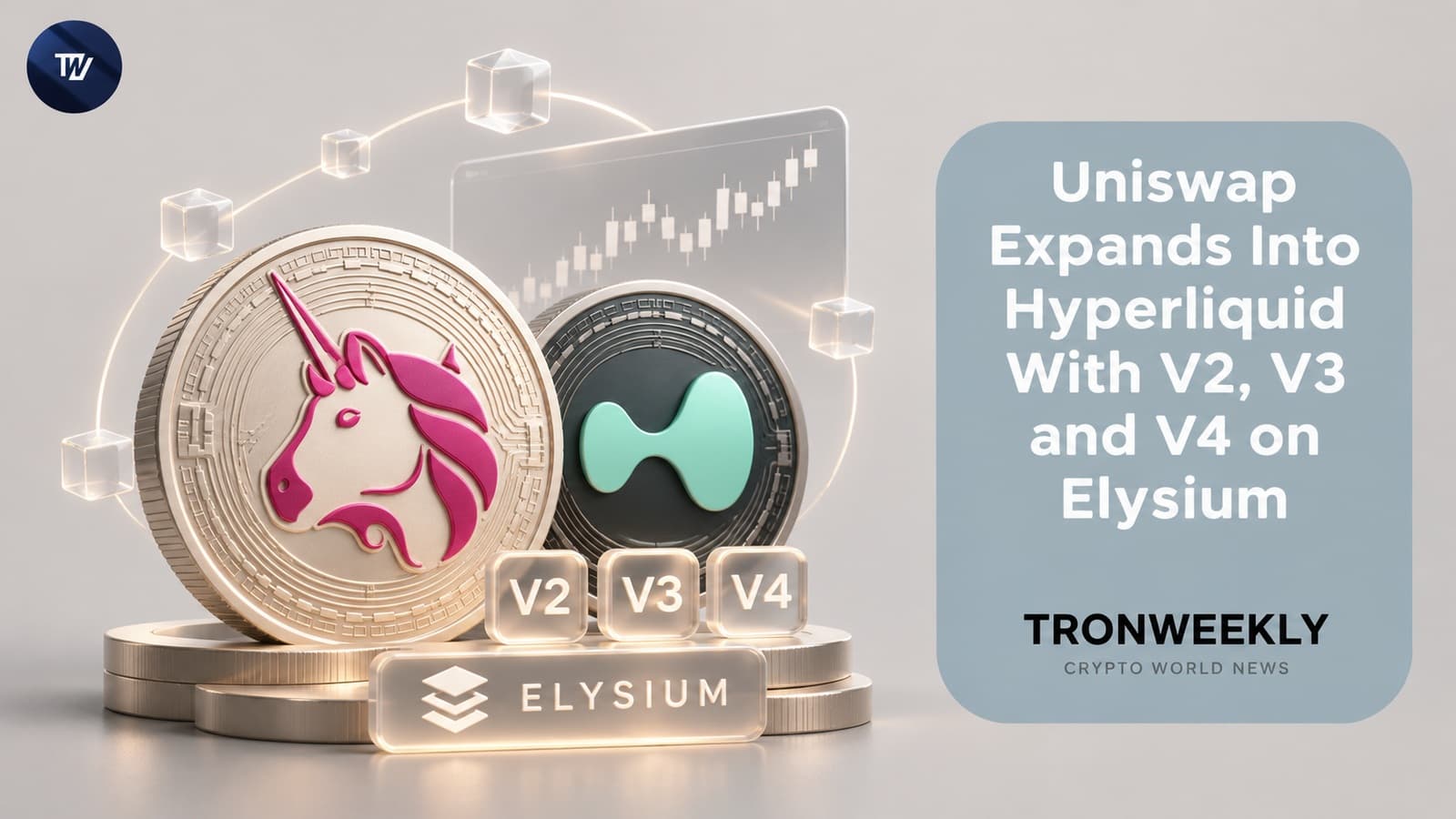
Uniswap has deployed its v2, v3, and v4 protocols on Elysium, a Layer 2 network built for the Hyperliquid ecosystem. The November 11 update followed the launch of Kinetiq’s mainnet by two days and has provided the developers with three different trading systems.
Table of Contents
Uniswap confirmed the expansion in an X post and directed developers to its official contract addresses. The deployment enables developers to build token exchange services and liquidity pools.
In the developer registry maintained by Uniswap, the contracts for each version are listed. In version 2, there are factory and router; while in v3, there are factory, position manager, and pricer. The listing of the v4 version contains PoolManager, PositionManager, Universal Router, Quoter, and StateView.
How Uniswap’s Three Versions Work on Elysium
The networks use chain IDs 99901 and HYPE for network transaction fee payment. The settlement environment HyperEVM uses its own chain ID of 999. Also, the networks have different v4 PoolManager addresses.
Also Read: Solana Expands RWA Market With 200+ Equities as SOL Price Eyes Upside Move
Uniswap asks developers to ensure the correct contract addresses for each network. Application may connect to the wrong contract by using the address of another chain. The registry offers the required mappings for the integration.
In version 2, the protocol introduces automated liquidity pools for direct token swaps. Uniswap launched the model in May 2020. It offers trading without the traditional order book. Users make a swap of assets against liquidity provided by the liquidity providers.
Concentrated liquidity was added in version 3 in May 2021. The liquidity providers set up price ranges for their positions instead of spreading their funds at all possible prices. It may help in efficient utilization of capital at the selected price range.
Positions cease to earn the fees once the price goes out of the price range. The fee income starts if prices return. The liquidity providers can distribute their funds between several price ranges.
Uniswap v4 keeps the concentrated liquidity and pool management changes. The PoolManager contract keeps information about pools in one contract and does not need a separate contract for every pool. It also allows for joint settlement of balances.
Uniswap v4 allows hooks to execute custom code before and after the trade and liquidity actions. Hooks may be used for fees adjustment, automated management, and many other pool properties. Settings of hooks define when it occurs.
What Kinetiq’s Elysium Network Offers
Elysium, Kinetiq’s public mainnet, has been launched on November 9 using Arbitrum technology and Conduit-run infrastructure. Transactions in Elysium settle to HyperEVM and run side-by-side with HyperCore.
According to Kinetiq, Elysium has 100 ms block times and 300 million gas per second. This is how Elysium is designed to work. Gas is the measure of computational work that smart contracts perform.
Kinetiq states that Solidity and Vyper contracts run unchanged. Developers are able to utilize well-known Ethereum development tools like Foundry, Hardhat, Viem, and Ethers for application deployment.
HYPE can be transferred from HyperEVM to Elysium one-to-one without wrapping. Supported ERC-20 tokens can also be bridged to Elysium from HyperEVM. Spot trading, lending, and derivatives are some of the planned use cases.
How Elysium Plans to Fund Developers
Kinetiq has committed 50% of its sequencer income to repurchasing KNTQ, its native token. Additionally, 25% of income will be used to reward developers whose apps create traffic within the network. These will depend on income earned.
Ecosystem lead of Uniswap Labs Ken Ng mentioned that the protocol is part of the Elysium launch infrastructure. Ng highlighted market creation, providing liquidity, and hooks. Integration with HyperCore was also noted as one way to utilize live market data in the future.
With the launch, builders have access to three protocol generations of Uniswap on Elysium. Trading volume and liquidity will be determined by the level of actual traffic. No amount of deposits to the newly created liquidity pools was disclosed.
Also Read: Fed Rate Hike Odds Hit 85% After Hot October Inflation
Arslan Tabish is a Technical Reporter and Market Analyst at Tron Weekly with over five years of experience covering cryptocurrency markets and blockchain developments. His reporting focuses on Bitcoin, Ethereum, altcoins, and decentralized finance, alongside NFTs, crypto regulation, policy, and Web3 innovations.
Arslan covers blockchain technology, Layer 2 scaling solutions, and emerging use cases, including AI-driven crypto applications, while delivering clear market analysis on how technical and regulatory developments impact digital asset markets. His work is designed for both beginners and experienced readers, offering accurate, easy-to-understand reporting without speculation or investment guidance.