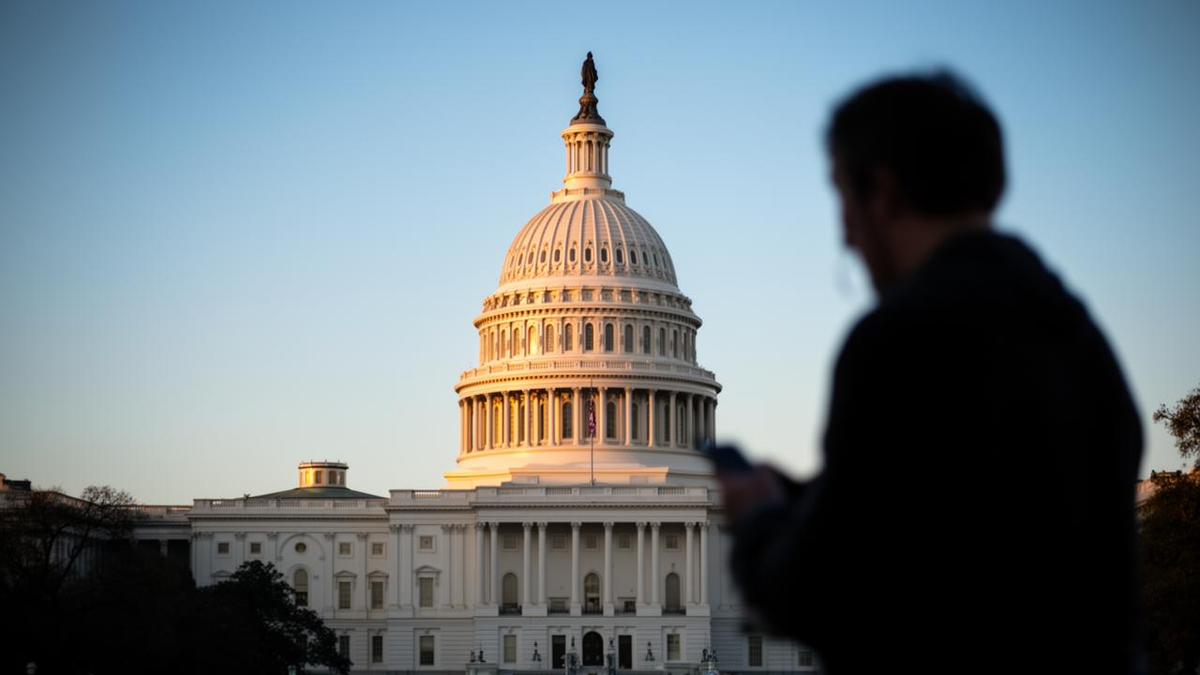
The first polls closed in Indiana and Kentucky late Tuesday, with control of both chambers of Congress still uncalled and the fate of the most consequential piece of US crypto legislation hanging on the outcome. All 435 House seats and 35 of the 100 Senate seats were on the ballot in the November 3 midterms, and neither chamber had been projected as of 00:50 CET Wednesday.
For digital-asset markets, the vote is less about the balance of power in Washington than about who will write the next market-structure law. The CLARITY Act, which cleared the House in July 2025 but died in the Senate 49 to 50 on September 15, expires on January 3 unless lawmakers act. Because the bill needs 60 votes to overcome a filibuster, no single election result can revive it on its own.
Prediction markets have largely priced in a Democratic takeover of the House. Polymarket's balance-of-power contract put a full Democratic sweep at 85.5% as of 00:50 CET, with a Democratic House and Republican Senate at 11.5%, Republicans holding both chambers at 2.2% and a Democratic Senate paired with a Republican House at 0.4%. Democrats need a net gain of three seats to take the House and four to take the Senate, where 65 seats are not up for election.
Four outcomes, four crypto paths
The practical consequences for the industry diverge sharply depending on which party controls the Senate.
Note: Odds from Polymarket's balance-of-power market at 00:50 CET Wednesday.
The most pointed assessment came from TD Cowen's Washington analyst Jaret Seiberg, who wrote on election day that a Democratic-controlled Congress would likely investigate Trump and his crypto ties, "which is why we do not expect the Clarity Act to pass over the next two years." Under a sweep, Elizabeth Warren would chair the Senate Banking Committee and Maxine Waters the House Financial Services Committee.
That leaves two routes for the industry. One is the lame-duck session running until January 3, where Senator Angela Alsobrooks, one of the bill's negotiators, still sees room for a deal before the new Congress is seated. The other is rulemaking at the SEC and CFTC, which can proceed without legislation as long as the agencies remain staffed.
Bitcoin holds steady as results trickle in
Bitcoin traded at $77,671 at 00:50 CET, down 0.3% from $77,877 just before the first poll closings and about 3.5% lower on the week, pressured by a hack at Binance and a broader Wall Street sell-off. Ether slipped 0.3% to $2,282. Brent crude eased 0.1% to $104.18 a barrel, WTI fell 0.4% to $96.31 and gold was essentially flat at $3,940.60 an ounce. S&P 500 futures were down 0.1% at $7,618.25.
Note: Prices in US dollars per unit as of 00:50 CET Wednesday.
Because a sweep is so heavily priced, a Democratic win alone would carry little surprise. The reaction to watch is a Republican hold on the Senate or a late shift in Texas and Ohio. History offers no reliable guide: in the 30 days after the last six US elections, Bitcoin moved anywhere between a 45% decline and a 44% gain.
The Senate map remains fluid. Five races were rated toss-ups -- Alaska, Maine, Michigan, Ohio and Texas -- while Iowa, Kansas and South Carolina leaned Republican. Democrats must defend Georgia, Michigan, New Hampshire and Minnesota while flipping four seats elsewhere, making North Carolina and Ohio, which report early, the first real signal. Several contests could take days to resolve: Alaska and Maine use ranked-choice voting, and Georgia heads to a runoff if no candidate clears 50%.
Preliminary exit polling pointed to a sour national mood. Seventy-five percent of respondents described the economy as not so good or poor, against 32% in 2018, and 79% said inflation had caused them hardship. Trump's approval stood at 38%, with 62% disapproving. Those are survey figures rather than counted votes and can shift overnight.
Why the Senate's 60-vote threshold matters
Even a Republican sweep would not deliver the CLARITY Act, since the 60-vote filibuster threshold still requires Democratic support. The difference lies in whether the bill stays alive for negotiation. Republican committee chairs would keep crypto legislation on the table in a divided Congress, while Democratic control of either chamber would shift the focus toward oversight hearings and nominee fights.
The industry has spent more than $170 million this cycle, largely through the Fairshake PAC, including more than $60 million aimed at keeping Sherrod Brown out of the Senate in Ohio. Brown, among the most consistent crypto critics in recent Senate history, would otherwise be positioned to shape the Banking Committee's agenda.
Beyond crypto, the result will shape the legislative branch's posture toward the White House during Trump's final two years. A Democratic Congress would be expected to launch investigations into the administration's conduct, while a stronger-than-expected Republican showing would reinforce the president's hold on his party and keep trade policy on its current high-tariff course.
Control of the House could become clear by Wednesday morning European time if Democrats win the early battlegrounds in the East, but California and other Western states count for days and the last polls close in Alaska at 07:00 CET. Senate control may hinge on Alaska, Maine or a Georgia runoff. The next scheduled marker is the US jobs report on Friday, November 6, followed by the lame-duck session and the seating of the new Congress on January 3, 2027.