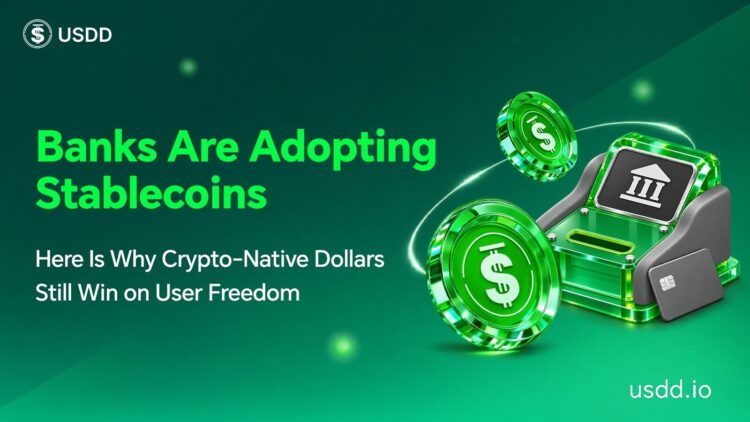
USDD outlines why decentralized stablecoins can outcompete bank-issued digital dollars: self-custody, 24/7 transfers, multichain reach, transparent reserves, and onchain yield distribution via sUSDD.
Access: Permissionless wallets instead of bank accounts
Traditional banking requires paperwork, minimum balances, geographic eligibility, and approval delays. USDD enables immediate access through any wallet on supported networks. Users manage funds directly, choose their own wallets and apps, and move assets across open blockchain rails without intermediary control.
Settlement: Always-on transfers and simplified fees
Banks follow limited operating hours, cutoffs, and holidays, with multi-day cross-border settlement and higher wire fees. USDD operates continuously. GasFree on TRON lets supported wallets pay fees in USDD, removing the need to hold TRX. Referenced costs: about 0.5 USDD per transaction versus around 1.5 USDT for a standard USDT transfer under the stated conditions. Low fees and 24/7 availability aim to make stablecoins practical for everyday payments.
Yield: Passing returns to users
Banks capture spreads from depositor funds. USDD’s USDD Earn converts deposits to sUSDD, allocating capital via a Smart Allocator to deliver onchain, automated yield without fixed lockups. Users retain flexibility while accessing productive stablecoin exposure.
Verification: Onchain data instead of closed ledgers
- Onchain transparency: Smart contracts, collateral reserves, and allocator deployments are publicly visible.
- Structured disclosures: Quarterly Treasury Reports detail reserves, performance, and operations.
- Independent security reviews: Third-party audits assess smart contract risk.
Users can independently examine data rather than rely solely on institutional assurances. Transparency clarifies, but does not remove, financial and technical risks.
Reach: Multichain utility and DeFi integrations
Post–January 2025 upgrade, USDD operates natively on TRON, Ethereum, and BNB Chain. The multichain model connects to varied liquidity and user bases. sUSDD integrates with DeFi protocols such as Pendle and Morpho, widening access to yield strategies across ecosystems. The aim: seamless movement between holding, transferring, exchanging, and deploying stablecoins as core financial infrastructure.
Outlook
Banks are adopting stablecoin rails for back-end settlement. USDD positions decentralized stablecoins as open, self-custodied, global, and yield-enabled financial primitives that extend beyond bank constraints. The protocol emphasizes transparent reserves, continuous availability, GasFree transfers on TRON, and multichain DeFi access to make digital dollars accessible and productive.
Authors credited by the source: BlockmanPR
Published by Holder based on an external source.