Share
Ethereum co-founder Vitalik Buterin wants the crypto industry to look past firmware and inspect the chip itself.
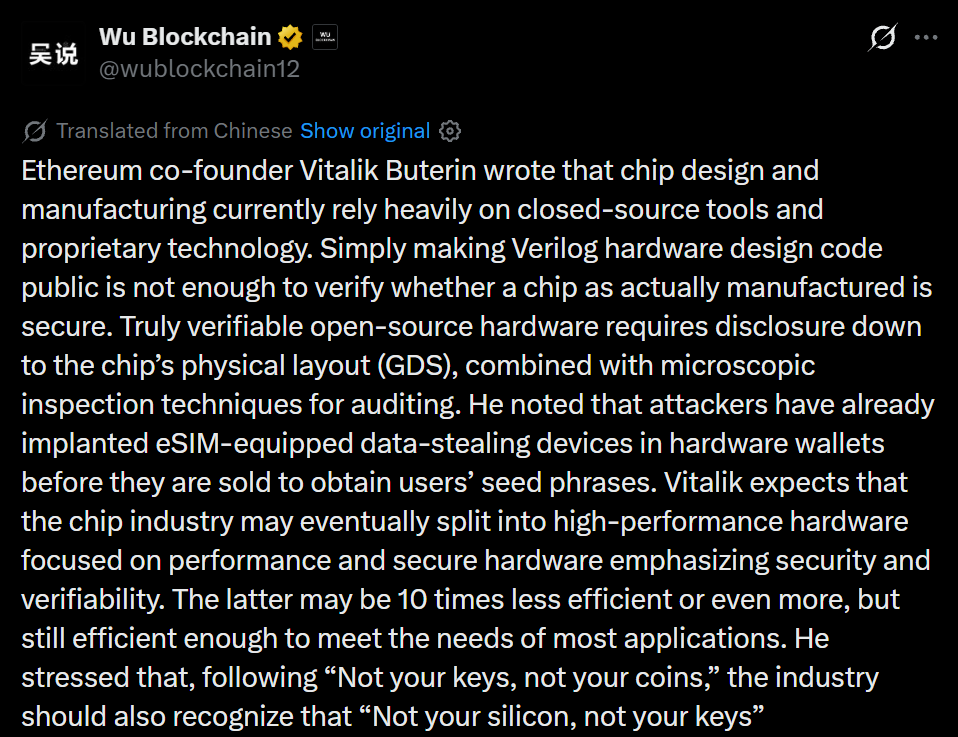
In a blog post published Thursday, he warned that future hardware wallet attacks could rely on lookalike chips carrying hidden malicious functions. Those swaps would be extremely hard to spot from the outside.
His core complaint is about transparency. According to Buterin, most commercial open-source chips do not reveal enough about their physical construction for anyone to confirm what they actually are.
Open source, but only up to a point
The post, titled “A shallow dive into open-source chip design,” went up on November 26, 2026. Its argument is simple to state and hard to fix.
Publishing the high-level code used to describe a chip, such as Verilog, is not enough for real security verification. Buterin argues that verifiers also need the detailed physical layout files, known as GDS files, plus the ability to examine the finished chip under a microscope.
That is the gap Buterin is pointing at. Commercial open-source chips typically do not hand over GDS files, which means independent verification stops before it reaches the silicon.
Not your silicon, not your keys
Buterin also offered an update to one of crypto’s oldest slogans. The original warned users that keeping coins on an exchange means trusting someone else with their keys.
“Not your silicon, not your keys.”
“Not your silicon, not your keys.”
The extended version makes a sharper point. Self-custody depends on every layer underneath the wallet app, and the chip is the bottom layer.
AI, tech, and the markets they move—in one daily briefing.
Daily. Free. Join 34,000+ readers across crypto, finance, and policy.
We respect your privacy. Unsubscribe anytime.
Hardware wallets exist to keep private keys offline and away from internet-connected devices. That protection only holds if the hardware is honest, though. A compromised chip turns a vault into a very convincing decoy.
This is not purely theoretical. Buterin referenced real supply-chain attacks in which bad actors implanted eSIM-based devices into wallets to pull out recovery phrases. Those attacks did not require any changes to the firmware.
That detail matters. Much of the industry’s security messaging focuses on verified firmware and signed updates. An implant that works around the software leaves those checks looking fine while the user’s seed phrase quietly walks out the door.
A split between fast chips and trustworthy ones
Buterin expects the hardware industry to divide into two camps. One will chase performance, as chipmakers always have. The other will be built from the ground up for security and verifiability.
The trade-off is steep. He suggested that security-focused hardware could end up 10x less efficient than its performance-oriented counterparts.
The idea did not come out of nowhere. The post builds on earlier chip-design proposals from the Ethereum Foundation and on themes Buterin raised during his Devcon 8 keynote.
Why the timing matters
The post lands a month after a costly reminder of what hardware failures can do. In October 2026, an incident involving a compromised hardware wallet drained $95.35 million from 1,486 addresses, linked to an unauthorized implant.
Incidents like that undercut the basic promise of cold storage. If the device itself can be tampered with somewhere along the supply chain, the burden shifts from the user’s habits to the manufacturer’s processes and the chip foundry’s integrity.
What this means for wallet makers and users
For hardware wallet manufacturers, Buterin’s argument raises the bar considerably. Publishing firmware and even chip design code may no longer be enough to earn the “open” label in the eyes of security-minded users.
The harder ask is releasing physical layout files and supporting real inspection of finished chips. That runs into commercial realities, since chip vendors often treat layout details as closely guarded intellectual property.
Supply-chain attacks like the eSIM implants Buterin described target the path a device takes before it reaches the buyer. Where a wallet comes from, and whether it could have been opened along the way, deserves as much scrutiny as the brand name on the box.