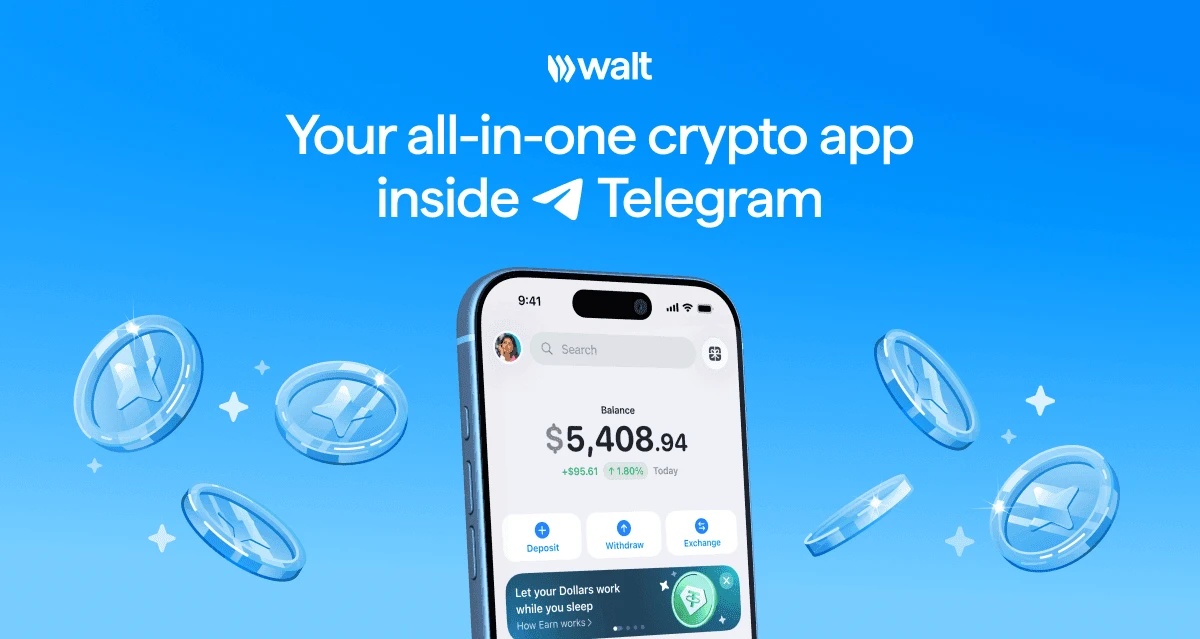
Walt, a crypto wallet that previously operated inside the Telegram messaging app ecosystem, has officially launched a standalone application, extending investment services such as crypto trading, tokenized US stocks and perpetual contracts from the chat interface to the phone's home screen. The move means Walt is no longer just a small tool inside Telegram, but has stepped directly into the fiercely competitive retail trading platform arena.
Walt, formerly known as "Wallet in Telegram," had provided services within Telegram for nearly five years and completed its rebrand on September 28 this year, in line with its expansion from a simple wallet into a full investment platform. The company said its existing Telegram product will continue to operate, and users can switch between the two with the same account; existing users can log into the standalone app directly with their Telegram accounts, while new users can register with Telegram, Google or Apple accounts.
According to the product lineup disclosed on its website, Walt currently supports more than 200 cryptocurrencies and over 100 tokenized US stocks and ETFs, and also offers perpetual contracts tied to crypto, metals and energy prices. On the yield product side, it covers stablecoins as well as deposit schemes for assets including Gram, Solana, Ethereum and Tron.
On transfer fees, Walt has adopted a design that distinguishes internal from external transfers. Users transferring crypto assets to each other within Telegram are not charged; to move assets to an external wallet, on-chain transfers are subject to blockchain network fees plus a platform service fee. On the TON network, for example, transferring any amount of USDT to an external address requires an additional 1 USDT service fee.
Walt CEO Andrew Rogozov said: "Walt started as a simple bot for buying crypto and has become a full investment platform used by tens of millions of people. We built the best crypto product in Telegram, and now we're opening it up to everyone." His remarks highlight the company's repositioning from a single-function bot to a comprehensive investment gateway.
Beyond trading features, Walt has also brought artificial intelligence into the order-placement process. The company launched AI-assisted perpetual contract trading on October 20, with agents powered by models including Mira, ChatGPT and Claude responsible for reading real-time perpetual contract prices, analyzing positions and risk exposure, and able to open and close positions. However, the order execution function is disabled by default, and the agent cannot withdraw or transfer funds, creating a firewall between convenience and asset security.
Note: Information compiled from Walt's official website and company statements.
From an industry perspective, Walt's move is about converting Telegram's massive traffic dividend into a trading business it can run independently. Telegram has long focused on messaging and community features; while its built-in wallet can reach a large number of users, it is ultimately limited in interface depth, product complexity and compliance disclosure. A standalone app allows Walt to design a complete order-placement, risk-control and asset-management process comparable to professional exchanges, and makes it easier to build brand identity.
For investors, the tokenized US stocks and ETF lineup is worth watching. Such products allow users to gain US equity exposure within a crypto wallet, bypassing the traditional brokerage account-opening process, but they also involve issues of custody, settlement and regulatory jurisdiction for tokenized assets, and rules in various countries are still evolving. If Walt wants to expand across multiple markets, how it handles the compliance boundaries of security tokens will be a key focus going forward.
On the other hand, perpetual contracts and AI-assisted trading features, while enhancing the product's appeal, also magnify the difficulty of risk management. Walt's decision to disable the AI agent's authority to transfer funds shows the company is aware of the controversy that automated trading may bring, but the actual effectiveness of operations and user protection mechanisms remain to be tested by the market. As competition among retail trading platforms intensifies, whether Walt can smoothly channel the tens of millions of users accumulated during the Telegram era to its standalone app will determine the ultimate success of this cross-boundary step.