- Warren eyes prediction-market, Trump crypto scrutiny as Banking Chair 1 minute ago Regulation
- Hyperliquid’s Weekly Priority Fees Climb to an All-Time High of $1.2M 9 minutes ago News
- Vitalik Buterin, Ethereum Foundation sued over “suicide pledge” firing 23 minutes ago News
- JPMorgan weighs $2B Qualtrics debt discount as AI fears mount 58 minutes ago News
- EU calls on industry to write tokenization standards as ECB races to head off fragmentation 15 hours ago Regulation
- New Zealand’s FMA moves to spark local stablecoin scene with stablecoin rules draft 16 hours ago Regulation
- FinCEN cuts MEXC off from US banking over $16.7B in illicit flows November 7, 2026 Regulation
- Elizabeth Warren is expected to chair the Senate Banking Committee when Democrats take control in January.
- She could use hearings and investigations to scrutinize crypto firms and Trump-linked financial ventures.
- Prediction markets are regulated by the CFTC, so Warren would not directly control their rules.
Elizabeth Warren wants to scrutinize prediction markets and the cryptocurrency ventures of President Donald Trump more closely. The victory of the Democratic Party in the midterm congressional elections paved the way for her to take the Chair position in the Senate Banking Committee in January 2027.
The appointment is not yet final, though. Reuters believes that this new role would enable her to conduct investigations. Yahoo Finance has also reported that hearings fall in the scope of her agenda.
What a Banking chair can and cannot touch
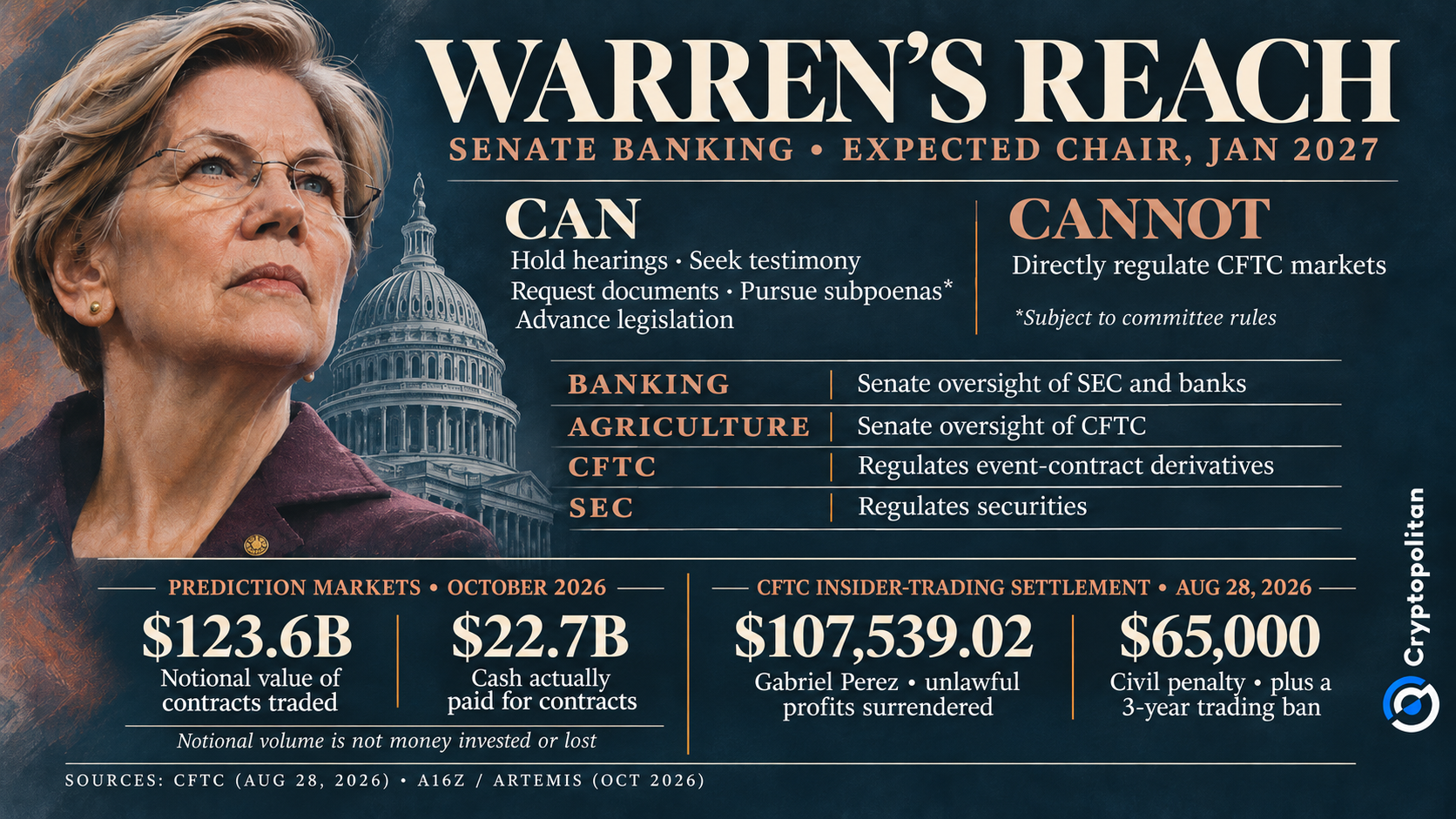
As Banking Chair, Warren has the authority to initiate hearings, obtain relevant documents and testimonies, issue subpoenas in accordance with the procedures of the committee, and expedite bills. However, she does not possess any authority to create rules for prediction markets.
The Commodity Futures Trading Commission (CFTC) regulates derivatives-based event contracts, while the Senate Agriculture Committee oversees the agency. The Senate Banking Committee, meanwhile, oversees securities regulation and federal banking regulators. In September, Cryptopolitan reported that Banking Democrats had already demanded a public hearing on prediction markets.
The cases that show where safeguards fail
Two federal cases have raised concerns about insider trading in prediction markets. This added weight to lawmakers’ calls for closer scrutiny.
On August 28, the CFTC ordered White House teleprompter operator Gabriel Perez to return $107,539.02 in profits from bets based on advance knowledge of presidential speeches. He also received a $65,000 civil penalty and a three-year trading ban. Kalshi helped the investigation.
In April, the Justice Department charged Army soldier Gannon Ken Van Dyke with allegedly using classified information about the operation to capture Nicolás Maduro to profit from Polymarket bets. Prosecutors allege Van Dyke made more than $400,000 from the bets. The allegations have yet to be proven in court.
Where commodities law leaves gaps
While federal regulators have been able to take legal action against specific instances of insider trading, researchers believe that prediction markets involving election results would need more protections.
According to an October report published by the Council on Foreign Relations, Americans had already wagered around $1.4 billion on the 2026 midterm elections. The report predicted that the amount will be over 2 billion dollars by the time of the elections.
The researchers recommended the need for more precise insider trading regulations, provision of information regarding massive positions, and better control over offshore exchanges.
Legislators from both parties are concerned about the points mentioned. On October 29, Senators Warren and Curtis questioned Polymarket and Kalshi regarding protections against wrongful trading related to elections.
The Trump family conflicts question
Warren’s expected investigations could extend beyond prediction markets. Reuters reported that she may examine the August bank-charter approval for World Liberty Financial, a crypto venture linked to President Trump.
Warren had previously requested an investigation into possible illicit-finance and national-security risks involving the company. Her concerns are not established findings of wrongdoing.
Disagreements over Trump-related ethics safeguards also helped stall the CLARITY Act in September, according to the Associated Press. Warren could investigate the charter approval and push for legislative changes, but she cannot revoke the charter herself.
What the numbers do and do not show
October trading figures show why US oversight could matter beyond Washington. Prediction-market activity reached $123.6 billion in notional volume, compared with $22.7 billion actually paid for contracts, according to market analysis using data tracked by Artemis.
The distinction matters. Notional volume measures trading activity, not how much investors deposited or lost.
Stricter US rules could increase compliance costs and push some trading offshore. Stronger safeguards might also improve investor confidence. The impact on global markets will depend on future legislation, regulatory decisions, and how trading platforms respond.
If you're reading this, you’re already ahead. Stay there with our newsletter.
FAQs
When will Elizabeth Warren become chair of the Senate Banking Committee?
She is expected to take the gavel in January 2027 after Democrats won control of Congress in the November 2026 midterms, according to Reuters and Yahoo Finance.
Can the Senate Banking Committee regulate prediction markets directly?
No. The CFTC regulates event contracts on registered exchanges, with primary CFTC oversight under the Senate Agriculture Committee; a Banking chair can hold hearings, seek documents and testimony, pursue subpoenas and advance legislation.
What enforcement cases show insider-trading risk in prediction markets?
The CFTC settled with former White House teleprompter operator Gabriel Perez for $172,000 over trading on presidential mention contracts, and the Justice Department charged soldier Gannon Ken Van Dyke with using classified information to bet on Polymarket, an allegation not yet proven.
Disclaimer. The information provided is not trading advice. Cryptopolitan.com holds no liability for any investments made based on the information provided on this page. We strongly recommend independent research and/or consultation with a qualified professional before making any investment decisions.
Micah Abiodun
Micah Abiodun makes good use of his Environmental Engineering and Management (MSc) at Tallinn University of Technology (TalTech) to polish content and price prediction news at Cryptopolitan. Now on his 7th year in the crypto media space, he covers major cryptos, altcoins, DeFi, stablecoins, macro trends, and emerging tech.
5 Ingenious Applications of ChatGPT And What You Should Do About Them
93% Business Leaders Favor AI-Powered Solutions for Brand Sustainability Management, Reuters
Here’s How Macron Supports France’s Vibrant and Productive AI Ecosystem
Bloomberg Estimates the Generative AI Market to Reach $1.3 Trillion by 2032
- Bitcoin ETF vs. Ethereum ETF: What’s the Difference? November 5, 2025 Learn Crypto: Beginner Guides
- What Is Base? The Ethereum Layer-2 Network Launched by Coinbase October 21, 2025 Learn Crypto: Beginner Guides
- Dogecoin vs. Bitcoin: Key Technical Differences October 20, 2025 Learn Crypto: Beginner Guides
- What Is TVL (Total Value Locked) in Crypto? October 14, 2025 Learn Crypto: Beginner Guides
- How to Read a Crypto Whitepaper? October 13, 2025 Learn Crypto: Beginner Guides
- Ripple vs. XRP vs. XRP Ledger: What’s the Difference? October 13, 2025 Learn Crypto: Beginner Guides