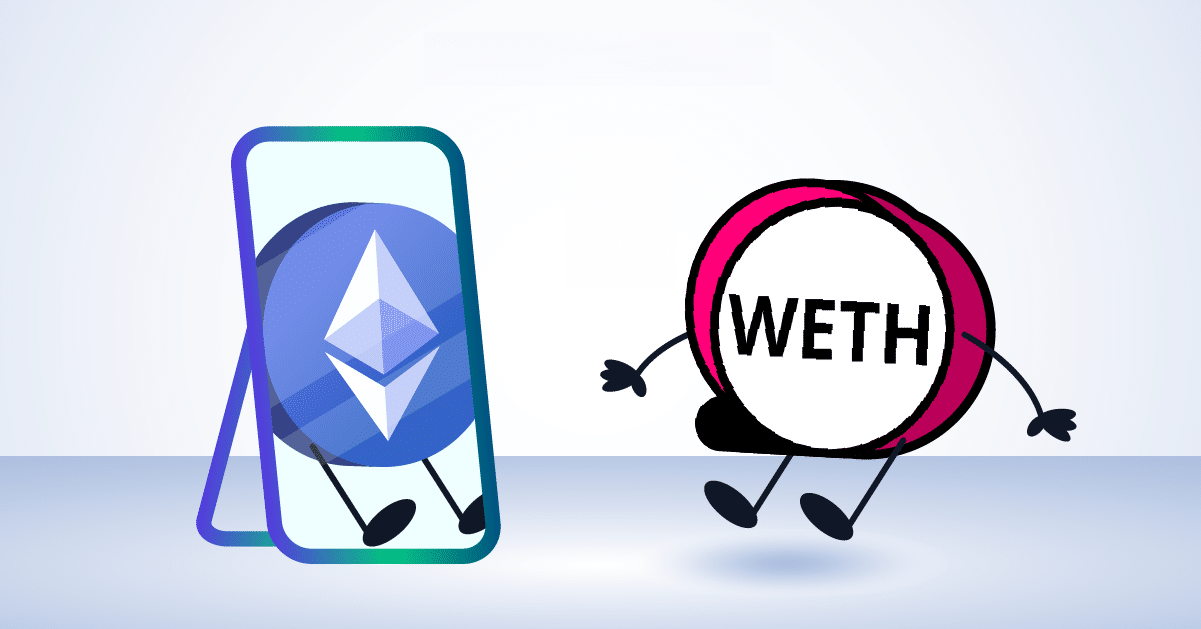
Key Takeaways
- Wrapped Ethereum (WETH) has the same 1:1 pegged value as native Ethereum (ETH).
- It is called Wrapped ETH because it is a “wrapped” version of native ETH in order to be compatible with the ERC-20 token standard and usable in decentralized finance (DeFi).
- WETH may be an ERC-20 token but it is present in other layer 1 and layer 2 blockchains as well.
Have you noticed that some tokens have the word “wrapped” in their name like Wrapped BTC (WBTC) or Wrapped ETH (WETH)?
We are going to be discussing about wrapped tokens, specifically Wrapped Ethereum, how it works, how it compares with the native Ethereum token, and the best scenarios for when to use a wrapped version of Ethereum.
WETH versus ETH
So we know that wrapped tokens are digital representations of another underlying asset.
For example, Wrapped Bitcoin (WBTC) is a “wrapped” version of Bitcoin that runs on the Ethereum network.
Similarly, Wrapped Ethereum (WETH) is a “wrapped” version of Ethereum that can run on different layer 1 and layer 2 blockchains.
In essence, wrapped tokens are like bridge assets that allow users to transact with different crypto assets on different blockchains.
Why WETH exists: the ERC-20 standard
It might sound confusing, but why do we need to use a proxy token for Ethereum on its own native blockchain?
This is due to the fact that Ethereum was launched before token standards were created. The native ETH token is not ERC-20 compliant, so it makes it harder to use frequently. Therefore, in order to remove the need for a third party, users can simply send their ETH to a smart contract and get WETH of the same value in return.
Do note that ERC-20 is a token standard for issuing tokens on the Ethereum blockchain, and it only defines the token’s properties. One of the most important aspects of an ERC-20 token is that it is fungible, which means that one token is always exchangeable for another of the same value. For context, crypto assets like Basic Attention Token (BAT), Compound (COMP) and Aave (AAVE) are all ERC-20 tokens.
Overall, Wrapped Ethereum’s main purpose is to expand users’ options not just on the Ethereum network but on other networks as well, allowing faster transaction speeds and even lower fees.
How wrapping works
Wrapped tokens are produced and destroyed through processes known as “minting” and “burning.” To create a wrapped token, the underlying asset, in this case ETH, is sent to a smart contract. Once the native ETH is secured, an equivalent amount of WETH can be created.
This procedure is also known as “wrapping” because a smart contract is used to “wrap up” the underlying asset in a digital vault, and a newly wrapped asset is minted for use on another blockchain.
The same procedure is used to burn WETH, but in reverse. The WETH token is removed from circulation and the equivalent amount of native ETH is released from and returned to the market.
Minting wrapped tokens is analogous to “wrapping” the underlying asset to create a token of equivalent value for use on another blockchain, whereas burning wrapped tokens is analogous to “unwrapping” the underlying asset.
Because of this minting and burning, or wrapping and unwrapping, all wrapped tokens, from WBTC to renDOGE (a wrapped version of Dogecoin), are backed by an equivalent amount of their underlying currency. For every 100 renDOGE minted, 100 DOGE are held in reserve to back the value of the wrapped token.
How to wrap and unwrap ETH
Now that we have learned the theory of wrapping and unwrapping an underlying asset like Ethereum. I’m going to provide a step-by-step guide on how to do it in a custodial wallet like MetaMask and on a decentralized exchange like Uniswap.
In MetaMask
Assuming you already have MetaMask installed as a browser extension or mobile app and have ETH in your wallet, go to the homepage and click “Swap.”
After clicking Swap, select ETH on the Ethereum network in the first section, then select WETH on the Ethereum network at the bottom.
Enter the amount of ETH you want to wrap into WETH. Review the details shown on your screen before hitting the swap button. Also leave a bit of ETH tokens for transaction fees.
On Uniswap
Head over to Uniswap and connect your Web3 wallet where your native ETH tokens are held.
Now that you have connected your wallet, first select ETH on the Ethereum network as your main token to wrap, and at the bottom select WETH on the Ethereum network as the token you want to be converted to.
Also enter the amount of ETH tokens you want to convert into WETH. Remember to keep some native ETH for gas fee transactions.
After confirming the details such as the transaction fee and the expected amount of WETH you will get, click “Swap” and approve the transaction when the pop-out window opens.
WETH on other chains (bridged WETH)
Notably, you can also have WETH on other blockchains as well. In Uniswap, you can choose up to more than 25 blockchain networks that support Wrapped Ethereum.
Is WETH on Arbitrum or Base the same thing?
In terms of price value, yes they are still the same. The only difference is that they are on different blockchains.
So when sending WETH, make sure you are on the same blockchain network as the sender. Don’t send WETH on Arbitrum to someone who has WETH on Base.
When receiving, ask which blockchain their WETH is on and send the wallet address on the same network.
Fees and risks
If you plan on wrapping ETH directly through the smart contract, it typically only costs an ETH network gas fee. Plus, there is no protocol fee and no price slippage.
But if you are using a custodial wallet’s swap feature to wrap the token, it may add a service fee on top of the gas fee.
That said, when it comes to the risks as well, wrapping ETH through the canonical WETH smart contract is considered safe since the contract has been audited, established, and in use for years.
The main risks come from bridges on other chains because blockchain bridges are a main source of hacks from previous market cycles ago.
Frequently Asked Questions
Now that we have reached the end of the guide on Wrapped ETH versus ETH, here’s a refresher on the most commonly asked questions regarding the topic.
Is WETH worth the same as ETH?
Yes. WETH and ETH have the same value as they should be strictly backed or pegged 1:1 in value. So if you wrap 1 ETH in a smart contract, then you will also receive 1 WETH once the wrapping process ends. The only difference is that ETH is the native token on its own network, while WETH is a wrapped version of Ethereum that can be used on different layer 1 and layer 2 blockchains.
Can you use Wrapped Ethereum to pay for gas fees?
No. Gas fees on Ethereum should be paid in native ETH tokens, not WETH. So if you plan to wrap your Ethereum tokens, make sure you leave some native ETH for gas fees. This also applies on layer 2 networks as well.
More crypto guides: Guides hub · What is cryptocurrency · What is a seed phrase · 7 crypto scams to avoid
Join our growing community
Rickie Sanchez
Author
Rickie Sebastian Sanchez is a content writer and researcher with four years of experience covering the crypto markets. His work has appeared in outlets including Blockzeit, CryptoFlash.Report, Cryptomaten, and CoinAlarm.ai, where he has built a reputation for clear, research-driven reporting on fast-moving market developments. At UseTheBitcoin, Rickie focuses on crypto and TradFi news, airdrop guides, and newsletter management. He holds multiple certifications from Binance Academy and is also a completer of Bitget’s Blockchain4Youth Learning Hub Program. Rickie holds BTC.