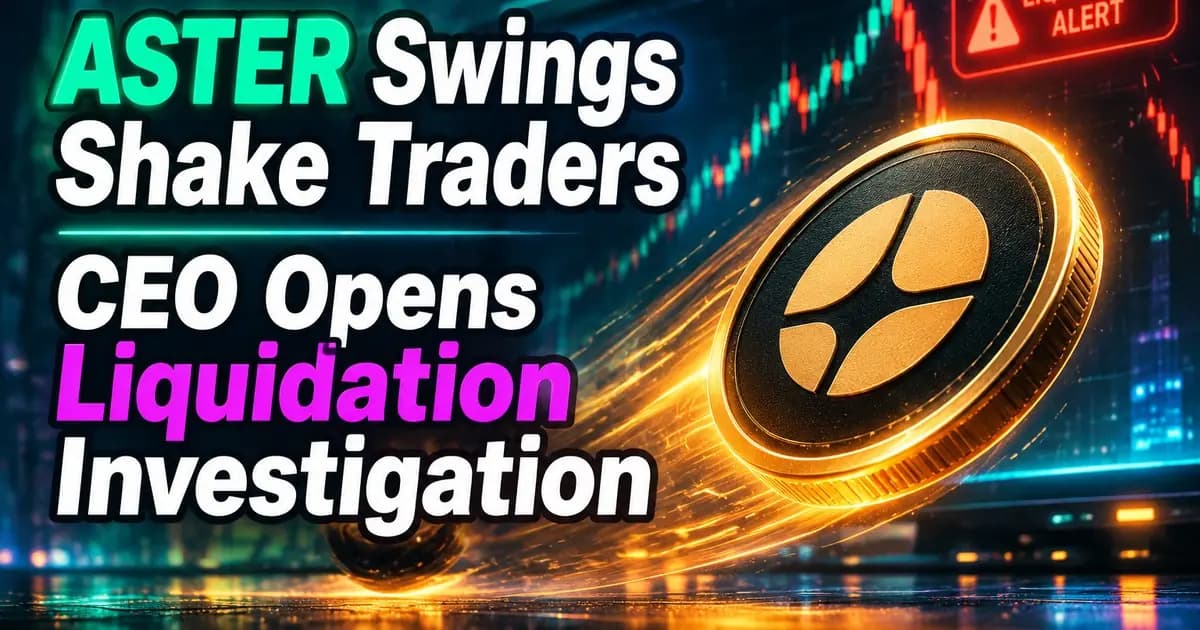
ASTER▲$0.5481 crypto gained 3% over the rolling 24 hours to November 16, 2026, despite an intraday reversal of roughly 33% that prompted an investigation by Aster CEO Leonard Leung. He attributed the sharp swing to liquidations of highly leveraged positions, describing them as “likely malicious.”
The token climbed to $0.7124 before falling to $0.4812 within minutes. By 07:22 UTC, it traded near $0.55, leaving holders with a modest daily gain after a much more violent trading session.
- 🔹ASTER’s Intraday Reversal Puts Its Perpetual Exchange in Focus
- ✨Aster CEO Investigates Highly Leveraged Liquidations
- 📋ASTER Utility Connects Governance, Listing Stakes and Buybacks
- 🧩ASTER Price and Market Cap After the Reversal
- ♟️ASTER Futures Activity and Liquidation Rules Explain the Stakes
- ⚠️ASTER Risks: Fast Reversals and Tokens Sharing Its Name
- 📋Where ASTER Is Listed and What Market Users Are Selecting
- 🔸Aster and Hyperliquid Compete on Trading Design
- ❓FAQ
ASTER’s Intraday Reversal Puts Its Perpetual Exchange in Focus
What Happened to ASTER on November 16?
ASTER’s slide followed a brief advance of nearly 30% within an hour. The subsequent reversal took just over 15 minutes, turning the session from a sharp advance into a rapid retreat.
Read More: Binance-Backed DEX Aster Launches Prediction Markets
The decline appeared on both Aster and Binance. That put trading across the decentralized exchange and a major centralized venue at the center of attention.
What Is the ASTER Token?
ASTER is the native token of Aster, a decentralized exchange offering leveraged perpetual futures. Its roles include governance and community rewards, while the protocol directs revenue toward token purchases.
Aster emerged from the merger of Astherus and APX Finance in late 2024. Its platform combines non-custodial trading with hidden orders and access across multiple networks, linking the token’s economics to a broader derivatives business.
Aster CEO Investigates Highly Leveraged Liquidations
What Did Leonard Leung Say Caused the Volatility?
Leung announced that the team was investigating the abnormal price movement. In his November 16 post, he wrote: “The price volatility is a result of liquidations of highly leveraged positions, likely malicious.”
He promised full details in upcoming reports. The allegation of deliberate activity remains his explanation while the investigation proceeds.
We are aware of the abnormal price fluctuation and the team is investigating .
— Leonard 💛 Aster 🥷 (@Leonard_Aster) November 16, 2026
The price volatility is a result of liquidations of highly leveraged positions, likely malicious. We will share full details in the upcoming reports.
We are aware of the abnormal price fluctuation and the team is investigating .
The price volatility is a result of liquidations of highly leveraged positions, likely malicious. We will share full details in the upcoming reports.
What Did Aster Say About Operations and Market Makers?
Leung said Aster was running “business as usual” after the price swings. He also rejected a connection between the episode and ASTER market-making arrangements.
“We do not have any such arrangement with any market makers,” he said. His response addressed both the exchange’s operations and concerns about the token’s trading activity, with further investigation findings still to come.
ASTER Utility Connects Governance, Listing Stakes and Buybacks
How Does ASTER Fit Into Exchange Activity?
Beyond governance and community rewards, ASTER is part of the process for proposing new perpetual markets. Rules introduced in August require applicants to commit tokens before their proposed listings can receive approval.
That creates a token commitment tied to market expansion. The listing framework also keeps leverage limits and contract settings under the platform’s risk team, giving proposed markets a separate approval and risk-control process.
How Does Aster’s Revenue-Funded Buyback Program Work?
A June 2026 revision directed 99% of daily platform fees toward ASTER purchases. The program combines distribution of repurchased tokens with an equivalent burn from reserves, rather than simply burning the purchased tokens themselves.
The stated objective is a gradual reduction in total supply. For token holders, the important connection is between exchange fee generation, purchases in the market and reductions in reserve tokens; the program continues alongside the liquidation investigation.
Which Network Hosts the ASTER Token?
The token discussed here is on BNB▲$590.12 Smart Chain. Aster’s exchange supports a wider set of networks, and its website advertises access across BNB Chain, Arbitrum, Ethereum and Solana through one account.
Aster also has its own chain. Crypto Briefing dates the launch of Aster Chain to March 2026, while the project’s current website promotes it as infrastructure designed for derivatives execution and privacy.
ASTER Price and Market Cap After the Reversal
What Was the ASTER Price on November 16?
DEX Screener showed ASTER at $0.549 at 07:22:11 UTC on November 16, with a 3.02% rolling 24-hour gain. The token’s market capitalization was approximately $1.41 billion.
The recovery left ASTER about 23% below its $0.7124 intraday peak. Reaching that peak again from $0.549 would require a gain of about 30%, showing how much ground remained between the rebound and the session’s high.
How Far Was ASTER Below Its Record High?
ASTER reached its record high of $2.41 in September 2025. At $0.549, the token remained about 77% below that level, putting the latest rebound inside a much larger decline from its launch-era peak.
Its fully diluted valuation also remained substantially larger than its circulating market value. Aster’s plans to reduce reserve supply are therefore relevant to the token’s longer-term economics, alongside demand for the exchange and its trading products.
ASTER Futures Activity and Liquidation Rules Explain the Stakes
How Much Trading and Liquidation Activity Accompanied the Move?
CoinGlass figures cited by Cointelegraph put 24-hour ASTER futures volume at about $1.29 billion, up 121% from the preceding day. Spot volume in the same account reached $118.3 million, up 67%.
Tracked liquidations over the 24 hours totaled approximately $9.1 million, including $5.97 million in long positions and $3.14 million in shorts. Long positions accounted for roughly two-thirds of the total, although traders on both sides suffered forced closures.
Which Aster Liquidation Rules Matter to the Investigation?
Aster’s liquidation documentation describes a mark price derived from funding information and prices across several spot exchanges. When an account’s remaining margin falls below its maintenance requirement, the platform begins closing the position.
Its rules allow positions to transfer to an insurance fund at their bankruptcy price, with the fund covering certain losses when balances turn negative. These procedures place mark-price inputs, margin requirements and position handling at the center of the mechanism Leung described.
For the investigation, the next substantive development is the fuller account of the abnormal trading that Leung promised. Details about how the affected positions moved through those rules would help explain the episode beyond the rapid change in the token’s price.
ASTER Risks: Fast Reversals and Tokens Sharing Its Name
What Trading Risks Did the Session Expose?
The move from $0.7124 to $0.4812 amounted to a 32.5% reversal within minutes. A modest positive daily return therefore sat alongside a session in which entry price and leverage made an enormous difference to traders’ outcomes.
The tracked PancakeSwap ASTER/WBNB pool held approximately $2.25 million in liquidity. For users trading through that pool, execution depth and order size matter when prices are moving quickly, especially after the kind of abrupt reversal seen on November 16.
The liquidation totals also show exposure on both sides of the market. A sharp upward move can pressure shorts before a subsequent selloff hits longs, making a volatile round trip costly even when the token finishes above its earlier daily level.
Why Does ASTER’s Token Identity Need Attention?
Several assets use the ASTER name or ticker, including similarly named tokens on Solana and Base. This article concerns the BNB Smart Chain token associated with Aster’s perpetual exchange.
Readers selecting a market should cross-check the project identity and token network against Aster’s official website and its linked channels. A matching ticker alone is insufficient to identify the asset, particularly when moving between exchanges and networks.
Where ASTER Is Listed and What Market Users Are Selecting
Which Exchanges List ASTER?
CoinGecko lists ASTER markets on Binance, KuCoin, Bybit, Aster, OKX, Gate, MEXC and Bitget, among other venues. The tracked decentralized market is an ASTER/WBNB pair on PancakeSwap on BNB Smart Chain.
The exchange’s name and the token’s name are closely connected, but users still need to identify the particular product they select. A spot token market and an ASTER perpetual position create different exposure during a session dominated by leveraged liquidations.
What Should ASTER Holders Watch in November?
Leung’s promised investigation findings are the immediate company development to watch. His statements that the exchange remained operational and had no token market-making arrangement form the starting point for Aster’s response.
The buyback program provides a second thread: continued exchange activity generates the fees directed toward token purchases. Further abnormal price swings or liquidation pressure could challenge confidence, while a detailed explanation of the episode and continued platform activity could help restore it.
Aster and Hyperliquid Compete on Trading Design
Why Are Aster and Hyperliquid Compared?
Decrypt’s September 2025 explainer identified Aster and Hyperliquid as competitors in decentralized perpetual futures. The comparison centers on their trading platforms, with Aster also offering spot markets and emphasizing access across several chains.
The same explainer described Aster as backed by YZi Labs, the investment firm associated with Binance co-founder Changpeng Zhao. That backing is part of Aster’s corporate background; the current response to the trading incident is being led by Leung and the Aster team.
Which Aster Features Are Relevant to Its Privacy Strategy?
Aster describes hidden orders and non-custodial trading as core features. Its website also promotes encrypted orders, one-time stealth addresses and viewer-pass access, presenting privacy as a central part of its trading infrastructure.
The project advertises yield-bearing margin and markets spanning crypto, stocks, forex, commodities and prediction markets. Its dedicated chain extends that product strategy beyond the multichain exchange described in its earlier launch coverage.
For ASTER holders, that leaves two connected questions for the business: whether the platform can sustain trading activity across those products, and how it handles episodes of extreme volatility. The November 16 investigation puts the second question directly in front of users.
FAQ
How Many ASTER Must Applicants Stake to Propose a New Perpetual Market?
The August listing rules require applicants to stake 1 million ASTER before a proposed market can receive approval. The commitment forms part of Aster’s market-listing process.
How Long Must the ASTER Listing Stake Remain Committed?
The required commitment lasts four years under the August rules. That ties the applicant’s token stake to a multiyear period rather than a short listing window.
Who Sets Leverage Limits and Contract Settings for Proposed Aster Markets?
Aster’s risk team retains responsibility for those settings. Applicants’ staking commitments sit alongside the team’s control over leverage and contract parameters.
Who Receives ASTER Purchased Through the Platform’s Buyback Program?
Repurchased tokens are distributed to veASTER stakers under the revised program. An equivalent number of tokens is burned from reserves.
What Total Token Supply Does Aster’s Buyback and Burn Program Aim to Reach?
The stated objective is to reduce total supply from 8 billion ASTER to 3 billion over time. The June 2026 revision links that process to purchases funded by daily platform fees.
How Much ASTER Did Aster Report Buying Back During October 19–November 2?
Aster’s update put purchases at approximately 2.60 million ASTER during that period. It also recorded an equivalent burn from the team allocation.
Can APX Holders Migrate Their Tokens to ASTER?
Aster’s project description says APX holders can migrate their holdings to ASTER. The migration follows the late-2024 merger of Astherus and APX Finance that created Aster.
This article is for information only and is not financial advice.
Related Articles
ZEC Crypto Price Is Surging: Why Zcash Could Be the Biggest Privacy Coin Comeback of 2026
Zcash staged one of the largest crypto recoveries of 2026, climbing near $800 in August for the...
Lighter (LIT) Price Prediction: Can LIT Hit $3 in 2026 After Its Massive Comeback?
Lighter has become one of the most hyped tokens in the perpetual DEX space. After turbulent days on...
Ethereum Is Approaching Cycle Bottom Relative to Bitcoin — What’s Next for ETH Price?
We break down what’s happening with Ethereum on July 24 and what to expect from ETH▲$1,812.08...
Ethena (ENA) Price Prediction 2026: Is the Project Slowly Dying or Just Cooling Off?
The Ethena (ENA▲$0.1175) price prediction 2026 has turned cautious because ENA is no longer...
Tokenized Asset Trading on Hyperliquid Surpasses Crypto for the First Time — RWA Captured 52% of Weekly Volume
For the first time in Hyperliquid’s history, trading volume of tokenized real-world assets...
Summer.fi Hack Fears Rise After $65M Flash Loan Nets $6M
Summer.fi hack concerns rose after CertiK said a suspicious transaction used a $65.4 million flash...