- 1077817
- Analytics
-
Share


 https://news.az/news/why-did-jensen-huang-resign-inside-nvidias-leadership-crisis
Copied
Nvidia founder Jensen Huang has resigned as CEO, sending shockwaves through global financial markets as shares in the artificial intelligence giant plunged and Bitcoin crashed below $69,000. The sudden leadership shake-up has raised serious questions about Nvidia's future, the stability of the AI investment boom and the potential for further turmoil across technology stocks and cryptocurrencies.
Nvidia officially confirmed on November 12, 2026, that Huang had stepped down as president, chief executive officer and a member of its board of directors, effective immediately. The company appointed Chief Financial Officer Colette Kress as interim CEO while launching a search for a permanent successor.
The announcement brought an unexpected end to Huang's 33-year leadership of the company he co-founded in 1993. Under his direction, Nvidia evolved from a graphics processor manufacturer into one of the world's most influential technology companies, playing a central role in the development of artificial intelligence.
The shock extended beyond Wall Street. Bitcoin dropped to $68,408 during early trading on November 13, while cryptocurrency liquidations reached approximately $1.47 billion over 24 hours.
However, analysts caution that the market turmoil reflects more than Nvidia's leadership crisis, with Federal Reserve interest rate expectations, inflation concerns and excessive leverage in cryptocurrency markets contributing to the downturn.
Why did Jensen Huang resign as Nvidia CEO?
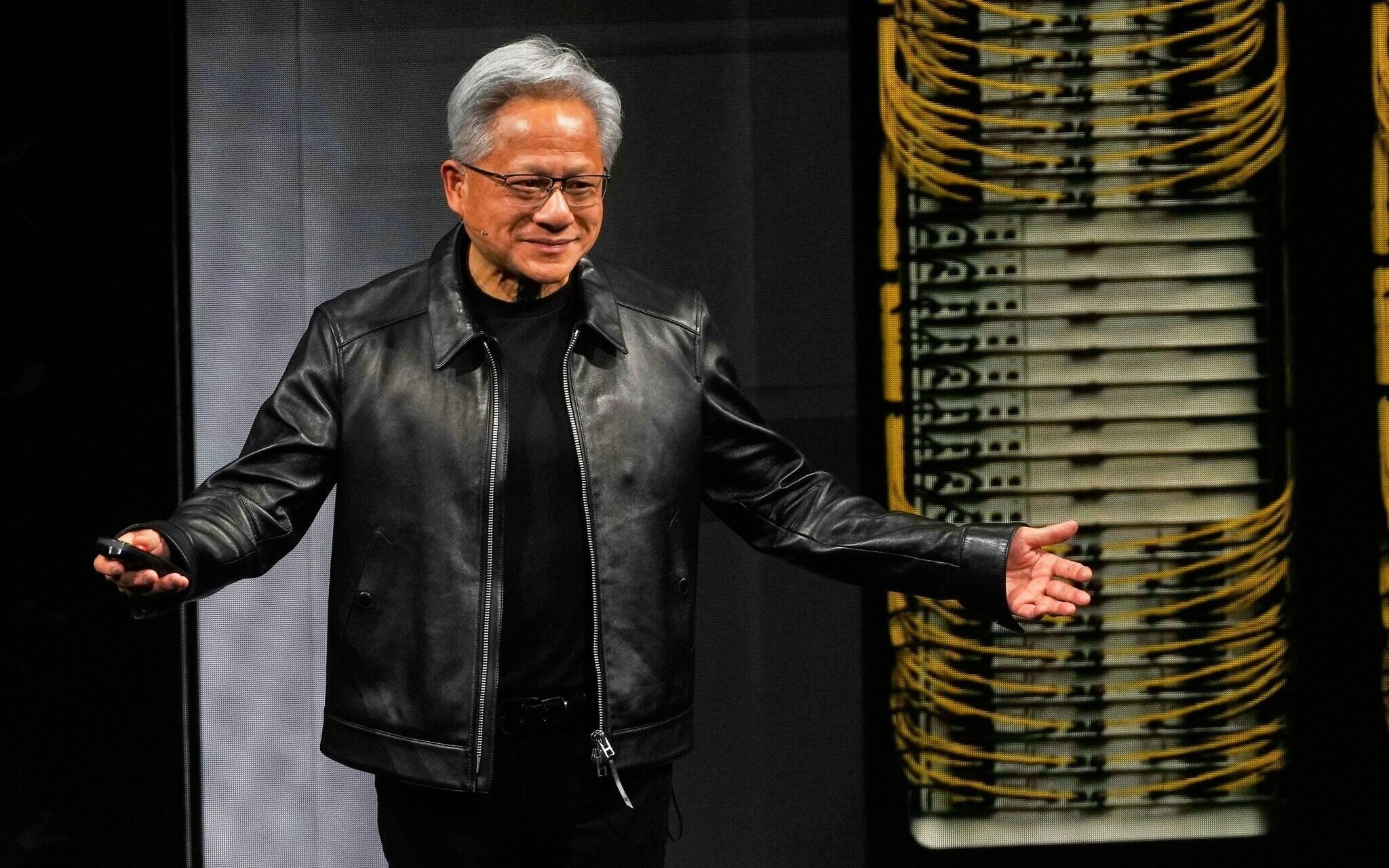
Source: BBC
Huang's resignation followed a series of media reports concerning his personal relationships and allegations involving a woman suspected by US authorities of having connections to Chinese intelligence.
On November 8, Nvidia's board announced an independent investigation following reports that Huang may have been targeted by a foreign intelligence operation.
The allegations attracted particular attention because Nvidia manufactures some of the world's most advanced artificial intelligence processors, placing the company at the center of growing technological competition between Washington and Beijing.
The company has previously faced intense scrutiny over Nvidia's ambitions in the Chinese AI chip market, particularly regarding US restrictions on exports of sophisticated semiconductors.
Huang acknowledged having an extramarital relationship and apologized to his family and colleagues.
"I was unfaithful to my wife. My actions hurt her and our children," he wrote in a message to Nvidia employees.
Additional allegations involving a relationship with a company employee emerged in media reports, although not all of those claims have been independently verified.
On November 10, Nvidia's independent directors retained former acting US Attorney Joon H. Kim and the law firm Wachtell, Lipton, Rosen & Katz to conduct the investigation.
Importantly, Nvidia's board stated that it had no reason to believe US national security or the company's confidential information had been compromised.
The company's November 12 resignation announcement did not explicitly identify the investigation as the reason for Huang's departure.
The developments have nevertheless intensified scrutiny of corporate governance, executive accountability and the security of strategically sensitive technologies.
Nvidia stock price today: How much did NVDA shares fall?
Source: BBC
Investors reacted sharply to the leadership announcement, triggering heavy selling in Nvidia shares during Thursday's trading session.
NVDA stock plunged as much as 14.3% intraday, touching $148.80 before recovering part of its losses.
By the close of regular trading on November 12, Nvidia shares stood at $166.19, a decline of 4.34% from the previous closing price of $173.73.
The steep intraday movement illustrated the uncertainty surrounding Nvidia's leadership transition and its potential impact on the company's long-term business strategy.
The selloff also followed months of concern about Nvidia's stock valuation and the sustainability of AI investments.
Nvidia shares had already experienced significant volatility as investors debated whether enormous spending on artificial intelligence infrastructure could continue generating sufficiently strong financial returns.
Earlier, technology stocks had also suffered losses amid concerns over rising AI development costs, reflecting broader uncertainty about the sector's valuations.
Despite the latest decline, Nvidia remains among the world's most valuable companies, with a market capitalization of approximately $4 trillion.
Its importance extends far beyond the semiconductor industry, as major technology companies rely on Nvidia chips to train and operate advanced AI systems.
The company has previously reported surging profits driven by strong global demand for artificial intelligence processors.
Whether that momentum can continue under new leadership has now become one of the most important questions facing technology investors.
Bitcoin price crashes below $69,000: Why is crypto falling?

Source: BBC
The turbulence coincided with another major development: a sharp decline in Bitcoin and the wider cryptocurrency market.
Bitcoin fell approximately 7% over 24 hours to $68,408 during early Asian trading on November 13, according to cryptocurrency news platform The Block.
That represented the digital currency's lowest level since August 20.
Ethereum also declined by approximately 6%, trading near $1,921, while other major cryptocurrencies, including XRP and BNB, suffered losses.
The selloff followed previous periods of Bitcoin market weakness driven by institutional selling and declining investor confidence.
This time, the pressure was intensified by widespread liquidations among traders using borrowed funds to increase their cryptocurrency exposure.
According to CoinGlass data cited by The Block, approximately $1.47 billion in leveraged cryptocurrency positions were liquidated over 24 hours.
Of that amount, around $1.31 billion involved long positions, meaning traders betting on rising cryptocurrency prices were forced out of their positions.
Rick Maeda, head of markets at Laevitas, described the sharp decline as a leverage-driven event.
"The sharp leg lower in crypto looks like a leverage event," Maeda said.
As Bitcoin fell through important price levels, forced liquidations generated additional selling pressure.
The resulting chain reaction further weakened investor confidence and accelerated the cryptocurrency market's decline.
The losses also highlighted risks facing corporate cryptocurrency holders during periods of market instability, particularly businesses with substantial exposure to Bitcoin and other digital assets.
Did Jensen Huang's resignation cause the Bitcoin crash?

Source: BBC
The timing of Nvidia's leadership crisis and Bitcoin's sharp decline has prompted questions about whether the two developments are directly connected.
Market analysts suggest the relationship is more complex.
Nvidia's central position in the artificial intelligence industry means unexpected developments at the company can influence investor sentiment toward technology stocks and other risk-sensitive assets.
Cryptocurrencies can also become vulnerable during periods of financial uncertainty, particularly when investors begin reducing exposure to speculative investments.
However, Bitcoin's decline cannot be explained solely by Huang's resignation.
Expectations of another US Federal Reserve interest rate increase have also weighed on market confidence.
Higher interest rates generally make traditional interest-bearing assets more attractive while reducing investors' appetite for riskier investments.
Similar concerns previously contributed to Bitcoin falling amid expectations of tighter US monetary policy.
Persistent inflation pressures have added to the uncertainty.
Earlier developments demonstrated how rising US producer prices and inflation fears can weaken cryptocurrency markets.
Jeff Mei, chief operating officer of cryptocurrency exchange BTSE, told The Block that investors were evaluating the possibility of further Federal Reserve tightening.
He warned that a larger-than-expected interest rate increase could put additional pressure on Bitcoin and other cryptocurrencies.
The cryptocurrency market's heavy use of leverage has further amplified short-term price movements.
These developments suggest that Nvidia's crisis contributed to wider uncertainty but was not the sole cause of Bitcoin's selloff.
Who is Colette Kress, Nvidia's new interim CEO?

Source: BBC
Following Huang's departure, Nvidia appointed Colette Kress as interim chief executive officer.
Kress has served as the company's chief financial officer since September 2013 and will retain that position while leading Nvidia during its executive transition.
Before joining Nvidia, she held senior financial positions at major technology companies, including Cisco and Microsoft.
Her extensive experience overseeing Nvidia's finances makes her an important figure in efforts to restore investor confidence.
The company has also appointed Harvey C. Jones as chairman of the board.
Nvidia's board has emphasized the importance of maintaining operational stability, customer relationships and the company's existing technology roadmap.
Nevertheless, replacing Huang permanently could prove challenging.
As Nvidia's co-founder, Huang played a decisive role in shaping the company's strategy and transforming its business model.
His influence extended to product development, relationships with major customers and the broader direction of the artificial intelligence industry.
Under Huang, Nvidia made substantial investments in accelerated computing and advanced AI infrastructure.
He also promoted the company's trillion-dollar opportunity in artificial intelligence computing, arguing that global demand for advanced processors would continue expanding.
The board has launched a search for a permanent chief executive, considering both internal and external candidates.
The outcome will be closely watched by shareholders, technology companies and investors across the global AI industry.
What happens to Nvidia stock next? November 17 earnings in focus
Source: Reuters
Investors are now looking ahead to Nvidia's financial results on November 17, which could become a crucial test of market confidence following Huang's resignation.
Nvidia is scheduled to report its third-quarter fiscal 2027 results at approximately 4:20 p.m. US Eastern Time, followed by an earnings conference call at 5 p.m.
The report will provide fresh information about the performance of its data center business, demand for advanced AI processors and the sustainability of its growth.
Investors will also assess profit margins, revenue guidance, customer spending and competition in the rapidly evolving artificial intelligence market.
Another major question is whether the leadership transition could affect Nvidia's relationships with major technology companies and strategic partners.
Huang was closely associated with Nvidia's long-term vision, particularly its investments in next-generation processors.
Earlier this year, the company announced that its next-generation AI chips had entered full production, highlighting its efforts to maintain a technological advantage over competitors.
Any indication that the company intends to change its investment priorities could have implications beyond Nvidia itself.
However, strong operating results and a clear succession strategy could help reassure investors that its technological position remains intact.
Similar news
-
 Analytics
Defence cooperation between Baku and London: A new stage in relations
The Declaration formalises relations that have developed successfully over several decades, dating back to the historic ... -
 Analytics
ANCA seeks to revive its influence in US Congress
The Republican Party’s defeat in the House of Representatives has raised new hopes among the Armenian community. T... -
 Analytics
Azerbaijan’s strategic role in a changing Europe
Held at the Convention Centre Dublin, with representatives of around 50 countries in attendance, this year’s summi... -
 Analytics
Iron Gate and the Caspian: How could the new US initiative affect regional security?
For Caspian states, however, enforcement measures could have implications beyond their stated targets, potentially affec... -
 Analytics
Why does Azerbaijan still tolerate X?
Today, X is increasingly associated with disinformation, aggressive campaigns and outright insults. False claims spread ... -
 Analytics
Abu Dhabi peace talks: Can Russia and Ukraine move closer to ending the war?
Political and military analysts interviewed by News.Az assess whether Washington can bridge these differences and what E...
Defence cooperation between Baku and London: A new stage in relations
ANCA seeks to revive its influence in US Congress
Azerbaijan’s strategic role in a changing Europe
Iron Gate and the Caspian: How could the new US initiative affect regional security?
Why does Azerbaijan still tolerate X?
Abu Dhabi peace talks: Can Russia and Ukraine move closer to ending the war?
-

Why did Jensen Huang resign? Inside Nvidia’s leadership crisis
-

-

Pacers edge Knicks as Miami Heat beat Cavaliers in NBA Cup action
-

Iran says another tanker hit naval mine east of Strait of Hormuz
-

-

Defence cooperation between Baku and London: A new stage in relations
-

Trump, Xi and Putin set to hold first three-way summit in China
-

-

-

Can Russia enter the Turkic World without reshaping its future?
Why did Jensen Huang resign? Inside Nvidia’s leadership crisis
Pashinyan schedules three trips to Russia next month
Pacers edge Knicks as Miami Heat beat Cavaliers in NBA Cup action
Iran says another tanker hit naval mine east of Strait of Hormuz
Azeri Light nears $103 per barrel
Defence cooperation between Baku and London: A new stage in relations
Trump, Xi and Putin set to hold first three-way summit in China
Azerbaijan beat Liechtenstein in latest group match
ANCA seeks to revive its influence in US Congress
Can Russia enter the Turkic World without reshaping its future?
Archive