World Liberty Financial's new WLFI buyback comes after the token fell about 67% this year, to roughly $0.048 on November 6. You'll see why its last $65.6 million buyback is now worth about $21 million, and how much USD1 reserve income could realistically fund.
Table of Content
realme 16 Pro+ vs POCO X8 Pro: Which Extras Are Worth Paying for in 2026?
- Nov 7
- 7 mins read
CMF Phone 2 Pro vs Moto G86 Power: Motorola Wins the Hardware, CMF Wins the Clock
- Nov 5
- 9 mins read
POCO F9 Ultra vs POCO F9 Pro 2026: 27% More Battery
- Nov 4
- 5 mins read
Nothing Phone (4a) Pro vs Fairphone 6: More Phone Now, or a Phone You Can Keep Fixing Until 2033?
- Nov 5
- 11 mins read
Honor WIN2 vs POCO F9 Ultra: Cooling or Cameras in 2026
- Nov 4
- 5 mins read
Sponsored
TL;DR
- World Liberty Financial announced a new WLFI buyback on November 6, with no size, timeline or burn plan.
- WLFI traded near $0.048 on November 6, down about 67% from roughly $0.144 on January 1.
- Its $65.6M buyback, at an average $0.1507 per token, is worth about $21M at November 6 prices.
- By our math, USD1 reserves could earn up to about $151M a year, roughly 10% of WLFI's market value.
- Democrats won the House on November 3 and plan probes into the Trump-linked project from early 2027.
Between late 2025 and April 2026, World Liberty Financial spent $65.6 million buying back its own WLFI token at an average of about 15 cents each. At November 6 prices, those same tokens are worth roughly $21 million.
On November 6, 2026, the Trump family-backed crypto project said on X that it’s launching a new WLFI buyback program, a plan to buy its own tokens on the open market. It comes after WLFI fell about 67% this year and slid roughly 10% in the days after the November 3 midterm elections. For anyone new to this story: World Liberty Financial runs the USD1 dollar stablecoin and issues WLFI, a token that gives holders a vote on how the project is run. Here’s what was announced, what the numbers say a buyback can achieve, and what it means for you.
Binance Referral Code
$100 Sign-Up Bonus
20% Lifetime Discount on Trading Fees
Code Valid: November 2026
What World Liberty Actually Announced
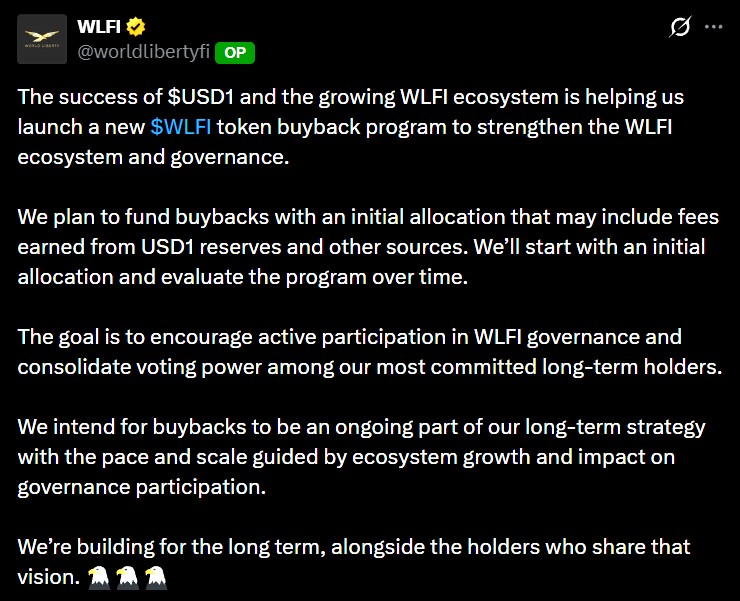
The announcement is short on details. Here’s what World Liberty said in its X post, and what it left out:
- Funding: an “initial allocation that may include fees earned from USD1 reserves and other sources.” The other sources weren’t named.
- Goal: to encourage voting and “consolidate voting power among our most committed long-term holders.”
- Timing: buybacks will be “an ongoing part of our long-term strategy,” with the pace tied to ecosystem growth and voting participation.
- Not disclosed: a dollar amount, a start date, a schedule, or whether bought-back tokens will be burned (permanently destroyed), held by the project or used some other way.
That last gap matters most. A buyback only shrinks the number of tokens in circulation for good if the tokens are burned. If World Liberty holds them, they can come back to the market later.
The Numbers Behind WLFI’s Slide
Here’s where WLFI stood on the day of the announcement, with the last buyback for comparison. Prices move quickly, so each figure carries its date.
The earlier buyback didn’t hold the price up. World Liberty disclosed in April that it had bought 435.3 million WLFI for $65.58 million, according to CoinDesk’s report at the time. By our math, those tokens are worth about $20.7 million at $0.0476, roughly 68% less than World Liberty paid. That purchase also covered only about 1.4% of the tokens in circulation.
Buybacks can soften selling, but they can’t outweigh the bigger forces moving WLFI, like political risk, token unlocks and the wider crypto market.
Can USD1 Fees Pay for a Meaningful Buyback?
This is the question most coverage skipped, so we ran the numbers.
How USD1 makes money. A stablecoin is a crypto token designed to stay worth $1. To back each USD1, the issuer holds cash and short-term U.S. government debt called Treasury bills, which pay interest. That interest is the “fees earned from USD1 reserves” World Liberty mentioned.
The ceiling. USD1 had about $3.63 billion in circulation on November 6, according to DefiLlama data. The 3-month Treasury yield was 4.17% on November 5. If every dollar of reserves earned that rate, USD1 would generate about $151 million a year, or about $12.6 million a month, by our math. That’s the absolute maximum: reserves include some cash, and the issuer has operating costs and other owners to pay.
How far that goes. At $0.0476, $10 million buys about 210 million WLFI, or roughly 0.66% of tokens in circulation. Even if World Liberty sent its entire theoretical reserve income to buybacks, it would match about 10% of WLFI’s market value per year. For comparison, the April disclosure works out to about $10.9 million a month, which didn’t stop the slide.
The pool is shrinking. USD1 peaked near $5.39 billion in February and was about $4.43 billion in late September. By our math, today’s supply is about 33% below the peak. Fewer USD1 in circulation means less interest to fund buybacks, and lower interest rates would shrink it further.
Buyback Isn’t Burn: Who Gets the Votes?
WLFI is a governance token, meaning holders can vote on proposals that shape the project. World Liberty says the buyback should put more voting power in the hands of long-term holders. That raises a question World Liberty hasn’t answered: what happens to the votes attached to repurchased tokens?
There are three likely paths:
- Burned: the tokens disappear, and each remaining token carries a slightly bigger share of the vote.
- Held in the treasury without voting: similar effect, but the tokens could be sold again later.
- Held and voted, or handed to “committed” holders: this would concentrate influence with the project or with the holders it selects.
Without that detail, holders can’t judge whether the program spreads power out or pulls it in. If you hold WLFI, that’s the first thing to look for in any follow-up post.
The Political Backdrop
The timing isn’t random. Democrats won control of the House in the November 3 midterm elections, according to network projections, and Rep. Robert Garcia, expected to chair the House Oversight Committee, responded with “Lawyer up.” Reports say Democrats plan subpoenas aimed at the Trump family’s crypto ventures, with inquiries possibly starting as early as February 2027. A reported $500 million investment in World Liberty by a group tied to UAE national security adviser Sheikh Tahnoon bin Zayed Al Nahyan is expected to be a focus.
There’s a court fight, too. Tron founder Justin Sun, who invested $45 million in WLFI, sued World Liberty in April over tokens that were frozen, reportedly about 4 billion WLFI. On November 3, he asked a federal court in California to sanction the company, saying it disclosed its UAE ties months into the case. Those allegations are disputed, and the court hasn’t ruled on them.
The wider Trump crypto trade was weak on the same day. The TRUMP memecoin and Trump Media shares both hit record lows on November 6. Separately, World Liberty’s trust company is still waiting for final approval of its national trust charter from the OCC, the federal bank regulator, after a conditional green light in August.
Binance Wallet Referral Code
100 USDT Sign-Up Bonus
20% Lifetime Discount on Trading Fees
Code Valid: November 2026
Three numbers will tell you whether this buyback is real: the dollar size of the first allocation, the share of tokens burned, and whether USD1’s supply stops falling. Until World Liberty publishes them, the announcement does more for sentiment than for the token’s math.
Prices are as of November 6, 2026. This article is for information only and isn’t financial advice.
FAQs
How is a crypto token buyback different from a stock buyback?
Both use company money to buy back what it issued. But a stock buyback reduces shares, which are a claim on company profits. Most crypto tokens, including WLFI, don’t give holders a share of profits, so a buyback mainly affects supply and voting power.
Is USD1 affected when WLFI’s price falls?
Not directly. USD1 is designed to be backed one-to-one by cash and Treasury bills, separate from WLFI’s price. The risks for USD1 are about the issuer, its reserves, and regulation, not WLFI. Stablecoin issuers can also freeze tokens.
Do other crypto projects fund buybacks from fees?
Yes. Several trading platforms send part of their fee income to buy back their own tokens. The HYPE token from Hyperliquid is one of the best-known examples. The key difference is that those programs usually publish how much they spend.
Are there clear US rules for tokens like WLFI?
Not fully. Stablecoins got their own federal law in 2025, but the bill meant to set rules for other tokens stalled when the Senate failed to pass the Crypto Clarity Act. That leaves governance tokens in a gray area.
How can beginners store crypto tokens safely?
Most beginners start with a reputable exchange or a self-custody wallet, where you hold the keys yourself. A hardware wallet adds protection for larger amounts.
Vincee Cole is a technology journalist with four years of experience covering the full spectrum of modern tech — from consumer devices, artificial intelligence, to quantum computing, blockchain, and digital assets. His reporting cuts through complexity to deliver stories that are sharp, grounded, and relevant to both general readers and industry insiders. Previously, he worked with fintech research teams across Southeast Asia, analysing how emerging technologies are reshaping financial systems at scale.
Apple’s DOJ Antitrust Fight Pulls in Epic, Samsung, Oura, and Roblox
- Nov 8
- 4 mins read
Read more
Apple’s DOJ Antitrust Fight Pulls in Epic, Samsung, Oura, and Roblox
- Nov 8
- 4 mins read
Vivo's Rumored Wide Phone Is Under 6.5 Inches, but It Could Show as Much as a 6.9-Inch Phone
- Nov 8
- 7 mins read
Huawei's OSTA Leak Hints at a Pricier Honor in 2026
- Nov 8
- 5 mins read
T-Mobile's Un-Carrier Pledge Meets Higher Fees in 2026
- Nov 7
- 5 mins read
Your Galaxy Buds Could Become Hearing Aids This Year: Who Qualifies, Which Phones Work and What's Still Missing
- Nov 7
- 6 mins read
Apple and Samsung Are the Only Smartphone Chip Winners as Shipments Tumble 21%
- Nov 7
- 5 mins read
Postman AI Plugin Backlash Could Benefit Bruno in 2026
- Nov 7
- 5 mins read
Data Center Stocks Fell While the Market Rallied. Investors Are Betting Democrats Will Slow the AI Buildout, Just Not From Washington
- Nov 6
- 6 mins read