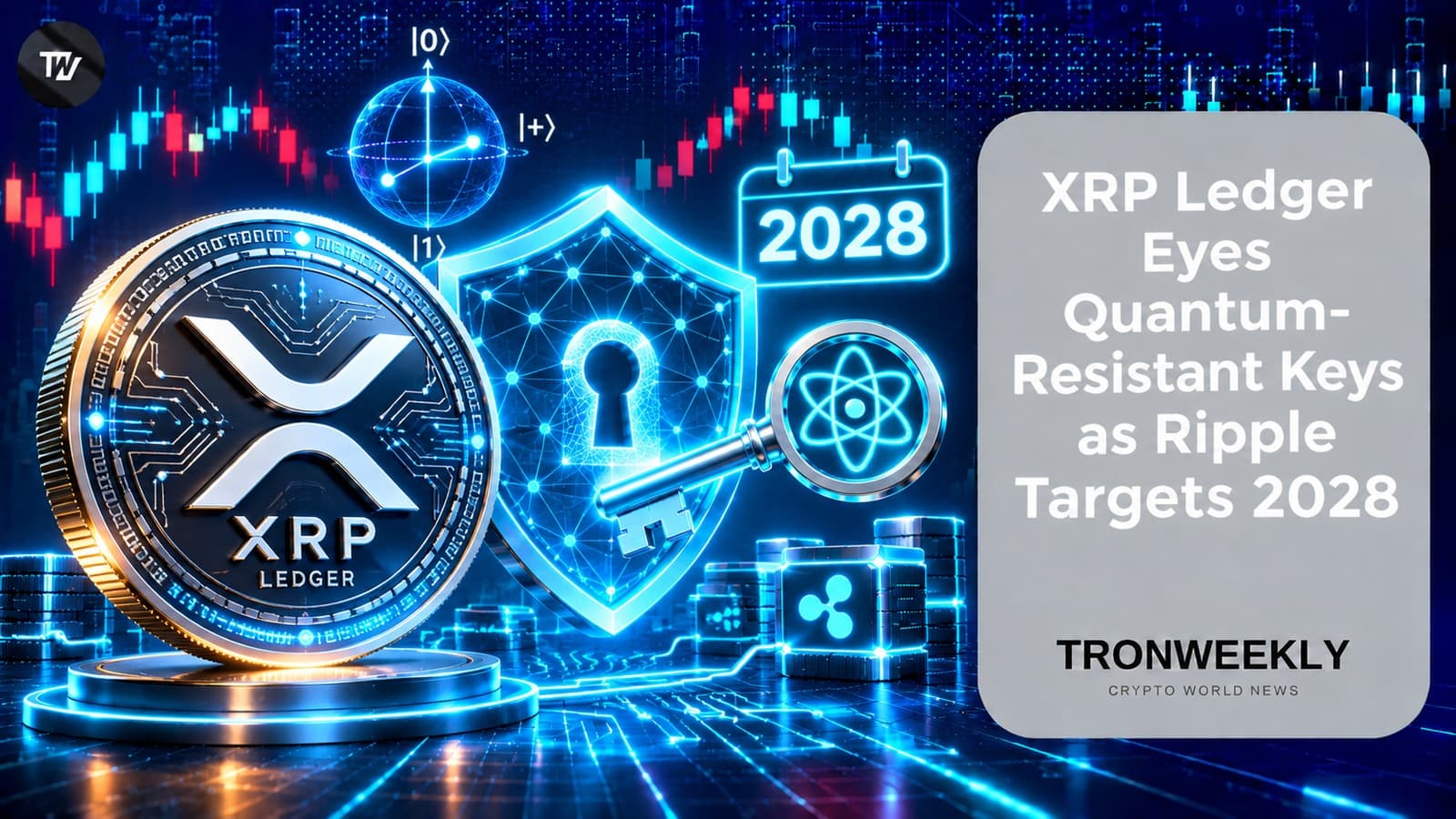
The XRP Ledger Foundation has proposed quantum-resistant signatures that would let XRP holders replace vulnerable account keys. Its draft uses the ML-DSA-44 standard and keeps base transaction fees unchanged, although larger signatures could increase network storage demands.
Table of Contents
The protocol roadmap for 2027 by the Foundation, revised on November 4, relates to accounts, validators, and trusted validator list publishers. While Ripple aims at transitioning to the next protocol by 2028, neither has been approved yet.
How XRP Ledger Accounts Would Change
Today, the XRP Ledger includes support for two types of signatures, namely, secp256k1 and Ed25519. These may be threatened by quantum computers. In the process of signing the transaction, the public key of the account appears on the blockchain.
Also Read: Robinhood IPO Access Opens US Listings to UK Retail Investors: Report
The new idea will make it possible for the owner of the account to use the ML-DSA-44 regular signing key. To do this, it will be necessary to deactivate the initial master key in order to close the old path of signature. Replacement of the regular key will not guarantee protection from the threat of quantum computers.
This migration path may be relevant to the exchanges, custodians, and other institutions that have large balances of XRP. The XRP Ledger already allows for key changes without changing the address of the account. The new idea is to expand this ability for quantum-resistant keys.
What Larger Signatures Mean for Fees
ML-DSA-44 was standardized by the US National Institute of Standards and Technology in August 2024. It has a public key size of 1,312 bytes and may have a signature of up to 2,420 bytes. Transaction keys and signatures take 105 bytes each.
The estimated space needed for the transaction history of a protected payment is 5,331 bytes compared to 1,704 bytes for a normal payment; that is, 3.1 times more. Such a change might lead to greater requirements for bandwidth and storage resources on the XRP Ledger.
The current draft does not increase the base transaction fee. The smallest transfer currently costs 10 drops of XRP; however, an increased load on the network might increase the fee. It is stated that researchers should consider the need for special transaction fees for abnormally sized transactions in the migration study.
When XRP Ledger Could Adopt Quantum Protection
Ripple has unveiled a four-phased post-quantum roadmap that features contingency recovery plans, cryptosystems testing, and gradual switching to signing methods in April. Ripple expects to be ready for 2028, rather than committing itself to any date for the protocol launch.
Ripple is collaborating with Project Eleven on hybrid signature development, validator tests, and the custody-wallet implementation. Also, the implementation branch of XRP Ledger has been tested on AlphaNet.
However, the testing does not imply the deployment of the amendment on the mainnet. First of all, the network would require compatible wallets and validators.
Developers currently face some compatibility issues. For example, the keys generated from the seed by the Python publisher and server implementations are different, while the shared test vectors have not yet been completed.
Moreover, the signing methods used by some tools do not support the key type required. Developers plan to sort out the problem prior to conducting independent audits.
What the Quantum Upgrade Would Cost
The Foundation estimates 640 development hours and 400 hours for engineering reviews. The budget for review is 40,000-80,000, while for an audit from an external auditor, the budget is $100,000. A reference implementation will be valued at $50,000, while additional wallet updates will be valued at $25,000.
The roadmap places the quantum proposal in the most complex category, as it affects fundamental cryptography and consensus. An independent audit of the protocol changes and cryptographic code will be required.
These listed costs are worth 215,000-$255,000 without development hours estimated by the foundation. In 24 amendments of the roadmap, the Foundation estimates 6,240 development hours and costs at $5.08 million-$5.74 million.
The XRP Ledger quantum proposal has yet to be assigned an XLS number. There is an intention to conduct a migration study within the first half of 2027 and develop and review its security after which it can be activated.
Also Read: Solana Privacy Rings Bring Programmable Privacy to Mainnet
Arslan Tabish is a Technical Reporter and Market Analyst at Tron Weekly with over five years of experience covering cryptocurrency markets and blockchain developments. His reporting focuses on Bitcoin, Ethereum, altcoins, and decentralized finance, alongside NFTs, crypto regulation, policy, and Web3 innovations.
Arslan covers blockchain technology, Layer 2 scaling solutions, and emerging use cases, including AI-driven crypto applications, while delivering clear market analysis on how technical and regulatory developments impact digital asset markets. His work is designed for both beginners and experienced readers, offering accurate, easy-to-understand reporting without speculation or investment guidance.