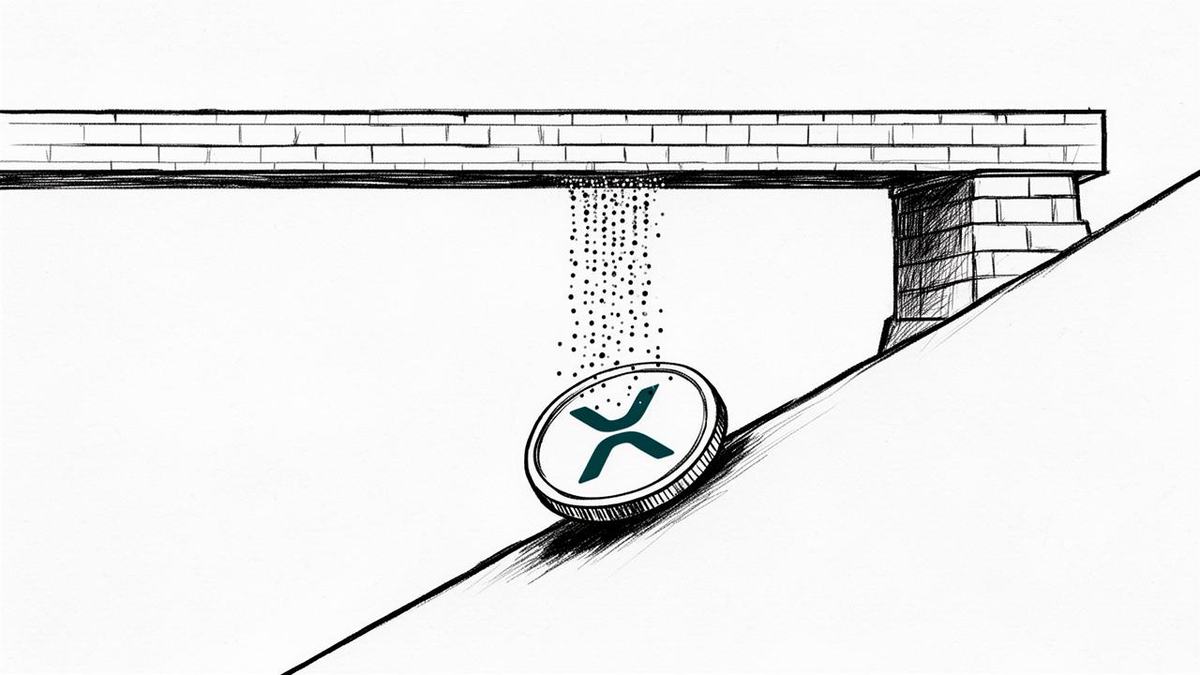
XRP has fallen back under the $1 mark, and the debate among investors is no longer about whether the token can reclaim its 2025 highs but whether it has a durable reason to exist at all. The token changed hands at about $0.9175 on Nov. 22, up nearly 4% in 24 hours but still roughly 75% below the all-time peak of $3.65 it touched in July 2025, according to CoinMarketCap data. It has lost about a quarter of its value this month alone.
The recovery from a session low near $0.87 to an intraday high around $0.94 marked an unusually wide range of roughly 8% in a single day, and trading volume fell 19% to $2.41 billion even as the price rose. Total market value stood at $58.27 billion, with the fully diluted figure for all 100 billion tokens at $91.75 billion.
The more consequential development sits inside Ripple's own product lineup. Ripple USD (RLUSD), the company's dollar-pegged stablecoin, has expanded by $420.53 million over the past 30 days to a record $2.82 billion in total supply, the largest gain of any stablecoin, according to DefiLlama figures. That growth came while the broader dollar-backed stablecoin market contracted by $17.7 billion, a divergence that points to genuine adoption rather than a rising tide.
Note: Price data reflects market conditions as of Nov. 22, 2026.
The problem for XRP holders is that RLUSD runs on the XRP Ledger and is issued on Ethereum, and it performs the cross-border settlement job that was long pitched as the token's central use case. A bank moving dollars to euros can use a stablecoin that holds a steady $1 value instead of holding a volatile bridge asset for even a few seconds. Transaction fees on the ledger are still paid in XRP, which sustains some baseline demand, but that has not been enough to stop the slide. Ripple's marketing now actively courts stablecoin business, telling clients to "Integrate stablecoin payments into your business."
Ripple's corporate momentum has decoupled from the token. At its Swell conference last month, the company said it expects to close 2026 with an annualized product revenue run rate approaching $900 million, roughly triple the year-earlier level, and it counts more than 1,700 institutions, corporations and enterprises as users of its products. That success has not translated into token demand in the way the bull case once assumed.
Supply mechanics add persistent pressure. Ripple releases 1 billion XRP from escrow each month and re-locks 70% to 80% of it, leaving 200 million to 300 million tokens entering circulation monthly. On the demand side, roughly 60% of holders carry an average cost basis of $1.44, about 50% above the current price, creating a wall of sellers likely to exit as the token approaches their break-even levels.
The technical picture offers the bulls a narrow opening. XRP's daily Relative Strength Index has dropped below 30, placing it in oversold territory after leveraged positions were flushed out and spot XRP exchange-traded funds recorded about $30 million in November outflows, with combined assets slipping below $1 billion. Prices between $0.70 and $0.90 have drawn longer-term buyers, and the token briefly touched the bottom of that band. Reclaiming $0.95 is the immediate hurdle; a clean break above $1 would open the way toward $1.05 and $1.10. A fresh break below $0.90 would put $0.86 back in play, a level where buyers stepped in during the latest selloff.
The November decline has tracked a broader risk-off move across crypto rather than a failure specific to Ripple's ecosystem. Bitcoin and Ethereum have begun to stabilize, and the sector has seen heavy liquidations as capital rotates toward AI-related equities. On-chain activity, RLUSD volumes, new lending infrastructure and governance votes on ledger amendments all continue to develop, giving investors fundamentals to revisit if risk appetite returns.
History is the strongest argument for caution. XRP's first run above $3 in 2018 was followed by a 95% collapse over two years to a bottom of $0.14. A comparable decline from the $3.65 peak would imply a floor near $0.18, though demand from fee usage makes that outcome less likely now than it was then. The structural case for a bridge currency is also awkward: in a typical transaction the sending bank buys XRP and the receiving bank sells an equal amount, so gross flows can grow without producing net appreciation.
For investors weighing an entry below $1, the question is whether Ripple's expanding enterprise business and its fast-growing stablecoin can restore demand for a token that increasingly sits beside, rather than inside, the company's core payments product.
Once added, BigGo Finance appears first in Google Search Top Stories, so you get the broadest, most up-to-the-minute, and most comprehensive global financial news first.