Zcash and Bitcoin developers are assessing how speculative advances in mathematics and future quantum computers could affect existing cryptographic protections. The issue is not an active attack, but the time and coordination required to upgrade blockchains, wallets and custody before stronger adversaries emerge.
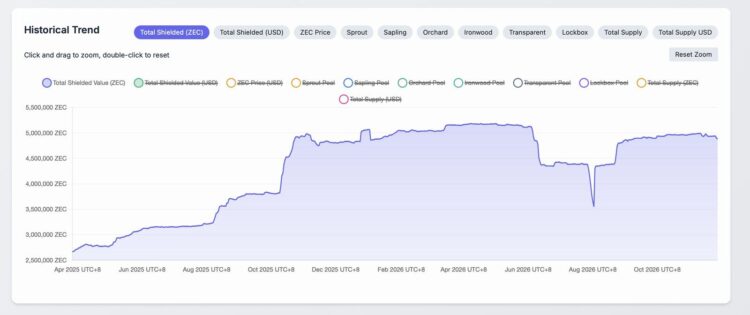
- Zcash team Zakura recommended accelerated retirement of the Sapling shielded pool on November 26, estimating around 400,000 ZEC in that system and citing speculative but unverified cryptographic risks.
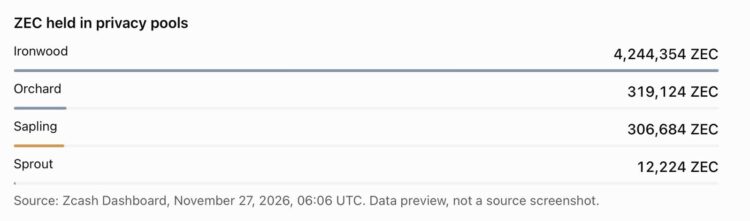
- A November 27 Zcash Dashboard snapshot showed about 306,684 ZEC remaining in Sapling, a lower figure that does not establish that the retirement warning triggered specific movements.
- Shielded Labs is working on Epoch, a post-quantum privacy system for Zcash, and expects to select a specific technical direction by the end of January 2027. Zcash’s newer Ironwood pool includes recovery-oriented features but is not fully quantum-resistant at present.
- The Quantum Ledger estimates that about 7.23 million BTC, 35.9% of issued supply under its methodology, is associated with public keys or scripts already visible on-chain and thus structurally exposed to future quantum attacks. Glassnode’s May 2026 estimate using a different framework was 6.04 million BTC.
- There is no reliable timeline for quantum computers capable of breaking widely used crypto signatures. However, research from Coinbase Institute and NIST highlights that migrating to post-quantum cryptography across blockchains, wallets and institutional custody will itself take years and requires early preparation.
Quantum Computing and Crypto Signatures
Quantum computers process information using qubits, which exploit quantum properties. This allows certain algorithms to solve specific mathematical problems more efficiently than classical machines. Public-key cryptography used by blockchains relies on problems that are currently intractable for classical computers.
Cryptocurrency systems use digital signatures based on private keys. The corresponding public keys can be shared because reversing them is computationally impractical today. A sufficiently capable quantum computer running Shor’s algorithm could recover private keys from exposed public keys and generate valid signatures to spend funds without owner consent.
NIST has already standardised post-quantum cryptographic schemes that are designed to resist such attacks. Integrating these standards into public blockchains requires protocol changes, wallet updates and long-term migration strategies.
Bitcoin’s Quantum-Exposed Supply
Bitcoin’s transparent ledger enables researchers to classify outputs that reveal public keys or other spending information. These outputs would be structurally vulnerable if quantum computers can invert existing signature schemes.
The Quantum Ledger’s November 25 snapshot attributes:
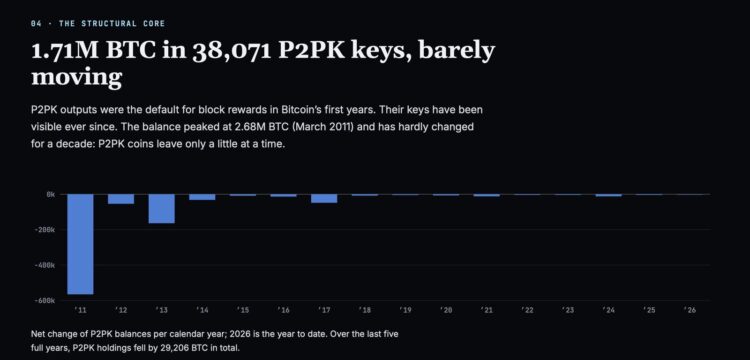
- around 1.94 million BTC to outputs whose design exposes them from inception
- around 5.29 million BTC to addresses that have previously revealed spending scripts or public keys
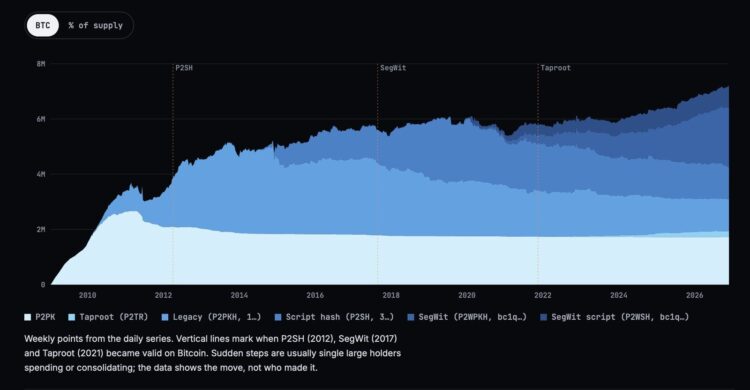
Glassnode’s May 2026 research measured 6.04 million BTC as quantum-exposed, using its own framework. Different methodologies produce different totals, but all highlight that a large fraction of circulating supply is structurally vulnerable under a strong quantum adversary model.
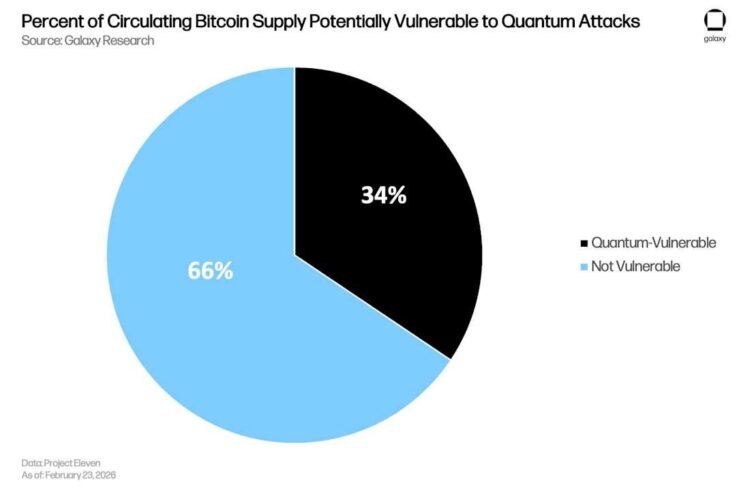
These numbers represent exposure under a hypothetical future quantum attack, not current losses. Owners of live wallets can migrate funds to safer output types once practical alternatives exist. Coins in dormant wallets with lost keys may remain exposed and introduce structural risk even if they never move.
Zcash’s Sapling Retirement and Migration
Zcash uses shielded pools to hide transaction details, unlike Bitcoin, where transfers are publicly visible. Sapling is an earlier shielded pool that relies on older proof systems. Zakura argues that its underlying assumptions should be reconsidered given progress in cryptographic research.
“
The time to prepare for a cryptographic breakthrough is before it happens.
Zakura · Sapling retirement proposal
“
The time to prepare for a cryptographic breakthrough is before it happens.
Zakura · Sapling retirement proposal
The proposal includes blocking new Sapling deposits and encouraging migration to Ironwood, a newer pool designed with more modern assumptions and a future recovery mechanism. If credible threat evidence emerged, the team suggests that emergency measures could follow. The current concern is speculative and relates to potential mathematical breakthroughs, not a confirmed quantum attack.
On November 27, the Zcash Dashboard reported 306,684 ZEC remaining in Sapling. This is below Zakura’s initial rounded estimate of around 400,000 ZEC but does not establish causality between the proposal and fund movements.
These discussions follow the NU7 upgrade, which increased private transaction speed and continues the shift away from older shielded infrastructure.
Post-Quantum Zcash: Epoch and Ironwood
Shielded Labs’ Epoch project targets shielded pools that remain secure under quantum adversaries. One central design problem is proof size: moving to post-quantum schemes often increases proof and key sizes significantly, impacting bandwidth, storage and verification costs on a blockchain.
Epoch researchers are comparing two technical approaches that trade off quantum-resistance, privacy, and on-chain efficiency. They aim to commit to one path by late January 2027 if research milestones are met. Ironwood, meanwhile, has hooks for future recovery in a quantum scenario but does not yet provide full quantum-resistant protection.
Bitcoin, Ethereum and Governance Challenges
Bitcoin developers are exploring protocol changes through proposals such as BIP-360 and BIP-361. BIP-360 adds an output type that reduces direct public-key exposure on-chain. BIP-361 sketches a gradual transition away from vulnerable signature schemes once post-quantum alternatives are ready. These documents are research proposals and have not been activated on the network.
Ethereum’s situation is more complex because its security model depends on validator signatures, smart contract interactions and staking infrastructure. Quantum threats would affect not only user accounts but also consensus participants and institutional custody arrangements that use current signature schemes.
Bitcoin faces an additional governance question over legacy outputs whose keys are exposed and may be unreachable. Restricting movements of such coins could reduce systemic risk if quantum attacks become practical, but could also lock out legitimate owners. Leaving them movable introduces potential theft scenarios that might affect market perception.
Timeline and Investor Implications
No organisation has published a reliable date for the arrival of quantum computers able to break mainstream crypto signatures. Scaling qubit counts is not enough: systems must maintain coherence and low error rates through extended, complex computations to run algorithms such as Shor’s at the scale required.
Coinbase Institute’s analysis stresses that upgrading cryptography across major public chains, wallet software and custody solutions will take years and require coordinated ecosystem changes. This makes reactive upgrades after a demonstrated attack structurally risky.
Investors can monitor whether networks adopt NIST-standardised post-quantum schemes, whether wallets support migration paths, and whether those paths preserve ownership guarantees. Claims that a token is quantum-resistant should be evaluated through its cryptographic design and implementation rather than marketing language alone.
Zcash’s handling of Sapling and its post-quantum work illustrates the structural challenge: updating an algorithm is a technical task, while coordinating timely migration of funds across a decentralised ecosystem is an economic and governance problem that will affect multiple major networks as quantum research progresses.
Authors credited by the source: Tomás Rivas
Published by Holder based on an external source.