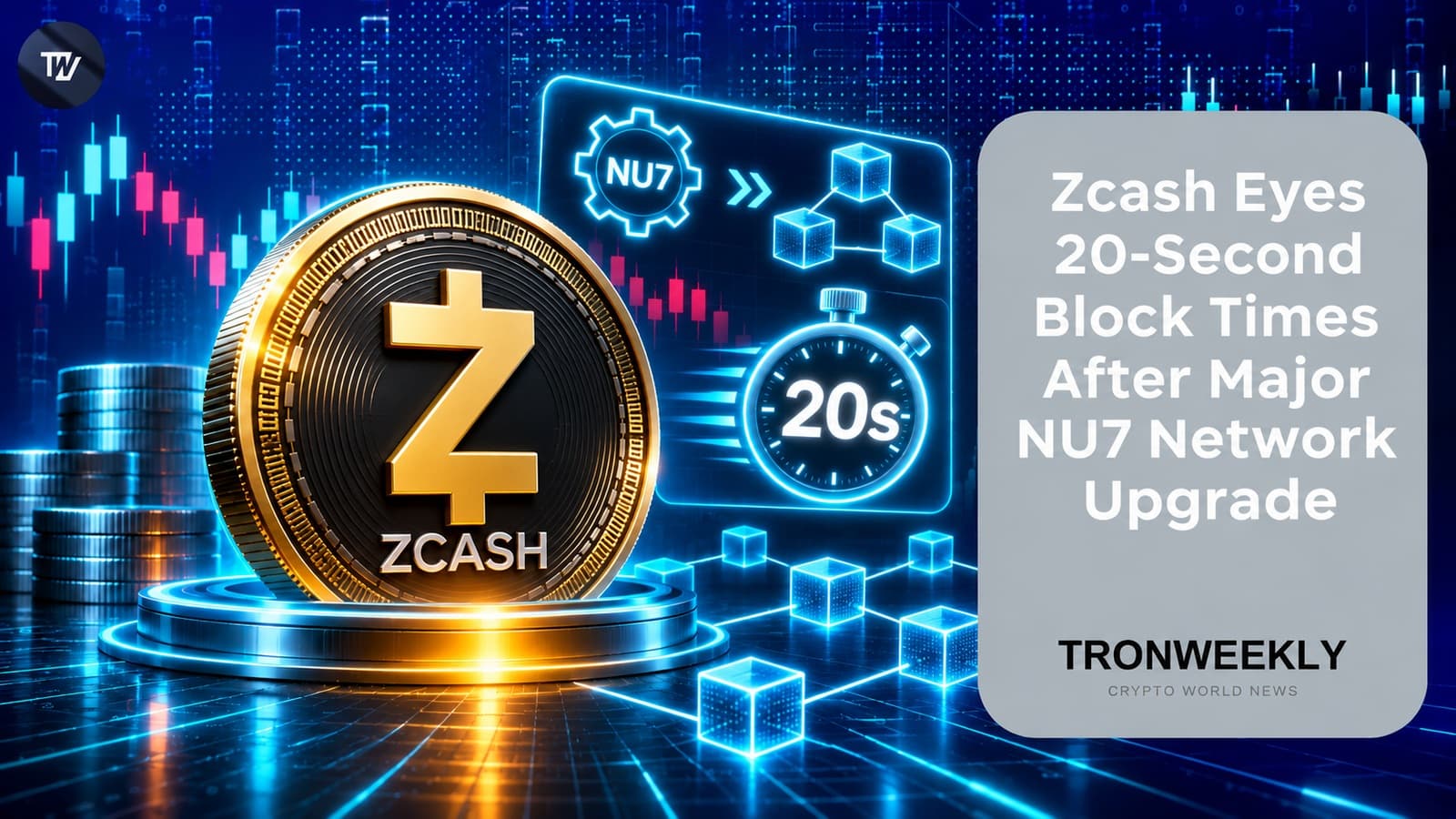
Zcash developers have proposed cutting the network’s target block time from 25 seconds to 20 seconds, days after a major upgrade accelerated confirmations. The change could shorten payment waits, but community approval and an activation date remain outstanding.
Table of Contents
Ojha and Forbes released the proposal on November 8. They seek that the change be included in the upcoming community vote and be incorporated into the potential NU7.1 update. This is still a draft.
The activation of NU7 took place at block 3,543,405 on November 6. Target blocks were reduced to 25 seconds from 75. Shielded transaction limits and 60% fee allocation for future mining reward pools were some other components of the NU7 update.
What 20-Second Blocks Would Change
In this regard, a decrease in the time period will help to reduce the estimated time of one confirmation from 25 seconds to 20 seconds. For a service that requires three confirmations, it is equal to one minute instead of 75 seconds.
Also Read: Crypto Investor Evan Luthra Reveals $2M Oxford Kidnapping Details
Miners mine blocks randomly; moreover, the exchange can determine its own requirements for deposits. According to the developers of Zcash, transactions of retail payments, exchange deposits, and cross-chain swaps could be faster with the help of fast confirmations. This change would come after increasing the number of blocks three times in accordance with NU7.
According to Ojha, this number should be an intermediary number and not the network’s ultimate target. Now the developers are checking whether another reduction is possible without interrupting mining.
What Mining Tests Show About Network Risk
A faster block speed increases the likelihood of the occurrence of competing blocks mined at almost the same time. The network selects one chain, while others are left orphaned. The miners whose blocks are orphaned fail to get the rewards for their efforts.
According to the early findings by ZecBlock, the rate of Zcash orphan blocks within the most recent 24-hour period was found to be 0.69%. The rate prior to the upgrade was found to be 0.66%, whereas the total rate since NU7 was 1.29%. This data represents the initial findings.
The monitoring system was increased from one node to ten before activation. As a result, it is capable of detecting more competing blocks than it used to do previously. Thus, the results cannot be used for making a reliable comparison. The observation period itself is too short.
In turn, developers conducted simulations where 20-second blocks were generated with 80 miners divided between 12 regions. Orphan blocks made up 1.9% with Zakura nodes and 3.3% with mixed software. Earlier simulations of 25-second blocks gave 4.68%.
These results correspond to the criteria established by the developers as the safety threshold. Nonetheless, simulated performance cannot guarantee the same rates for the Zcash mainnet.
How Zcash Would Preserve Private Transaction Capacity
The proposed plan will see the maximum limit of shielded actions reduced to 264, from 330 per block. Additionally, Sapling’s maximum input-output transactions will be reduced from 300 to 240. The current limit of 2 MB will still be maintained.
However, the frequent generation of blocks will see more daily transactions done privately increase. The development team seeks to ensure that there is no change in the daily shielded capacity to avoid additional wallet scanning. The plan seeks to increase speed, not throughput.
The issuance schedule will remain the same for Zcash, with the 21 million coin limit remaining the same as well. The subsidy per block will decrease to a fifth, while the halving period will move to 6.3 million from 5.04 million blocks. Daily coin issuance will be constant.
The difficulty averaging period will be increased to 128 blocks from the current 102 blocks in the plan. This ensures that there will be a similar timeframe for making adjustments regarding mining difficulty despite the faster block generation. The default transaction expiration will also increase to 150 blocks.
When Could NU7.1 Be Approved
Ojha and Forbes believe that a community vote on the change should be done prior to its inclusion in NU7.1. There is no activation height or launch date for now. This makes the 20-second block target not yet a protocol rule.
The new protocol will keep the recommendation of a three-block anchor time. It will have an expected duration of 60 seconds if approved. In the meantime, Zcash still runs using the 25-second block target from NU7.
Also Read: Blumenthal Crypto Probe Sets January 4 Deadline for Binance and Tether
This article contains market analysis and price predictions. These are not guarantees. Crypto markets are volatile. Always DYOR. Not financial advice.
Arslan Tabish is a Technical Reporter and Market Analyst at Tron Weekly with over five years of experience covering cryptocurrency markets and blockchain developments. His reporting focuses on Bitcoin, Ethereum, altcoins, and decentralized finance, alongside NFTs, crypto regulation, policy, and Web3 innovations.
Arslan covers blockchain technology, Layer 2 scaling solutions, and emerging use cases, including AI-driven crypto applications, while delivering clear market analysis on how technical and regulatory developments impact digital asset markets. His work is designed for both beginners and experienced readers, offering accurate, easy-to-understand reporting without speculation or investment guidance.