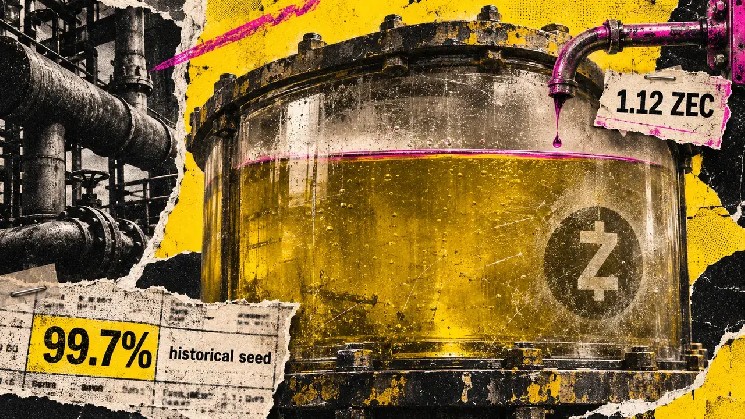
Zcash’s new reserve for future block rewards is still overwhelmingly inherited value. About 99.7% of its balance in an early post-NU7 mainnet observation on November 7, 2026, came from previously unclaimed subsidy and fees, leaving just 1.12 $ZEC accumulated under the new rules.
At 05:08:38 UTC, the mainnet API for Zakura’s NU7 monitoring dashboard reported a Network Sustainability Mechanism, or NSM, balance of 369.7 $ZEC at block 3,547,068. Its status data showed NU7 active.
ZIP 237, the specification governing the reserve, sets the historical seed at 368.58445520 $ZEC. Subtracting that seed leaves 1.11895065 $ZEC of subsequent accumulation, or about 0.3% of the observed total.
Know when your
coins move
The distinction matters for Zcash’s future security funding. NU7 has established a way to recycle transaction fees into later block subsidies. Its opening accumulation provides an early measure of contributions; assessing future security support requires a much longer record of fee demand.
The historical seed consists of subsidy and transaction fees that miners left unclaimed in coinbase transactions before NU6. ZIP 237 brings that fixed amount into NSM accounting. It therefore gives the mechanism a positive starting balance before any new fee contribution arrives.
For the rules deployed at NU7, ZIP 237 registers transaction fees as the reserve’s only contribution mechanism. ZIP 259, the deployment specification, excludes ZIP 233’s separate removal mechanism and ZIP 234’s alternative issuance design.
There is also no reserve reissuance at the observed height. Taken together, those rules mean the excess over the historical seed represents accumulated fee contributions under the specified accounting. The 1.12 $ZEC figure follows from the reported reserve balance and those accounting rules.
The NSM balance itself is public consensus accounting for value outside issued supply. Distribution follows the protocol’s future subsidy rules.
Zcash sets aside fees now, with payouts later
ZIP 235 directs 60% of each block’s aggregate transaction fees into the NSM. The contribution is rounded down once per block to whole zatoshi, Zcash’s smallest unit; miners receive the remainder, including the rounding difference.
Scheduled subsidy remains separate from this fee allocation. The mechanism temporarily removes fee value from circulation and returns it through future block subsidies.
The delay is substantial in block terms. ZIP 259 assigns mainnet activation to block 3,543,405, while reserve reissuance starts at block 8,939,664. ZIP 237 sets the additional NSM subsidy to zero before that later height. Reaching that block threshold determines when payouts begin.
Once reissuance starts, each block adds a small fraction of the preceding reserve balance to the scheduled subsidy, rounded up to a zatoshi. The existing halving schedule remains in place.
ZIP 237 illustrates the scale with 100,000 $ZEC removed from circulation: that amount would initially contribute 0.01375 $ZEC per block under the post-NU7 formula. This hypothetical illustrates the payout rule; the actual starting payout will depend on the reserve accumulated by then.
Funding streams also receive a share of future reissuance. ZIP 237 applies funding streams’ prescribed percentages to the combined scheduled and additional subsidy. The reserve mechanism and discretionary developer grants are different arrangements.
Before payouts begin, the fee-funded portion grows with cumulative fee spending. More time permits more contributions if fee-paying activity continues; elapsed time alone supplies no funding.
That makes the useful follow-up measure the amount added beyond the fixed historical seed over clearly dated intervals. A growing total can otherwise obscure how much of the reserve still comes from inherited value.
The opening snapshot cannot establish a sustainable annual funding rate, predict future usage or show whether eventual support will be sufficient for network security. Those questions depend on fee demand over time and the balance available when gradual reissuance begins.