- live LIVE: US nuclear strike on Iran within days? Big claim surfaces November 2, 2026 Live Updates
- ZEC slides as Helius Labs CEO ties Anthropic’s FlashProve to Zcash 4 minutes ago News
- Liquid restores 1:1 BTC backing as Adam Back warns on AI fixes 1 hour ago News
- CFTC clears single-stock perps as watchdog warns of gambling risk 1 hour ago Regulation
- Liquid restores 1:1 BTC backing as Adam Back warns on AI fixes 1 hour ago News
- CFTC clears single-stock perps as watchdog warns of gambling risk 1 hour ago Regulation
- China pauses IPOs after the AI listing frenzy turns into a $480B rout 3 hours ago Economy
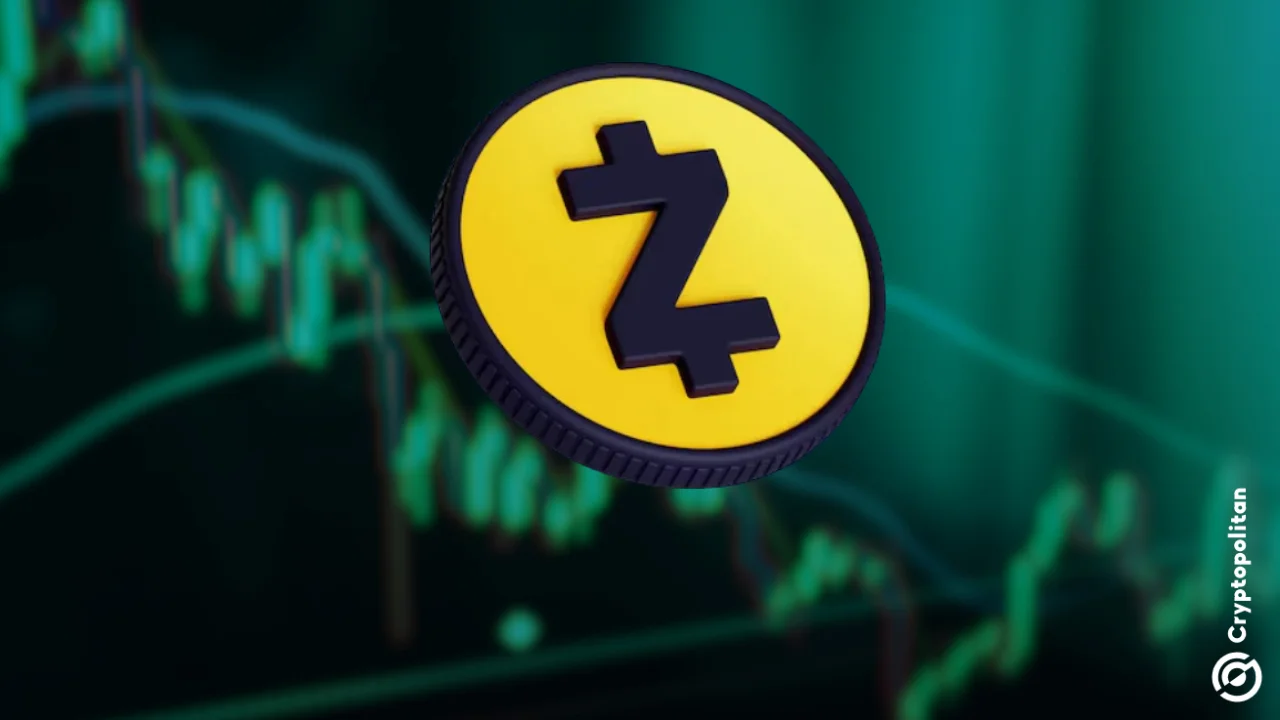
- ZEC fell about 5.9% to around $1,190 as the wider crypto market sold off.
- Helius founder Mert Mumtaz tied Anthropic’s newly released FlashProve to the zk-SNARK cryptography Zcash pioneered.
- FlashProve is an open-source research prototype that proves which model generated an answer without revealing its weights.
Zcash (ZEC) fell by about 5.9% in 24 hours to roughly $1,190 as the wider crypto market also experienced a drop.
Amidst the decline, Helius founder Mert Mumtaz pointed out that Anthropic’s new FlashProve tool uses the same type of privacy math that Zcash helped bring to the world.
Why is Zcash being linked to Anthropic’s FlashProve?
Zcash (ZEC) fell by about 5.9% in 24 hours and is currently trading at $1,190. The whole market declined, with Bitcoin (BTC) trading near $76,673, and the total crypto market value falling by about 1.8%.
In those same 24 hours, Helius founder Mert Mumtaz said in a post on X that “anthropic/claude are now using the same cryptography that zcash was first in the world to pioneer,” and ended with “probably nothing.” The post drew a bit of attention, gaining more than 1,000 likes and over 170 replies at the time of writing.
In May, Mumtaz went on the Bankless podcast and argued that Zcash is worth more than the market gives it credit for, especially when compared with XRP and BNB. He said ZEC’s value should be a share of Bitcoin’s total market value; about 10% has been suggested.
Zcash grew out of the 2014 paper “Zerocash: Decentralized Payments from Bitcoin.” In 2024, the IEEE Symposium on Security and Privacy gave it a Test of Time Award. The committee said the paper gave “an actual example for how to use zk-SNARKs in practice.” The Zcash network launched in October 2016.
One person, Alessandro Chiesa, is tied to both projects. He co-wrote the Zerocash paper and now works at EPFL. Chiesa is also linked to StarkWare and is on the FlashProve contributor list with Anthropic’s Roy Rinberg and Alex Allain.
This is not the first Anthropic and Zcash overlap this year. Zcash founder Zooko Wilcox said in June that an audit by Anthropic’s Mythos AI, requested by Shielded Labs, found no serious new bugs in the protocol.
Notably, the Zcash community is currently arguing over its roughly $125 million grants treasury.
What is FlashProve, and how costly is it to run?
Anthropic released FlashProve, an open-source research prototype, on November 2. It uses a hash-based zkSNARK to prove that an answer came from a specific AI model, without showing the model’s inner settings, known as weights.
FlashProve aims to close a trust gap. When a user sends a prompt to an AI service, they cannot be sure the reply came from the model they paid for. Before the answer is delivered, a routing service could swap in a cheaper model to respond, or the reply could be changed along the way. The FlashProve tool is designed for mixture-of-experts models, which send each input through a few specialized parts of the system.
FlashProve works in two steps. First, the provider publishes a small commitment of about 6.5 MB that locks in one exact set of weights while keeping them secret. This takes about 39 minutes. Second, for each prompt and reply, the system creates a short proof that the committed model produced those exact output tokens.
Anthropic tested FlashProve on Llama 4 Maverick, an AI model from Meta (NASDAQ: META). The model has 400.7 billion parameters and was run in a compressed 4-bit form. The test used one NVIDIA (NASDAQ: NVDA) H100 chip, which handled about 110 tokens per second. A token is a small piece of text, such as a word or part of a word.
The system handled 24 requests in about 223 seconds. Each request was 1,024 tokens long and produced a proof of about 19 MB. Checking a proof took only 17 to 21 seconds on a regular computer chip (CPU), and the checker did not need access to the model’s weights.
However, compared with vLLM inference, proof generation took about 72 to 94 times more time per GPU, depending on load.
Anthropic calls FlashProve an intermediate research tool, not production software. The GitHub page labels the code an unmaintained research artifact under the Apache 2.0 license. The project also says it has not had an independent security audit.
If you're reading this, you’re already ahead. Stay there with our newsletter.
FAQs
What is Anthropic's FlashProve?
FlashProve is an open-source research prototype, released November 2, 2026, that uses a hash-based zkSNARK to prove a response came from a specific set of committed model weights without revealing those weights.
Why did Mert Mumtaz connect FlashProve to Zcash?
Mumtaz argued that Anthropic is now using zk-SNARK cryptography that Zcash first deployed in practice, writing on X that it was "the same cryptography that zcash was first in the world to pioneer." One Zerocash co-author, Alessandro Chiesa, also contributed to FlashProve.
How much did ZEC fall and was FlashProve the cause?
ZEC dropped about 5.9% over 24 hours to roughly $1,190, but the move tracked a broad selloff that also pushed Bitcoin down about 2.1%, rather than any direct reaction to the FlashProve release.
Disclaimer. The information provided is not trading advice. Cryptopolitan.com holds no liability for any investments made based on the information provided on this page. We strongly recommend independent research and/or consultation with a qualified professional before making any investment decisions.
Hannah Collymore
Hannah is a writer and editor with nearly a decade of blog writing and event reporting experience in the crypto space. At Cryptopolitan, Hannah contributes to the news page, reporting and analyzing the latest developments in DeFi, RWA, crypto regulation, AI and frontier tech industries. She graduated from Arcadia university with a degree in Business Administration.
5 Ingenious Applications of ChatGPT And What You Should Do About Them
93% Business Leaders Favor AI-Powered Solutions for Brand Sustainability Management, Reuters
Here’s How Macron Supports France’s Vibrant and Productive AI Ecosystem
Bloomberg Estimates the Generative AI Market to Reach $1.3 Trillion by 2032
- Bitcoin ETF vs. Ethereum ETF: What’s the Difference? November 5, 2025 Learn Crypto: Beginner Guides
- What Is Base? The Ethereum Layer-2 Network Launched by Coinbase October 21, 2025 Learn Crypto: Beginner Guides
- Dogecoin vs. Bitcoin: Key Technical Differences October 20, 2025 Learn Crypto: Beginner Guides
- What Is TVL (Total Value Locked) in Crypto? October 14, 2025 Learn Crypto: Beginner Guides
- How to Read a Crypto Whitepaper? October 13, 2025 Learn Crypto: Beginner Guides
- Ripple vs. XRP vs. XRP Ledger: What’s the Difference? October 13, 2025 Learn Crypto: Beginner Guides