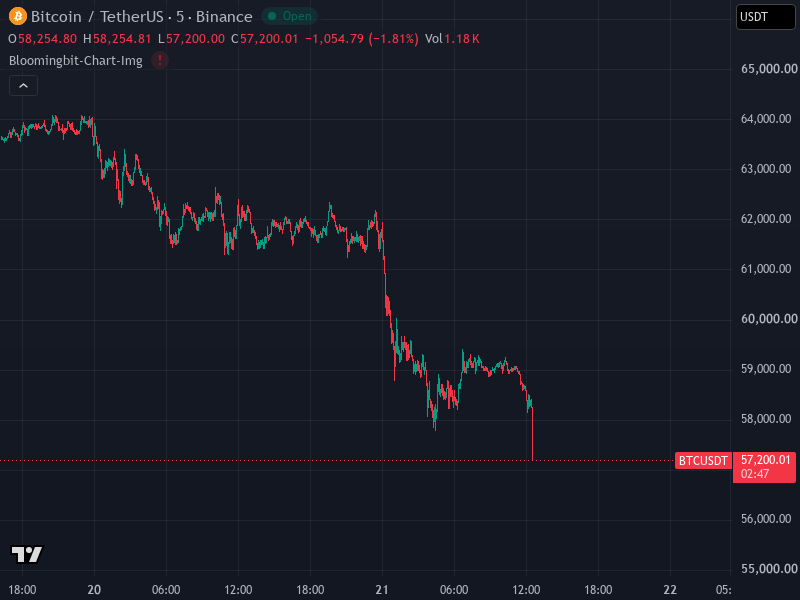
Bitcoin has slumped below the $60,000 line for the first time in four months, falling to less than half its all-time high from October 2025 and logging a seventh straight weekly decline — its longest losing streak since 2022. The drop is the product of a sharp selloff in U.S. tech stocks, rate-hike fears, and an exodus of institutional money all hitting at once.
According to cryptocurrency market data on the 21st, Bitcoin fell as low as $58,678 during U.S. trading the previous day (local time). It later pared some losses to close around $59,467, roughly 4.7% below its level 24 hours earlier. This is the first time it has traded below $60,000 since July. Compared with its record high of $126,210 set in October 2025, it is down more than 53%.
Ethereum, the second-largest cryptocurrency by market capitalization, fell in tandem. At the same time, Ethereum was trading at $1,643.6, down 6.5% from 24 hours earlier. Major altcoins including Solana and XRP also weakened across the board.
Institutional outflows are cited as the most direct cause of the decline. According to fund-flow analysis firm Farside Investors, U.S. spot Bitcoin exchange-traded funds (ETFs) saw $582.3 million in net outflows on the 19th alone. Of that, $541.1 million drained from the iShares Bitcoin Trust (IBIT) run by BlackRock, the world's largest asset manager. It was the largest single-day net outflow for IBIT since its launch. Cumulative net outflows since October 30 have reached $4.1 billion.
Note: Figures are compiled from market data including Coinbase and Farside Investors.
The macro backdrop also worked against risk assets. As the possibility of additional rate hikes by the U.S. Federal Reserve (Fed) came into focus, Bitcoin's appeal as a non-yielding asset diminished in relative terms. Indeed, the U.S. two-year real yield climbed above 2.4% to its highest level since 2023, while 10-year and 30-year real yields remain near long-term highs. With bonds now offering strong returns even after accounting for inflation, money has been flowing out of non-yielding assets broadly.
Paul Howard, a senior director at cryptocurrency liquidity provider Wincent, noted that the Fed's hawkish stance is pressuring risk assets and that institutional investors have yet to step in with meaningful buying.
The initial public offering (IPO) of artificial intelligence (AI) company Anthropic also weighed on supply and demand. Analysts say investors sold existing holdings to buy Anthropic shares. Matthew Sheffield, chief investment officer (CIO) of cryptocurrency treasury management firm Sharplink, told CNBC that "right after Anthropic's listing, investors sold other assets to raise cash for the stock purchase, sending tech stocks, gold, and cryptocurrencies down all at once." Indeed, the tech-heavy Nasdaq index also fell about 2.4% that day, moving in tandem with Bitcoin.
Headwinds inside the cryptocurrency market itself also chilled sentiment. The aftershocks of last month's massive hack at Binance, the world's largest cryptocurrency exchange, have yet to fade, while delays in the U.S. Senate's passage of the Clarity Act, which would establish a cryptocurrency regulatory framework, have added to uncertainty.
Bitcoin's plunge dealt a direct blow to shares of related listed companies. Strategy (MSTR), the world's largest publicly traded holder of Bitcoin, closed at $77.80, down about 30% from the prior week's close. That is because Bitcoin's intraday slide into the $57,000 range pushed it well below the company's average purchase price of about $75,446. Coinbase (COIN), the largest U.S. cryptocurrency exchange, also fell about 20% on the week to $101.97, while Robinhood (HOOD) closed down about 20% at $62.17.
Derivatives markets saw a wave of forced liquidations. According to market data, more than $600 million worth of positions were liquidated in cryptocurrency futures markets over the past 24 hours. At Deribit, the global cryptocurrency options exchange, open interest in Bitcoin put options with a $60,000 strike reached about $900 million — the largest among single strike prices. The shift was driven in large part by the unwinding of call positions that had bet on a rally to $100,000, which reshuffled the rankings.
The market's next line of defense is $60,000. There are concerns that a decisive break below that level could trigger further selling alongside the loss of a psychological support. Conversely, analysts say reversing the trend would require reclaiming the 200-week moving average around $68,000 and a return to net inflows for spot ETFs.
Some see reason for optimism that money could flow back into cryptocurrencies now that the major IPO has wrapped up. Still, some analysts caution that if institutions are cutting their overall exposure to risk assets, AI stocks and Bitcoin could end up being sold together rather than seeing money rotate between them. Market participants identify the direction of U.S. monetary policy and institutional fund flows as the key variables that will determine whether Bitcoin falls further.
Once added, BigGo Finance appears first in Google Search Top Stories, so you get the broadest, most up-to-the-minute, and most comprehensive global financial news first.