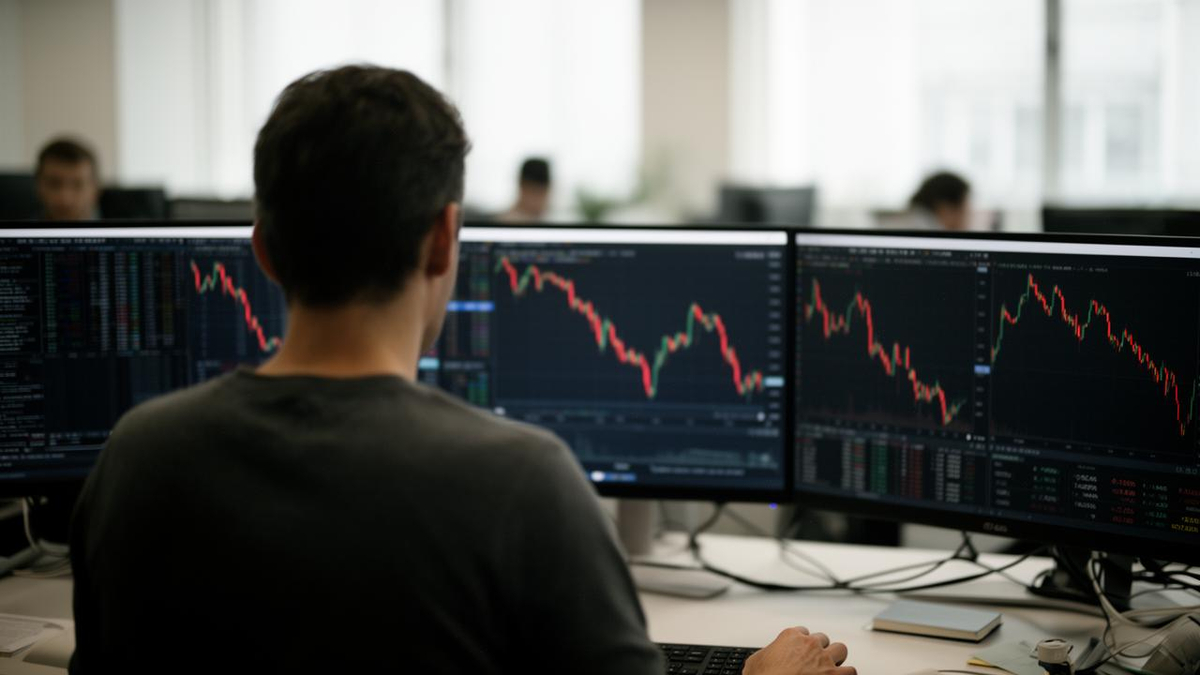
As Bitcoin (BTC) failed to hold the $64,000 line and slid lower, analysts both inside and outside the market are rushing to explain the cause. VanEck points to large-scale capital migration tied to Anthropic's initial public offering (IPO) as the backdrop for the recent decline, while projecting that a short-term bottom could form in early December.
Matthew Sigel, who heads digital asset research at VanEck, said in a broadcast interview on the 17th (local time) that Anthropic's IPO is acting as a "capital vacuum" sucking in $64 billion (~85.4 trillion won) in funds. Bitcoin is down about 24% from its pre-election peak and has fallen below both its 200-day moving average of $73,000 and its 200-week moving average of $68,900. Commenting on the 24% drop in just 10 days to $61,946, Bitcoin analyst Joe Consorti offered a similar read, describing Bitcoin as "funding the Anthropic IPO."
Sigel, however, does not attribute the decline to IPO-related capital outflows alone. He explained that a credit squeeze has taken hold as a stronger U.S. dollar index coincides with reports that Nvidia may scale back funding for its artificial intelligence ecosystem partners, and that Bitcoin is pricing in an economic slowdown ahead of traditional markets. He added a warning that such pressure could translate into broad macroeconomic weakness in the first quarter of 2027.
Derivatives markets have already turned defensive. Over two days, November 13 and 14, more than $1.3 billion (~1.7 trillion won) in leveraged long positions were forcibly liquidated, and perpetual futures funding rates flipped negative. The 24-hour put/call ratio on options exchange Deribit climbed to 1.42, with short-dated puts at the $62,000 and $58,000 strike prices seeing the heaviest trading. Crypto market maker Wintermute said in a report on the 16th that a bear market has persisted following a 12.7% weekly decline and that the recent liquidation volume is hard to read as a bottom signal. Stablecoin supply also shrank over the past month from $14 billion (~18.7 trillion won) to $20 billion (~26.7 trillion won), pointing to deteriorating liquidity conditions.
Sigel also noted similarities to the run-up to SpaceX's listing. In the 50 days before SpaceX went public, Bitcoin fell about 19%, hit a bottom (-25%) on the 18th day after the listing, then rebounded sharply around the 70-day mark. If the pattern repeats, the short-term bottom could arrive in early December.
The fact that Bitcoin trades like a tech stock rather than "digital gold" is another point of debate. Sigel noted that Bitcoin's correlation with the Nasdaq has risen to its highest level in years, making it more vulnerable to tech-stock selloffs. VanEck CEO Jan van Eck made the same point when he likened Bitcoin to a "chameleon" whose correlations shift with market conditions. Indeed, Bitcoin briefly tracked gold in August amid news about Treasury purchases but has since moved more closely with the Nasdaq. Sigel also said tools from companies like Anthropic are lowering software development costs while raising competition and security risks, weighing on both software stocks and Bitcoin.
Longer-term indicators are flashing positive signals. Net unrealized profit/loss (NUPL) has fallen to about 0.20, and only 52% of the total Bitcoin supply is in profit. Realized losses have exceeded realized gains for the first time since August. Sigel assessed that long-term holders are not capitulating and that coins are shifting from weak hands to strong hands.
The selloff shows that crypto assets are simultaneously exposed to macro liquidity and tech-stock sentiment. If the pattern repeats—Bitcoin reacting first whenever a large private tech company's IPO absorbs capital—investors should reconsider Bitcoin's character as a hedging tool, critics say. In the near term, whether a bottom forms in early December and whether Nvidia actually follows through on investment cuts are seen as the variables that will determine direction.
Once added, BigGo Finance appears first in Google Search Top Stories, so you get the broadest, most up-to-the-minute, and most comprehensive global financial news first.