Share
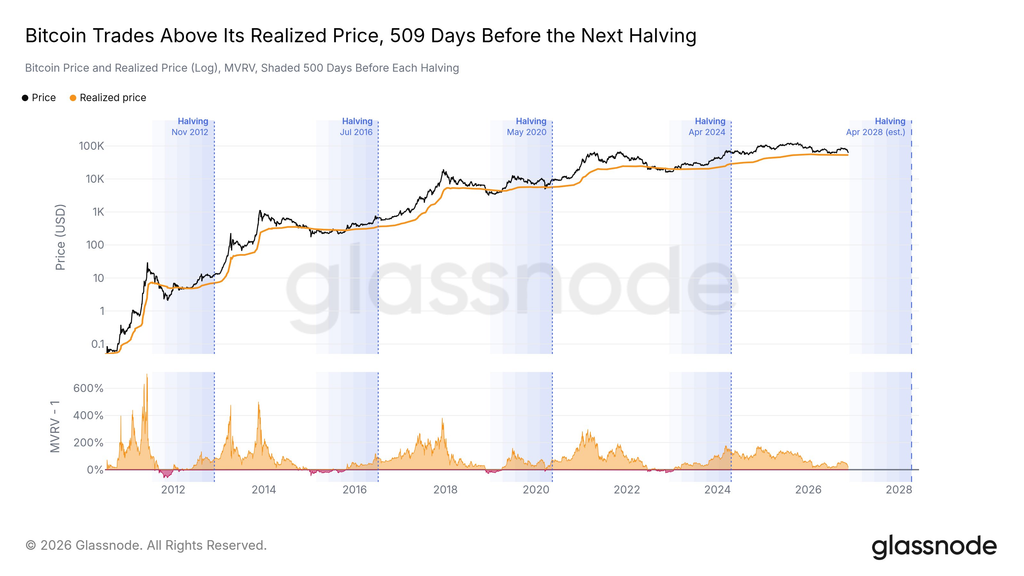
Bitcoin is trading above its realized price, which means the average holder is still in the green. The margin, though, is not exactly a cushion you would want to land on.
As of November 19, 2026, the realized price sat at approximately $53,418, while Bitcoin traded near $61,987. That works out to a 16% premium over the aggregate cost basis of every coin in circulation.
What the realized price actually measures
Think of the realized price as the network’s collective receipt. Instead of valuing every coin at today’s market price, it values each one at the price it last moved on-chain, then averages the whole thing out.
Put simply, it estimates what the typical holder paid. When the market price sits above that line, the average wallet is up. When it sits below, the average wallet is nursing a loss.
The related Market-Value-to-Realized-Value ratio, or MVRV, compares those two numbers directly. It came in at approximately 1.16 as of November 19, indicating a moderate premium over the aggregate cost basis.
For context, an MVRV of 1.0 would mean the market price and the average cost basis are identical. At 1.16, holders are ahead, but only modestly.
One notable feature of the realized price is how slowly it moves. It stood at $53,836 on November 12, 2026, barely different from the reading a week later, even as the spot price swung around.
Spot price reacts to every headline. Realized price reacts only when coins actually change hands, so it behaves more like a tide line than a wave.
A tale of two cohorts
The headline average hides a sharp split between investors who bought recently and those who have held for a long time.
The crypto and markets news you actually need—every morning.
Daily. Free. Join 34,000+ readers across crypto, finance, and policy.
We respect your privacy. Unsubscribe anytime.
Short-term holders have an estimated cost basis between $68,700 and $77,700. With Bitcoin near $61,987, that group is underwater, in some cases by a wide margin.
Long-term holders tell a different story. Their average cost basis sits around $48,500, well below the current price and below the network-wide realized price as well.
The gap traces back to recent price action. Bitcoin had pushed past $80,000 before pulling back from an October peak, and the buyers who arrived near those highs are now carrying the heaviest losses.
The last time Bitcoin slipped below the line
Sustained trading below the realized price is relatively rare. The last extended stretch ran from August 19, 2022, to January 12, 2023.
That period covered roughly five months in which the average holder was sitting on a paper loss.
The current setup is not that. Bitcoin remains above the line, and the 16% premium gives the market some room before it would revisit that territory.
What this means for the market
The most immediate pressure point is the short-term holder cohort. When a large group of recent buyers is sitting below their entry price, any rally back toward their cost basis can turn into an exit ramp, as some look to get out at breakeven.
That dynamic could create overhead resistance in the range between $68,700 and $77,700.
Long-term holders, by contrast, are the market’s shock absorbers in this setup. With an average cost basis around $48,500, they remain comfortably profitable and are under far less pressure to sell into weakness.
The realized price at approximately $53,418 is the line worth watching. It represents the point at which the network as a whole flips from profit to loss, and historically, crossing below it has coincided with extended periods of stress.
The MVRV reading adds a useful frame. At around 1.16, the market is not stretched the way it tends to be during euphoric phases, when the market price runs far ahead of what holders paid. It is also not in the deep-discount territory of a capitulation.
The slow-moving nature of the realized price also matters here. Because it shifts only when coins move, a sharp spot decline would close the gap quickly, while a recovery would widen it.
For now, the data describes a market that is profitable on paper, divided underneath, and still digesting its pullback from October highs.