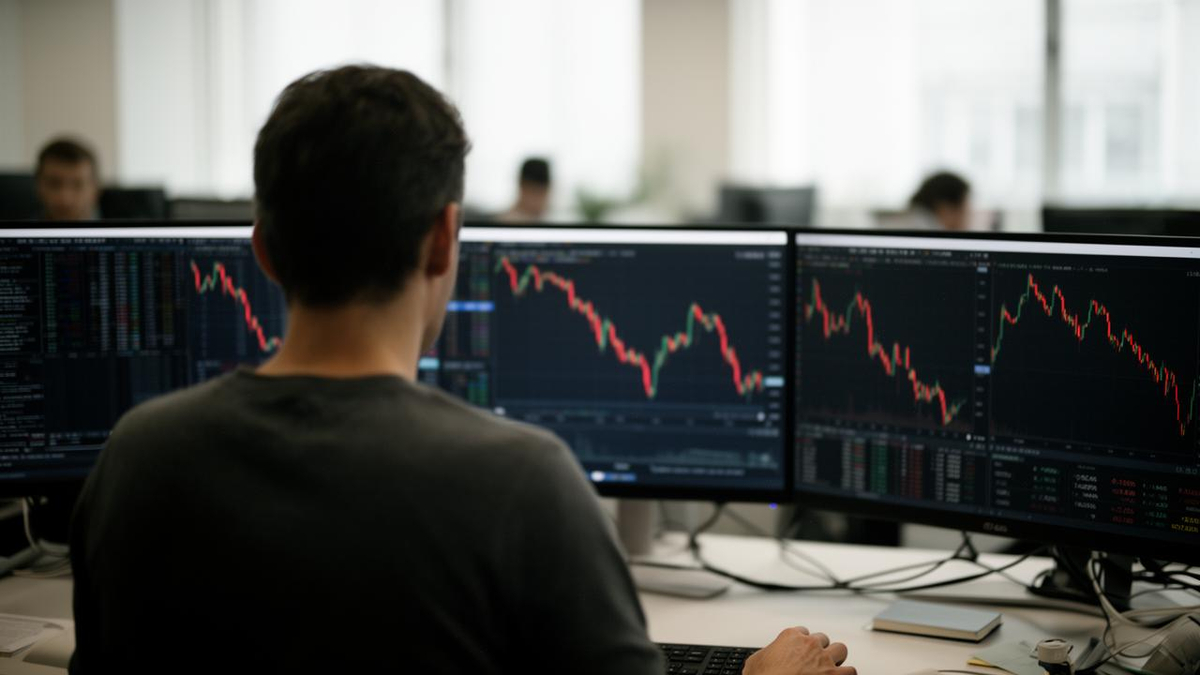
The cryptocurrency market has entered a sharp contraction. As Bitcoin slid to the $64,000 level (~85 million won), the total cryptocurrency market capitalization evaporated about 20% in a single month. The decline is the combined result of rising odds of a US rate hike, capital outflows from Bitcoin spot exchange-traded funds (ETFs), and a shrinking stablecoin supply.
As of the 19th, Bitcoin was trading around $64,000, according to CoinMarketCap. The total cryptocurrency market capitalization was tallied at $2.19 trillion (~2,917.7 trillion won), down about 20% over the past month. The Fear and Greed Index, which gauges overall market sentiment, stood at 13, entering "extreme fear" territory. The closer the index is to 0, the stronger the fear; the closer to 100, the stronger the greed.
The South Korean market is no different. On Bithumb, Bitcoin traded at the 80.73 million won (approximately $61,000) level, falling below 90 million won for the first time in about three months. That is down about 10% from a week ago and about 20% from a month ago. Even after the price drop, however, buying interest has not been fully extinguished. Bithumb's Bitcoin buy share was tallied at 44% and the sell share at 56%. Some in the market even suggest Bitcoin may be forming a bottom.
Bithumb's AI analysis service diagnosed short-term conditions as weak, citing declines in both the 7-day and 30-day price trends. The service noted that "network activity is above its recent baseline, but total value locked (TVL) and core developer activity are below baseline," adding that "buying flows amid negative community sentiment and improved exchange fund flows are key to a rebound."
Altcoins are also uniformly weak. On Bithumb, Ethereum traded at the 2.45 million won (approximately $1,800) level, down about 10% from a week ago, with the sell share at 70%, far outpacing the buy share (30%). Ripple (XRP) traded at the 1,325 won (approximately $0.99) level, down about 5% from a week ago. Bithumb AI analyzed that Ripple's 7-day and 30-day price change rates came in at -7.83% and -24.76%, respectively, and that the current price is nearing the lower end of its 30-day closing range, indicating prevailing short-term downward pressure. South Korean investor sentiment also remained at "extreme fear," with a Fear and Greed Index reading of 12.
ETF capital flight is cited as the most direct driver of this correction. According to cryptocurrency data firm SoSoValue, a total of $2.35 billion (~3.1 trillion won) flowed out of Bitcoin spot ETFs on a net basis over the past two weeks. There had been expectations that capital fleeing AI-related stocks would rotate into Bitcoin and other assets, but in practice selling has spread across risk assets broadly. Cryptocurrency media outlet CoinDesk, citing expert analysis, reported that investors are showing a preference for cash and yield-bearing tokenized real-world assets (RWA) over cryptocurrencies. The explanation is that, since both AI-related stocks and Bitcoin are liquidity-sensitive risk assets, investors are more likely to seek cash rather than rotate between assets when volatility rises.
Note: The closer the Fear and Greed Index is to 0, the stronger the fear; the closer to 100, the stronger the greed.
Bithumb AI said that "selling in cryptocurrencies has pushed Bitcoin to its lowest level in four months and Ethereum has also fallen, deepening risk aversion amid large-scale liquidations, ETF outflows, and extreme fear."
Market participants are focused on three main variables. First is the path of US monetary policy. If the possibility of a rate hike comes to the fore again, liquidity-sensitive cryptocurrencies could be hit first. Second is ETF fund flows. Whether net outflows subside and fund inflows into exchanges improve will be a watershed for a short-term rebound. Finally, there is the stablecoin supply. As it is read as a barometer of liquidity provision in the market, whether supply increases again is interpreted as a signal of recovering buying interest.
That said, the fact that the buy share has held in the 40% range despite the sharp price drop is cited as a sign of downside rigidity. Some mention the possibility of a bottom forming, but short-term indicators still weigh toward further declines. With both the 7-day and 30-day price trends falling together and core developer activity and total value locked below baseline, the analysis is that a rebound requires two conditions to be met simultaneously: a recovery in sentiment and an inflow of funds.
Once added, BigGo Finance appears first in Google Search Top Stories, so you get the broadest, most up-to-the-minute, and most comprehensive global financial news first.