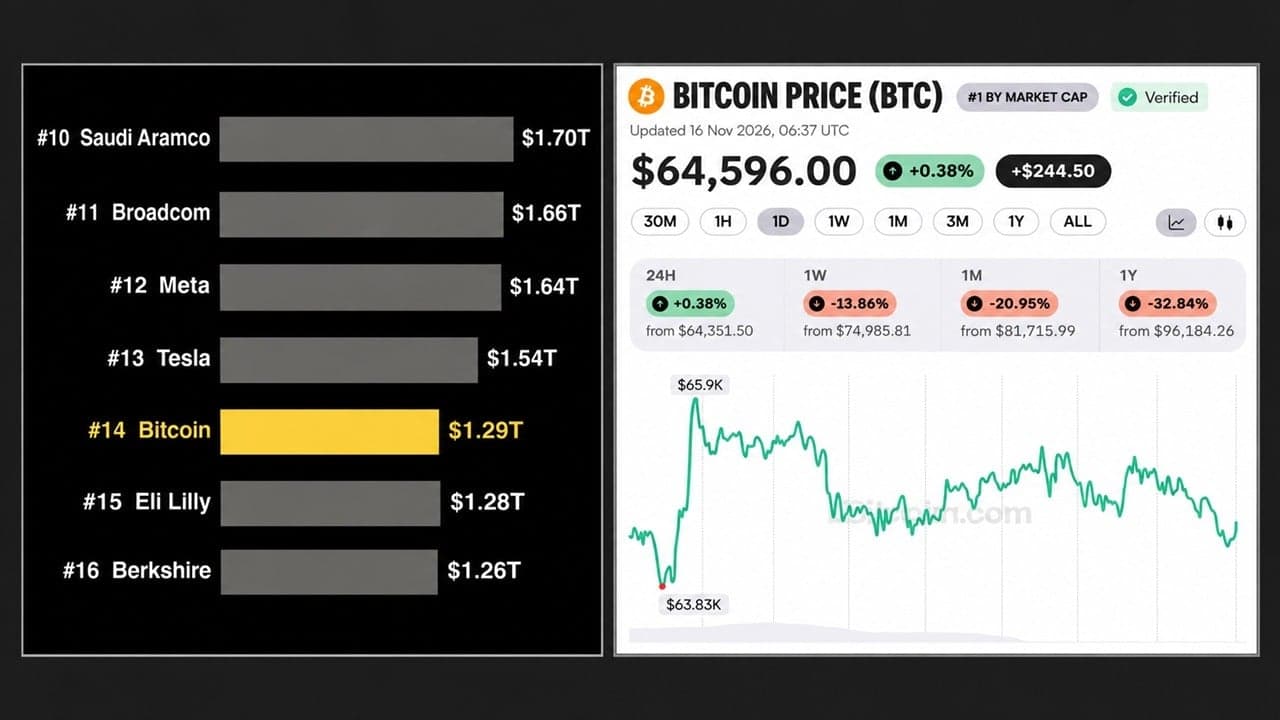
Bitcoin recovered toward $64,700 on Monday after falling close to $62,000 over the weekend. The rebound followed one of the market's sharpest recent sell-offs, as investors faced continued withdrawals from US spot Bitcoin exchange-traded funds (ETFs), hotter inflation and uncertainty surrounding the upcoming Anthropic IPO.
Binance founder Changpeng Zhao, widely known as CZ, outlined several possible reasons for the decline in a November 15 post. These included approximately $1.9 billion in US spot Bitcoin ETF outflows, the proposed Anthropic IPO, security incidents across the crypto industry, rising inflation and political uncertainty following the US midterm elections.
CZ also cautioned that the exact reason behind the decline remains unclear. He noted that correlation does not establish causation, meaning the factors he listed should be viewed as possible sources of pressure rather than confirmed triggers.
Bitcoin Recovers After Testing $62,000
Bitcoin touched approximately $62,006 on Binance on Sunday, its lowest level in around three months. It subsequently recovered toward $64,500 - $64,700, although the move has not yet reversed the broader downtrend.
The cryptocurrency has fallen sharply from its November 4 levels near $81,000. The latest decline also pushed Bitcoin below its 200-week moving average, which had been trading around $68,000.
The break is significant because traders have historically watched this long-term average as an important measure of Bitcoin's broader market trend. A sustained move back above it could help restore confidence, while continued trading below it would leave the market vulnerable to further selling.
Technical indicators also point to stretched selling conditions. Bitcoin's daily relative strength index (RSI) has moved into deeply oversold territory, suggesting that the recent decline may have been excessive in the short term. However, an oversold reading does not guarantee an immediate recovery.
Related: Bitcoin Falls to $69K as $1.2B in Crypto Liquidations Deepen Sell-Off
The $62,000 area is now an important level to watch. If sellers regain control, the next major area of interest sits around $60,000. On the upside, traders will look for Bitcoin to hold its recovery toward $64,700 before testing resistance around $66,000–$68,000.
Anthropic IPO Adds to Bitcoin's Liquidity Concerns
The upcoming Anthropic IPO has become another talking point in the crypto market. The artificial intelligence company plans to raise as much as $64.4 billion through its public offering, with shares expected to begin trading on Nasdaq under the ticker ANT on November 19.
Some market participants believe investors may be selling liquid assets, including Bitcoin, to free up capital for the offering. The possibility has drawn comparisons with the SpaceX IPO earlier this year, which also coincided with a significant Bitcoin correction.
Matt Cole, CEO of Bitcoin treasury firm Strive, highlighted the similarity. He noted that Bitcoin fell approximately 19% during the 50 days before SpaceX went public. Ahead of Anthropic's planned listing, Bitcoin had recorded a decline of roughly 18% over a comparable period.
Cole also pointed out that Bitcoin continued falling after the SpaceX listing before eventually recovering. The asset was reportedly up around 28% from its listing-period reference price by the 100-day mark.
The comparison offers a possible recovery scenario, but it does not establish that IPO-related capital movements caused either decline. Bitcoin's performance around the SpaceX listing also coincided with other market pressures, making it difficult to isolate the IPO's impact.
ETF Outflows and Inflation Add Pressure
Institutional demand has weakened alongside Bitcoin's price. US spot Bitcoin ETFs recorded approximately $1.9 billion in net outflows over seven consecutive trading sessions through November 13, according to data cited in market reports.
These withdrawals matter because spot ETFs provide a route for traditional investors to gain exposure to Bitcoin. Sustained outflows indicate that some investors are reducing their positions rather than using the decline to increase exposure.
Macroeconomic conditions have added another challenge. US consumer prices increased 0.4% in October, above the 0.3% expected by economists. Higher inflation has strengthened expectations that the Federal Reserve could keep interest rates elevated or consider another increase.
Higher interest rates can weigh on assets such as Bitcoin because investors may prefer interest-bearing investments when government bond yields rise. A stronger US dollar and higher Treasury yields can also reduce demand for riskier assets.
Political uncertainty has contributed to the cautious mood. The November midterm results gave Democrats control of both chambers of Congress, raising questions about the future direction of US crypto legislation. Changes to the regulatory outlook could influence institutional participation and investor sentiment.
CZ Points to Security Concerns, While Saylor Signals Confidence
CZ also highlighted security incidents as a possible factor behind the decline. The recent Binance-related hack, alongside reports of compromised crypto wallets and software vulnerabilities, may have weakened confidence in the wider industry.
However, these incidents do not establish a direct connection to Bitcoin's price movement. They are among several developments that may have influenced investor sentiment during an already difficult period for the market.
Despite the selling pressure, some major Bitcoin holders continue to express confidence. Strategy Executive Chairman Michael Saylor posted that the dip "could use a little orange," referring to Bitcoin's familiar orange branding and hinting at the possibility of another purchase.
Saylor's comments followed Strategy's recent Bitcoin acquisitions and came as the company's holdings faced increasing paper losses due to the market decline. His post did not confirm that a new purchase had already taken place.
The contrast between ETF withdrawals and continued interest from Bitcoin treasury companies shows that institutional sentiment is not moving in one direction. Some investors are reducing exposure, while others appear willing to accumulate at lower prices.
Can Bitcoin Hold the $60,000 - $64,000 Range?
Bitcoin's recovery toward $64,700 offers some relief after Sunday's drop, but the market has yet to establish a confirmed bottom. The $62,000 area remains an important near-term support level, while the broader $60,000 - $64,000 range is attracting attention as a potential accumulation zone.
A stronger recovery would require renewed ETF demand, improving macroeconomic conditions and a move back above the 200-week moving average near $68,000. The upcoming Anthropic listing could also provide a test of whether investors continue shifting capital toward large technology offerings or return to risk assets after the IPO.
For now, traders will be watching ETF flow data, Bitcoin's ability to defend the weekend low and whether the price can reclaim key technical levels. The recent rebound is encouraging, but it is too early to conclude that the selling pressure has ended.