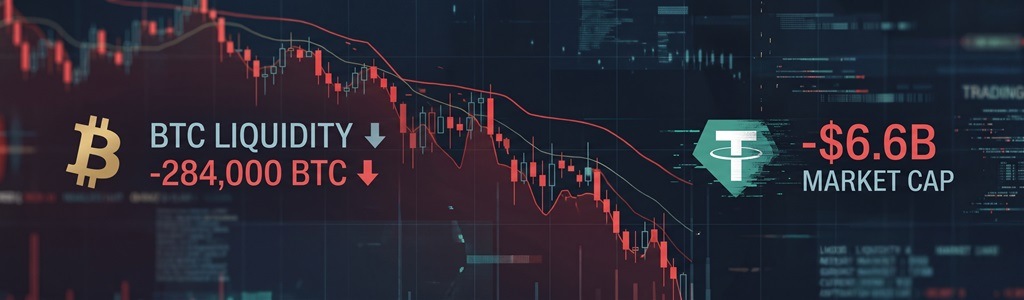
Bitcoin has fallen to the low $73,000 range. The drop comes as US consumer prices came in above market expectations, reviving caution that the Federal Reserve (Fed) may tighten further. On top of that, money flowed out of US spot Bitcoin exchange-traded funds (ETFs) for a third straight day, adding downward pressure.
According to global crypto price tracker CoinMarketCap, Bitcoin was trading at $73,637 as of 8 a.m. on the 11th, down 2.05% from 24 hours earlier. That is more than 5% below its level a week ago. Ethereum, the second-largest cryptocurrency by market capitalization, fell 4.1% to around $2,046.
Altcoins were broadly weaker as well. Binance Coin (BNB) dropped 1.78% to $677.8, and Solana fell 4.54% to $82.94. XRP (Ripple) slipped 4.28% to $1.05, while Hyperliquid held at $72.2, down 4.39%.
Measures of investor sentiment also froze over quickly. CoinMarketCap's crypto fear-and-greed index stood at 26 on the day, pointing to "fear" territory. That is down from 29 the previous day and 35 a week earlier. Compared with 57 last month, when the reading was "neutral," the index has plunged 31 points in a month. The index runs from 0 to 100, with lower readings meaning greater fear in the market.
The direct hit came from US inflation. The US Labor Department's October consumer price index (CPI), released on the 10th (local time), rose 0.4% from the previous month. Core CPI, which strips out volatile food and energy, also rose 0.3%, topping market forecasts of 0.3% and 0.2%, respectively. With inflation cooling more slowly than hoped, expectations gained ground that the Fed could raise rates again in December.
Comments from Fed officials further stoked tightening concerns. Fed Governor Christopher Waller said at a Bank of England conference in London on the 10th, before the CPI release, that he would support a 25-basis-point (bp; 1bp = 0.01 percentage point) rate hike in December even if inflation shows signs of cooling. He said that if core CPI comes in at 0.3% or more month over month, a 50bp "big step" hike should also be considered. In such a situation, he explained, settling for a 25bp increase could undermine the Fed's credibility.
Dallas Fed President Lorie Logan also said that given the current economic outlook, at least two more 25bp hikes are needed. The Fed raised rates by 0.25 percentage point in September and held them steady in October.
The bond market reacted immediately. Reflecting the possibility of a rate hike, the US 10-year Treasury yield climbed as high as 4.996%, closing in on the 5% mark. When yields on safe-haven government bonds rise, crypto assets become relatively less attractive, increasing downward pressure on prices. Some forecasts suggest Bitcoin could fall below $73,000 if the 10-year yield tops 5%.
Regulatory uncertainty stemming from a shift in the US political landscape is also cited as a negative factor. In the midterm elections on the 3rd, the Democratic Party won majorities in both the Senate and the House, spreading concerns that oversight and regulation of the crypto industry could tighten. Expectations that the previously industry-friendly policy stance could waver are weighing on investor sentiment.
Institutional outflows are adding to pressure on the supply-demand side. According to crypto data firm SoSoValue, US spot Bitcoin ETFs saw a net outflow of $201.08 million in a single day on the 9th (local time), the third consecutive day of net outflows. BlackRock's IBIT alone saw $213.23 million leave. Net assets in spot Bitcoin ETFs stand at $94.43 billion, equivalent to 6.27% of Bitcoin's market capitalization.
Inflows of institutional money through ETFs had been a key driver supporting crypto prices. But with the recent trend reversing, they are now acting as a factor that increases downside risk for the market. Market participants see the Fed's December Federal Open Market Committee (FOMC) rate decision and the path of inflation data as the variables that will determine the near-term direction.